


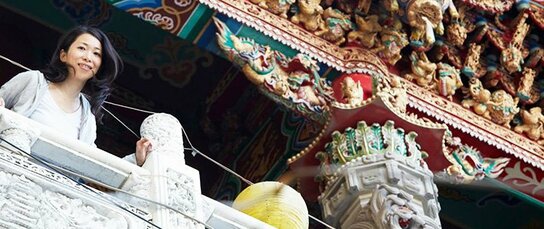
A Japanese Guesthouse in Tainan
There are charming little alleys in parts of Tainan that the wave of redevelopment has left untouched. One symbol of those back streets is a guesthouse called Hamuya, named after the nickname of its Japanese owner. As he explains, the first kanji of his given name Kōichi (公一) looks like ha (ハ) and mu (ム) written in katakana, so people call him Hamu. The guesthouse is particularly popular with young Japanese travelers as a cheap place to stay where they can communicate in their own language.
Hamu was born in Toyama Prefecture in 1968 and used to work as a construction worker. At the age of 24, he started his own business, which he ran as president until he was 42. In 2010, however, the company went bankrupt after falling behind on loan repayments. Although he was able to quickly rebuild the business, the experience kept nagging him and prompted him one day to leave Toyama behind. Without thinking at all about his future and feeling that his life was over, he headed to Okinawa. Then, wishing to leave Japan behind as well, he traveled to Taiwan.
He was thrilled to learn so many new things about Taiwan on his first-ever trip. He had not even known that people there spoke Chinese or that the island had once been controlled by Japan. “I want to start something in Taiwan,” he thought. With this in mind, in April 2013 he set out on a journey around the country, arriving at last in Tainan.
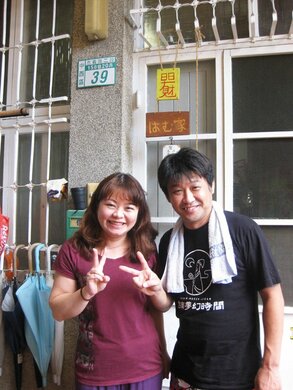
 Hamu (right) with his wife Miki.
A friend advised him that running a guesthouse would suit him, so he opened Hamuya. “While I traveled around Taiwan, the weather was bad wherever I went, but it brightened up as soon as I came to Tainan.” It felt as if he had been led to the city, which also served to brighten his outlook.
Hamu struggled alone through the first month after opening the guesthouse, with those around him warning that few Japanese visitors stayed in Tainan. He then met his wife Miki, a Taiwanese who had previously studied in Japan, and four months later they got married. Her daughter Yui became a part of Hamu’s new family of three.
“Taiwan gave hope to me when I was lost and in despair. Tainan gave me a place to live. I can’t be more thankful,” Hamu said. Hamuya, not surprisingly, appears to attract people who have lost their way in life or who want to break a new path. A diverse mix of Japanese gather there, including a young yakitori shop owner, a housewife who sings in the city, a former office worker spellbound by Taoist temples, and a couple who run a diner.





 Read in other languages