


Special Measures for Afghanistan
On September 11, 2001, terrorists infamously launched attacks on US targets with four hijacked airliners. Two of the airliners brought down the North and South towers of New York’s World Trade Center; another struck the Pentagon in Arlington County, Virginia; and the fourth crashed in Pennsylvania after passengers overcame its hijackers. The UN Security Council concluded that the attacks were the work of the terrorist organization al-Qaeda and that they constituted just cause for exercise of the right of collective self-defense.
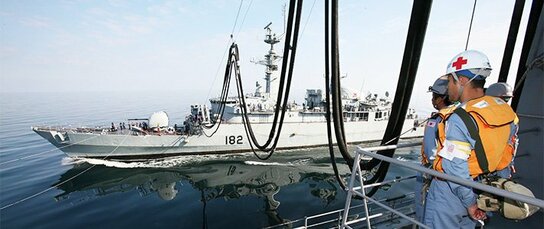
Intelligence gathered by the United States indicated that the Taliban government of Afghanistan was providing sanctuary to the perpetrators of the September 11 attacks, so the United States orchestrated a multinational offensive against the Taliban. Japan’s then Prime Minister Koizumi Junichirō agreed with the rationale for that offensive, and he secured the passage of the Anti-Terrorism Special Measures Act in October 2001 to allow for lending support to the offensive. Japan thereupon dispatched replenishment oiler vessels to support the coalition’s naval operations in the Indian Ocean.
Article 9 of Japan’s Constitution renounces “the threat or use of force as means of settling international disputes.” And the Indian Ocean is well beyond anything conceivably encompassed by the Japan-US Security Treaty, which refers to contribution to the maintenance of “international peace and security in the Far East.” But the Koizumi government avoided those obstacles by ostensibly eschewing military participation that might involve “the threat or use of force” and by limiting Japan’s participation to noncombat stretches of international waters and airspace and to the territorial waters and airspace of nations that granted transit rights.
Reconstruction Work in Iraq
Japan remained a faithful ally when the United States embarked on another military campaign in March 2003. The US and British governments argued that Iraq was in possession of weapons of mass destruction, that it had failed to comply with a UN Security Council resolution calling for the elimination of those weapons, and that Iraq’s noncompliance justified military intervention. Nations formally opposed to military action—led by France and Germany—outnumbered those in favor of intervention, but nevertheless the US government cobbled together a 49-nation “coalition of the willing” and went to war against Iraq.
Four of the coalition members—the United States, Australia, Poland, and Britain—deployed troops in the invasion. The other members, including Japan, provided logistical support and other assistance. Not until Saddam Hussein’s government had collapsed and the war was essentially over did Japanese troops set foot on Iraqi soil.
Japan’s National Diet enacted the Iraq Assistance Special Measures Act in July 2003, and the government subsequently deployed personnel from all three Self-Defense Forces to take part in the reconstruction effort. The deployment began with the preliminary dispatch of Air Self-Defense Force personnel in December 2003 and continued with a series of troop dispatches in 2004.
Members of the Ground Self-Defense Force established a base in the southern Iraqi city of Samawah in February 2004. There they engaged in such work as installing water purification equipment and repairing schools and roads. Japan’s presence in Iraq peaked at more than 1,000 troops during the multiyear mission there. The last of the ground troops left in 2006, though the Japanese ASDF cargo planes continued ferrying materiel for the coalition until 2008.
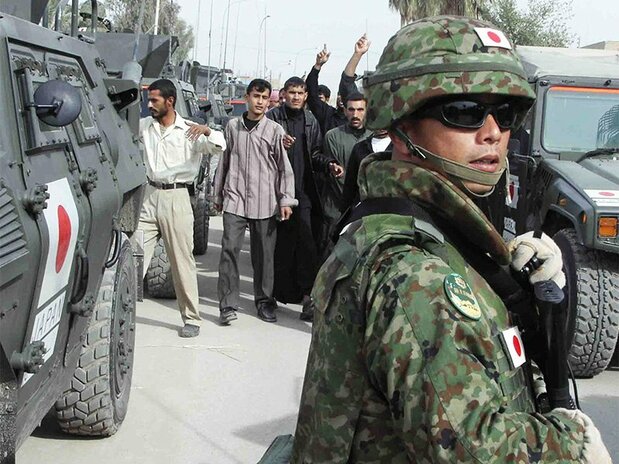
 Shiite protesters loyal to the anti-US cleric Moqtada Sadr approach Japanese light armored vehicles in the southern Iraqi city of Ar-Rumaitha [December 4, 2005]. ©Jiji.
Japan enacted the Armed Attack Situation Response Act in June 2003. This law is the cornerstone of Japanese emergency-response legislation. It incorporates legal definitions of “armed attack situations” and “anticipated armed attack situations” and prescribes how the national government, local governments, and the citizenry should cooperate in responding to aggression by another nation or by a terrorist group. The law offers a comprehensive format for protecting the Japanese citizenry in the event of an attack and for countering the attacker.
Chinese Stimuli
Underlying the Abe government’s recent moves to overhaul Japan’s framework of national security legislation is a combination of geopolitics and domestic politics. The Japanese are naturally wary of China’s increasingly assertive military stance and of North Korea’s nuclear weapons development program. Abe, meanwhile, has long positioned national security as a central plank in his political platform.
The national security bills that the Abe government submitted to the National Diet this year have been gestating for eight years. Abe’s first cabinet established the Advisory Panel on Reconstruction of the Legal Basis for Security in April 2007 to develop proposals for beefing up Japan’s national security legislation. Abe, however, had resigned by the time the panel submitted its report in June 2008, and his successor, Fukuda Yasuo, essentially shelved the report.
Japanese concern with national security spiked in September 2010, when a Chinese fishing boat collided with a Japan Coast Guard vessel in waters near the Japanese-administered Senkaku Islands, also claimed by China. Japan’s government was then in the hands of the Democratic Party of Japan, which had ousted the LDP-led government in general elections in August 2009. Tensions remained high as Chinese naval and coast guard vessels repeatedly traversed the disputed waters, and Japan’s government scrambled to frame an effective response.
A Cabinet Resolution
Abe reclaimed the government for the LDP with an electoral romp in December 2012, and the second Abe government relaunched the Advisory Panel on Reconstruction of the Legal Basis for Security in February 2013. The panel submitted a report in May 2014, and the findings of that report furnished the basis for a historic cabinet decision. Abe’s cabinet officially changed its interpretation of the Constitution to countenance the exercise of the right of collective self-defense.
Representatives of the LDP and the Kōmeitō met this February and reached agreement about a proposed package of national security legislation. The cabinet, meeting on May 14, approved the package, which comprised 11 bills. Abe then bundled the bills into two pieces of legislation and submitted them to the National Diet on May 15.Steps in Transforming Japan’s National Security Legislation (3)
| 2007 | Apr | First Abe cabinet establishes Advisory Panel on Reconstruction of the Legal Basis for Security |
|---|---|---|
| 2008 | Jun | Panel submits report to Prime Minister Fukuda Yasuo |
| 2010 | Sep | Chinese fishing boat collides with Japan Coast Guard vessel near Senkaku Islands |
| 2012 | Sep | Government of Prime Minister Noda Yoshihiko nationalizes Senkaku Islands |
| Dec | Second Abe government takes office | |
| Dec | North Korea allegedly displays upgraded ballistic missile capabilities by launching satellite into orbit | |
| 2013 | Jan | Ten Japanese die in terrorist attack in Algeria |
| Feb | Abe government relaunches Advisory Panel on Reconstruction of the Legal Basis for Security | |
| Dec | Newly established Japan National Security Council holds inaugural meeting | |
| 2014 | May | Advisory Panel on Reconstruction of the Legal Basis for Security issues report acknowledging right of collective self-defense |
| Jul | Cabinet adopts resolution that officially changes interpretation of Constitution to acknowledge right of collective self-defense | |
| 2015 | Jan | Unit of Daesh (Islamic State) in Iraq kills two Japanese hostages |
| Feb | Liberal Democratic Party and its ruling coalition partner Kōmeitō reopen discussions on formulating national security legislation | |
| Mar | LDP and Kōmeitō reach final agreement on broad outlines for national security legislation | |
| May | Cabinet decides on 11 bills for national security legislation and submits them to the National Diet as two pieces of legislation |





 Read in other languages