


A Steep Rise in Relative Poverty
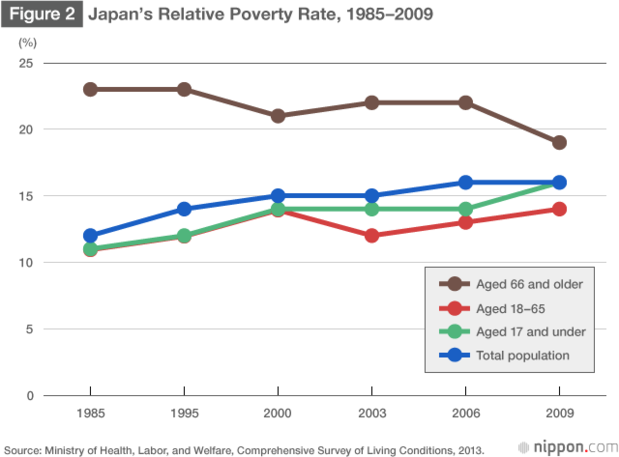
Another piece of the puzzle is relative poverty rate—that is, the percentage of people falling below the relative poverty line. In Japan the relative poverty line is defined (following OECD standards) as half the median equivalent disposable income (household income adjusted for the number of household members). However, another poverty line often used in Japan is the minimum income required to maintain basic living standards as determined by the government for the purposes of determining eligibility for livelihood protection—hereafter referred to as the “livelihood protection poverty line.” Because the livelihood protection poverty line varies according to such factors as the age of family members and the place of residence, it is difficult to draw a simple comparison with the relative poverty line, which varies only by household size. However, we can confirm that 86% of households that fall below the relative poverty line also fall beneath the livelihood protection poverty line, indicating that trends in the relative poverty rate largely reflect trends in the percentage of people below the livelihood protection poverty line.(*1)
Figure 2, which charts trends in Japan’s relative poverty rate between 1985 and 2009, reveals an increase overall and a particularly steep rise among younger Japanese. This undercuts the argument of those who claim that rising poverty levels in Japan are primarily an outgrowth of demographic aging and the fact that elderly persons typically have lower incomes.

Impoverished Single Moms
Let us now look more closely at income inequality and poverty by age group and generation, beginning with children.
The rise in income inequality and poverty among Japanese children mirrors what is happening among adults. Japan’s overall child poverty rate is 16%, higher than the OECD average. For Japanese single-parent households the child poverty rate is 50%, among the highest in the industrial world.
Poverty has been shown to have a dramatic impact on children’s education and health.(*2) In terms of education, lower income levels correlate with lower grades and lower rates of college enrollment. This contributes to a cycle of poverty that continues from one generation to the next, as indicated by a wide range of data, including the high percentage of children from low-income families among juvenile reformatory inmates, the large number of children from welfare-supported families who go on to receive public assistance as adults, and the large proportion of orphanage-raised children who end up on welfare.
Among young and working-age adults, temporary, part-time, and short-term contract labor—known as nonregular employment—has expanded dramatically since the mid-1990s and constitutes an important factor behind the growth of poverty and income inequality. It also accounts in large measure for the increasing proportion of adults who remain unmarried. Another serious problem is the growing number of young shut-ins (hikikomori) who stay at home and remain dependent for years, unable to bounce back from setbacks at school or at work.
The major cause of income inequality and poverty among the elderly is inadequate pension benefits. Under Japan’s National Pension System, Basic Pension benefits average only ¥55,000 per month, substantially below the livelihood protection poverty line. While regular employees also enroll in the Employees’ Pension Insurance system, which provides supplemental benefits to retirees, some 8.5 million elderly people are forced to make do on Basic Pension benefits alone. Moreover, in fiscal 2015 the government will begin calculating pension payouts using a new formula that is expected to cut Basic Pensions benefits by about 30% in real terms over the next three decades.(*3) As the elderly population continues to grow, the number of impoverished seniors is threatening to explode.
Designing Policies for Each Age Group
Policies to address Japan’s poverty problem should be tailored to each age group. Where child poverty is concerned, the most pressing needs are guaranteed income and employment support measures for single mothers. The government must also do more to assist the children in low-income households with educational expenses.
For young adults and others of working age, the priority should be measures to help nonregular employees. Premiums for the public pension and health insurance schemes, on which many such workers depend, are regressive by nature, placing a disproportionately heavy burden on low-income earners. As a result, many of these employees fall into arrears on their payments. The best approach to reducing income inequality among these working-age adults would be to apply the same social insurance system to all employees while boosting housing and child allowances and offering more scholarships so that nonregular employees can start building families confident of maintaining a minimal standard of living and receiving access to healthcare.
For the elderly, we need to adopt a minimum guaranteed income to supplement pension benefits where necessary and reduce premiums and co-insurance under the health and long-term care insurance systems.
The government also needs to provide more wide-ranging assistance for needy households across the board. More and more people are finding themselves in straitened circumstances yet ineligible for any kind of government assistance. These include shut-ins and the long-term unemployed—people who are unable to penetrate or return to the labor market after personal or professional failures—as well as households that are mired in debt. Cash benefits alone are not the answer. We must provide a variety of supports, including career training, job placement, and consumer and financial counseling. This April local governments began administering a brand new system of public assistance designed to provide comprehensive support to a wide range of needy families and individuals. How well this system succeeds could have major implications for Japanese society in the years ahead.
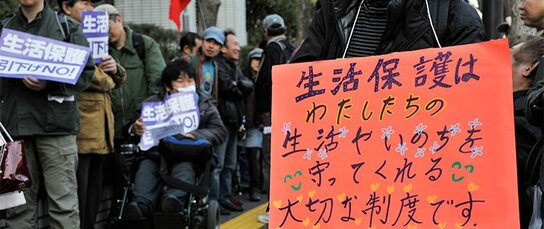
(Originally published in Japanese on March 31, 2015. Banner photo: Citizens protest the government’s decision to lower livelihood protection standards, March 2013. © Jiji.)
(*1) ^ Yamada Atsuhiro, et al., “Hinkon kijun no kasanari—OECD sōtaiteki hinkon kijun to seikatsu hogo kijun no kasanari to tōka shakudo no mondai” (Overlap of Poverty Standards—The Problem of Equivalence Between the OECD Relative Poverty Standard and the Livelihood Protection Standard), in Hinkon Kenkyū, no. 4 (May 2010), pp. 55–66.
(*2) ^ See Abe Aya’s 2008 Kodomo no Hinkon―Nihon no fukōhei o kangaeru (Child Poverty: Examining Japanese Inequality) and 2014 Kodomo no Hinkon II―Kaiketsusaku o kangaeru (Child Poverty: Examining Solutions).
(*3) ^ See Komamura Kōhei’s 2014 Nihon no nenkin (Japanese Pensions).










 Read in other languages