


The Importance of Kadena
ENDŌ That said, Kadena Air Base of the US Air Force is another story, and not even Okinawans are calling for its scale-down or withdrawal. Kadena has a very important place in America’s global strategy, and there should be a way of moving the Marines out of Okinawa so that the US commitment to the security of Japan and Okinawa is firmly maintained and so that Beijing won’t misconstrue it as indicating Washington’s loss of interest in maintaining the status quo in East Asia. This is the sort of idea that Japan can propose, but our officials haven’t been doing so.
MIYAGI I think the important thing is to deescalate the growing tension between Naha and Tokyo. There’s been a proliferation of political parties in national elections, but they all seem to take the same view on Okinawa, with the possible exception of the Social Democratic Party and the Japanese Communist Party. Proceeding with the existing Henoko plan will only further alienate the people of Okinawa. Wouldn’t this become a destabilizing factor in the Japan-US security framework, which relies heavily on the bases in the prefecture? Isn’t there a way to defuse the Henoko issue so that it isn’t so divisive?
ENDŌ Americans, too, are concerned about the local opposition to their presence. I’m not referring just to active military personnel but to Japan experts like Richard Armitage and Joseph Nye. They’ve suggested that a replacement facility in Okinawa wouldn’t do much good if it’s not going to make it easier for American soldiers to operate there. But when Governor Nakaima finally agreed to the plan, this gave the impression that their concerns were largely groundless. I have a feeling that Mr. Nakaima’s decision was a big disservice to the people of Okinawa.
MIYAGI The national government, for its part, seems straitjacketed by its past policy decisions and is not being very creative. Most of the dynamic changes to Japan’s postwar foreign policy, it appears to me, have come from Washington’s initiative.
Japan’s Lost Opportunity
TAIRA The crux of the problem may have been inability or refusal of Japan’s leaders to ask the Marines to leave Okinawa after the 1995 schoolgirl rape.
They may still have been bound by a Cold War mentality. Up until the early 1970s, Japan’s politicians were eager to achieve parity with the United States as a sovereign nation and, at the same time, anxious about the country’s security environment. While they were keen on eliminating the residue of the Occupation, they were also afraid of what would happen if the Americans left completely.
As I mentioned earlier, many US installations were returned by then, particularly in the greater Tokyo area, and in 1972 Okinawa was also returned. Recent research has revealed that when Washington proposed further cutbacks in US forces in 1970, Japan’s Defense Agency and Self-Defense Forces were of the opinion that force levels were already at or below the minimum required for the country’s security.
What this suggests is that while there was a desire for US withdrawal from a political perspective, security needs dictated that troop strength be kept at existing levels. That was the equilibrium point at which the desires for parity and the needs for security were balanced.
US ground combat troops left mainland Japan by the late 1950s and the only remaining ground forces were the Marines in Okinawa. Washington proposed in the early 1970s to withdraw the Marines, but Tokyo asked that they stay to provide deterrence for contingencies in the Far East. This, too, is something that recent research has turned up.
The Japanese government’s position on the presence of the Marines, established in the 1970s, no doubt remained intact even after the end of the Cold War, and this prevented officials from asking the troops to leave following the rape incident.
MIYAGI While I hope that a similar tragedy will never happen again, one can’t say that the probability is zero. I shudder to think what might occur if there is an incident or accident involving US forces under the present circumstances.
ENDŌ This concern is probably shared more strongly by the US military than the Japanese government. Our national leaders are astonishingly obtuse when it comes to the political ramifications of the US presence. US personnel are more realistic about their impact on the local community.
MIYAGI That was true in the wake of the rape incident. Even a die-hard liberal like Foreign Minister Kōno Yōhei was very restrained in his reaction, as if worried that an angry outburst would jeopardize the bilateral security arrangements. Governor Ōta, frustrated by Tokyo’s weakness, was more direct, as he refused to sign the land leases for US bases. Because of their physical presence in Okinawa, I think the US forces tend to be more sensitive to local opinion.
TAIRA The difference in perception is a factor of visibility. By the end of the 1970s, most US bases on the mainland were gone, and incidents involving US personnel fell correspondingly. The negative image of the bases faded, leaving only the positive contributions the US presence was making to Japan’s security. Quite naturally, efforts were directed at further deepening and growing the bilateral security alliance.
But from Okinawa’s perspective, the US military still constitutes a huge presence, along with all the lingering minuses. This is a chief source of the perception gap between the mainland and Okinawa.
ENDŌ It’s quite sobering to think such a gap continues to exist more than four decades after Okinawa’s reversion.
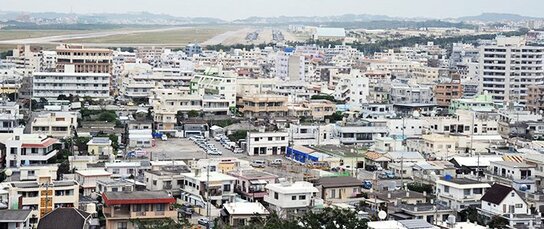
(Translated from a roundtable discussion conducted in Japanese on June 19, 2015, and edited by the Nippon.com editorial department. Banner photo: Houses cluster around Marine Corps Air Station Futenma, located in the middle of a densely populated area in the city of Ginowan. © Jiji)


 Read in other languages