


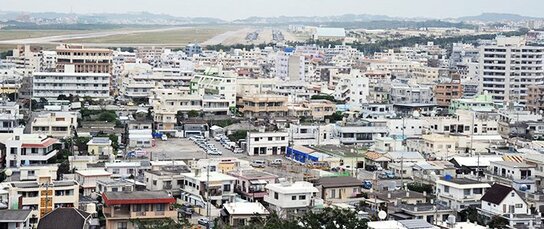
Okinawa Governor Onaga Takeshi’s staunch opposition to the Futenma relocation plan has deepened the rift between the local and central governments. In the first of a three-part series, political experts shed light on the issues involving US bases in Okinawa, host to 74% of American military installations in Japan.
Different Sets of Assumptions
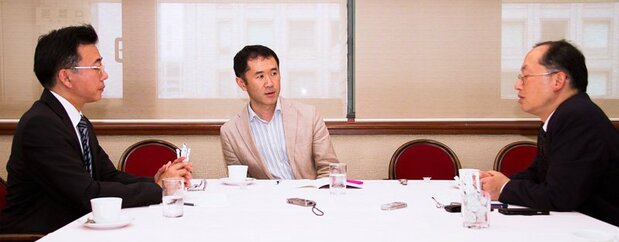

MIYAGI TAIZŌ I’d like to begin by asking your views on what’s happening in Okinawa right now.
ENDŌ SEIJI I think the biggest source of strife between Okinawa and mainland Japan today is the fact that the US bases in the prefecture are regarded as a “local” issue by most people outside Okinawa, whereas Okinawans see them as an issue that needs to be addressed by the whole nation. The underlying premise of the arguments against the plan to relocate Marine Corps Air Station Futenma to Henoko in the city of Nago is that the burden of hosting the US bases should be more equitably shared with the rest of the country. Very little progress is being made in the Futenma debate because the arguments traded between Tokyo and Naha—and also between mainlanders and Okinawans in general—rest on different sets of assumptions.
The administration of Prime Minister Abe Shinzō is pushing forward with the relocation plan on the understanding that local authorities have already approved the construction of a new base at Henoko—notwithstanding the recent expressions of Okinawan opinion to the contrary, including the sweep by anti-relocation candidates in the November 2014 gubernatorial contest and the House of Representatives election the following month. The government’s intransigence has alienated the Okinawa public, and escalating hostilities have made it impossible to hold any fruitful dialogue.
Should the international and security environment in which Japan finds itself improve, there may emerge some room for calm discussion on the importance of the bases in Okinawa, leading to greater options about reducing the prefecture’s burden. But given the rising tensions in the South China Sea and, to a now somewhat lesser degree, in the East China Sea around the Senkakus, the importance of the bases in Okinawa viewed not only from the mainland but also from the United States is bound to grow. In such a context, Okinawans are going to find it very difficult to win sympathizers for a reduced US presence in Northeast Asia and, specifically, in their prefecture.
Mainland policy debate, in particular, is increasingly focused on the need to step up Japan’s security, which is invariably premised on the continued presence of US forces in Okinawa. Purely from a military perspective, though, there’s room for debate on whether those bases have to be in Okinawa in order to deter Chinese aggressions. But most government officials and others on the mainland mechanically link the need for deterrence with a continued strong US military presence in Okinawa, without making any attempt to examine other alternatives.
We should remember that the opposition expressed to the Henoko plan by the people of Okinawa isn’t a knee-jerk response; they reached this conclusion after carefully weighing the various factors involved, such as the security needs of the country as a whole, the safety of Okinawa residents, the benefits of relocation to the local economy, and threats to the ecosystem posed by the landfill project. Mainlanders make little attempt to understand all the myriad factors that Okinawans are having to balance.
My perception of the current situation is that the climate for dialogue is deteriorating and that there’s increasing tension in the relationship between the central government and the administration and people of Okinawa.
The Vestiges of Wartime Defeat
TAIRA YOSHITOSHI From a slightly different vantage point, I would argue that the situation Okinawa finds itself in today is emblematic, in condensed form, of the course taken by postwar Japan. We need to see that the “Okinawa problem” isn’t really about Okinawa per se and that it can’t be explained as long as we continue to use a framework pitting Okinawa versus the mainland. It’s a byproduct of the process by which Japan sought to come to terms with itself following its wartime defeat.
Okinawa’s present situation raises two very fundamental questions. One relates to Japan’s existence as a sovereign state, and the other to the functioning of its democratic institutions.
The latter issue is raised by the fact that recent elections for the mayor of Nago, governor of Okinawa, and the House of Representatives were all won by candidates strongly opposed to the Henoko relocation plan. Now, if Japan is a democracy, can the central government in Tokyo continue to ignore these expressions of the popular will? An even more fundamental question for a democracy is equality in sharing the burden of defending a nation. Unless we analyze the current situation in Okinawa from these two angles, we’re going to find ourselves going around in circles.
MIYAGI Can you elaborate on the points you just made?
TAIRA Sure. Six years and eight months of Allied Occupation came to an end when the San Francisco Peace Treaty came into force in 1952, restoring Japan’s sovereignty. During the 1950s, the Japanese government sought the withdrawal of US troops stationed in the mainland and a downsizing of US bases. This continued through the 1960s, and by the 1970s many of the bases in the greater Tokyo area were returned, notably in accordance with what’s known as the Kantō Plain Consolidation Plan. In 1952, US exclusive use military installations covered 135,200 hectares of mainland Japan. This area shrank to 33,500 hectares in 1960, to 19,700 in 1972, and further to 8,500 in 1980. It’s now down to 8,000.
What compelled Japanese politicians to push for the withdrawal and downscaling of US military bases? In the words of Prime Minister Kishi Nobusuke, who successfully negotiated the revision of the Japan-US Security Treaty, they were driven by the desire to clear away the “residue” of the Occupation. To a greater or lesser degree, Japan’s political leaders wished to stand on an equal footing with the United States as a sovereign state. This, I think, was the basic driving force for the revision of the Japan-US Security Treaty in 1960 and the reversion of Okinawa in 1972, enabling Japan to end a humiliating chapter in its history and achieve parity with its former occupiers.
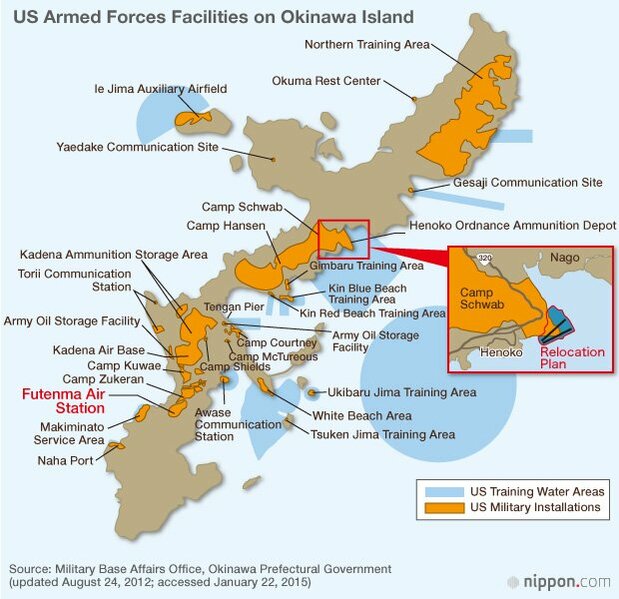
But can we really say that the residue has been cleared? After all, US forces continue to occupy 22,700 hectares of land in Okinawa, seventy years after the war. These sprawling bases were built in the years between the Battle of Okinawa in 1945 and the islands’ reversion to Japanese control in 1972. Okinawans are reminded daily that the residue of defeat and occupation have yet to be swept away. This is what I meant when I said that the current situation in Okinawa raises questions about Japan’s sovereignty.


 Read in other languages