


What Okinawa Says About Japan
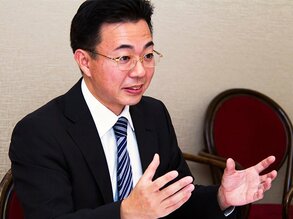

TAIRA That’s why we need to shift the debate to find a way out of the current impasse. Right now the government and its mainland supporters are framing the issue as a matter of national security, citing the threat from China and so forth. The Okinawans, meanwhile, are approaching it in terms of their own rights, stressing self-determination, structural discrimination, even calling for independence. We’re talking past one another. We need to reframe the debate so that we can start discussing the issue on the same level.
One way to go about this is to ask people to think about what the situation in Okinawa says about the character of Japan as a sovereign state. Another is to ask how it reflects on Japan as a democracy. How does Japan, as a democratic nation, justify the fact that 73.8 percent of the US military facilities in Japan, by area, are concentrated in a prefecture that accounts for only 0.6 percent of the country’s total land area? In a democracy, sovereignty resides with the people. It follows that the people themselves should have the collective will to defend their own country and share the burden of defense equally. So the question becomes, How do each of us, as Japanese citizens, feel about the fact that the burden of national security in the form of US bases falls so disproportionately on one region?
MIYAGI Some people counter that the central government has compensated Okinawa amply in the form of generous subsidies for local development and so forth. They argue that Okinawans are in no position to talk about independence, given that outlays from the central government’s coffers are what keep their economy going. How do you answer those critics?
Breaking the Cycle of Dependence
TAIRA Once again, I think it’s a matter of reframing the issue. Much of this discussion is predicated on the assumption that Okinawan politics is divided between progressives who oppose the bases on ideological grounds and conservatives who support them for economic reasons. Furthermore, there’s a perception among mainland Japanese that the two sides are basically in cahoots, since the anti-base sentiment helps the prefecture wring more economic benefits from the government. There’s no denying that the construction industry has its eye on the bottom line, but nowadays it's quite mistaken to equate conservative politicians with economically motivated support for the US bases. Most of Okinawa's conservatives are embracing a platform of economic development paired with base reductions—together with the idea of Okinawan pride.
Since the 1972 reversion, the Japanese government has allocated a total of 15 trillion yen for Okinawa’s economic development. Of course, the government created this program because it wanted to reduce the economic gap between Okinawa and the mainland that had emerged during the twenty-seven years of US control. This has become clear to me from my interviews with officials who worked in the Okinawa Development Agency, as well as from my study of historical documents.
Under the program, the government instituted the practice of defraying 90 percent of the cost of local infrastructure projects and other public works. This completely undermined the fiscal discipline of local government and nurtured a system in which the construction industry got fat off undisciplined spending on public works projects.
This is the scary thing about subsidies. Before you know it, they take on the character of an entitlement program, and people become more and more dependent on them. Once that happens, the system becomes self-sustaining and resistant to change. In recent years, the government has reinforced this structure of dependence by targeting the weak links with new spending programs, like the northern development program and the Shimada Commission initiative. In the end, this policy has hurt Okinawa, just as it has hurt the taxpayers who shoulder the burden.
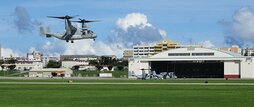
But the northern development program and the Shimada Commission initiative both have their roots in the agreement that the Japanese and US governments reached in 1996 to relocate Marine Corps Air Station Futenma from its current site to a less populated area in Okinawa Prefecture. The programs were adopted as a kind of compensation or inducement. We need to ask why the base couldn’t be relocated to mainland Japan or to another country.
The LDP's Widening Chasm
ENDŌ At the national level, the [conservative] Liberal Democratic Party seems baffled by the complexity of conservative politics in Okinawa. Mainland LDP leaders today don't see how Okinawa's conservatives can call themselves conservatives. What’s the reason for this gap?
TAIRA I don’t like to reduce everything to generational differences, but I do think that the experience of World War II and the US Occupation provided the basis for a shared understanding between Okinawans and mainland Japanese. Old-school LDP politicians like [former Chief Cabinet Secretary] Gotōda Masaharu, [former Prime Minister] Hashimoto Ryūtarō, and [former chief Cabinet Secretary and Head of the Okinawa Development Agency] Nonaka Hiromu seemed to feel a certain amount of remorse over the fact that Japan had basically abandoned Okinawa for twenty-seven years, and that even after that, the United States, which had defeated Japan in World War II, still maintained all those military bases in Okinawa. I would imagine that deep inside, they harbored feelings of guilt toward the inhabitants of this island, where more than 180,000 Japanese citizens died in the war.
But that generation of politicians gave way to a new one that no longer had this shared experience of the war and the US Occupation. Around the time Prime Minister Koizumi [Jun’ichirō] took the helm, a more pragmatic, unsentimental breed of conservative politician began to dominate the LDP.
MIYAGI There's a certain logic to it when you view it in the context of postwar political history. The LDP politicians who considered themselves representatives of the conservative mainstream credited Prime Minister Yoshida Shigeru with restoring Japan’s sovereignty via the San Francisco Peace Treaty. Yet Article 3 of the treaty abandoned Okinawa and left it under the administration of the US military. That's why Prime Minister Satō Eisaku, Yoshida's protégé, saw the reversion of Okinawa as the all-important piece of unfinished business left to him by his mentor. Similarly, from Hashimoto's viewpoint, the bases were the business left unfinished by his mentor, Satō Eisaku.
But Koizumi came to power on a pledge to destroy the old LDP, to end the dominance of the Takeshita faction—of which Hashimoto was a member. And that's just when the LDP’s attitude toward Okinawa began to undergo a fundamental change.
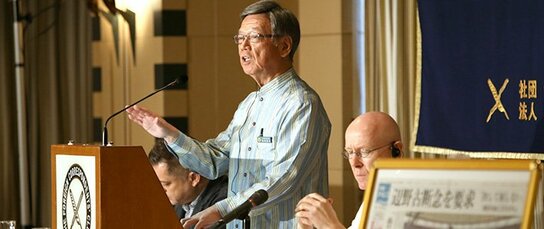
(Translated from a roundtable discussion conducted in Japanese on June 19, 2015, and edited by the Nippon.com editorial department. Banner photo: Okinawa Governor Ongaga Takeshi meets foreign correspondents in Tokyo in May, 2015. © Jiji)





 Read in other languages