


Evolving International Relations
KAWASHIMA We’re probably all aware that the international order is coming before an important crossroads, and everyone’s wondering how the US-Sino relationship is going to play out. China has announced its One Belt, One Road policy, under which it seeks to pave a path toward smoother ties with its neighbors, as well as with the Eurasian continent as a whole. Beijing is beginning to feel that its eastern borders, namely, the East and South China Seas and the western Pacific, are quite contentious, and that the dangers of escalating tensions with the Japan-US alliance are more trouble than they’re worth. This is probably the reason for focusing on its westward strategy, but we shouldn’t assume this will mean Beijing will pay less attention to the eastern front.
Washington is responding by rebalancing its security resources toward the Asia-Pacific, and it will no doubt ask Tokyo to pick up more of the security burden. Seoul is caught in the middle between Washington and Beijing, and it may soon have to make a choice. It’s playing a very tricky balancing game right now, and we’ll see if it can finesse its way forward.
The issue of historical perception goes to the heart of the Communist Party of China’s legitimacy, but as Mr. Shiraishi has pointed out, playing the history card too often can backfire. Should anti-Japanese protests, which are not prohibited by the authorities, flare up, they could turn into excuses for the masses to vent their frustrations with the party leadership. So Beijing is being cautious, criticizing Japan in international arenas but muffling such criticism domestically. This, I feel, was precisely what transpired on September 3.
South Korean President Park Geun-hye delivered a speech on August 15, the day after Abe issued his statement. I understand that she worked late into the night to revise her comments after the statement was announced. So efforts are being made by Seoul as well. All in all, the months of August and September were reasonably well managed by all three countries. There’s no telling what the future holds, but at least for now the countries demonstrated to the world that they were capable of preventing an escalation of tensions.

History as a Political Tool
KAWASHIMA Regarding the prime minister’s desire that our children and grandchildren not be predestined to apologize, I hope the topic will be addressed by many more people in Japan. Germany, for instance, has taken the step of identifying various types of war crimes. The philosopher Karl Jaspers has noted that Germans born after the war cannot be held guilty of crimes committed during wartime. But he adds that the postwar generations do have a responsibility of sorts for achieving reconciliation.
There’s very little of that kind of analysis in Japan. And our East Asian neighbors have a tendency to push war responsibility on the Japanese people as a whole, seeing the present generation as being just as guilty as those fought the war. There’s no need to imitate what the Germans are doing, but I do think that as the years go on we should deal with the subject of Japan’s aggressions and war responsibilities from a more philosophical perspective—both in Japan and in other East Asian countries. Only then can we achieve a kind of common understanding about the past.
Interestingly, there are elements of the prime minister’s statement that I feel drew lessons from the German experience. His expression of “gratitude to all the nations and all the people who made every effort for reconciliation” echoes the sentiments that have been conveyed by German Chancellor Angela Merkel. I found the statement quite intriguing in that regard.
HOSOYA I think you’re absolutely right in pointing out that the prime minister turned to the German model while drafting his statement. Chancellor Merkel visited Japan in March and made a speech that strongly emphasized the importance of the conciliatory gestures made by France and other neighboring countries.(*3) That was also a clear jab at Greece and other states with revisionist intentions.
In other words, she was pointing out that there are countries in Europe that sincerely seek reconciliation with Germany and others, like Greece, that use history—perhaps abuse it—in an effort to gain leverage over Germany to resolve contemporary issues. I think the chancellor took a very tough position on what the Greek administration was trying to do.
It’s important for both Germany and Japan to take a very honest look at the past, but it’s also crucial for international community to understand that history must not be used as a tool to solve modern political problems.
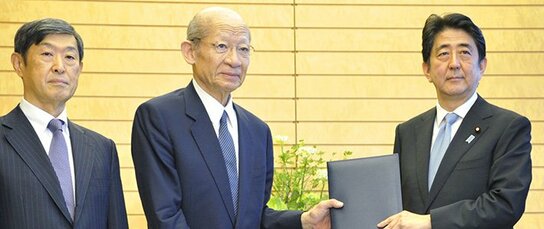
(Translated from a September 9, 2015, discussion in Japanese and edited by the Nippon.com editorial department. Banner photo: Prime Minister Abe receives the final report of the advisory panel on the seventieth anniversary statement from panel chairman Nishimuro Taizō (center) president of Japan Post Holdings. At left is deputy chairman Kitaoka Shin’ichi, then president of the International University of Japan. © Jiji)(*1) ^ The roundtable was held on September 9, before the bills were passed into law on September 19.
(*2) ^ During his visit, the Chinese president criticized the teaching of history in Japan and demanded an apology from the Emperor and Prime Minister Obuchi Keizō regarding the two countries’ past.
(*3) ^ In a speech during her visit, she stressed that France’s generosity was a key factor in enabling reconciliation between the two countries and in laying the foundations for peace and integration in Europe. While she made no direct reference to historical issues in East Asia, she suggested that efforts are needed on both sides to achieve reconciliation through apology and magnanimity.







 Read in other languages