


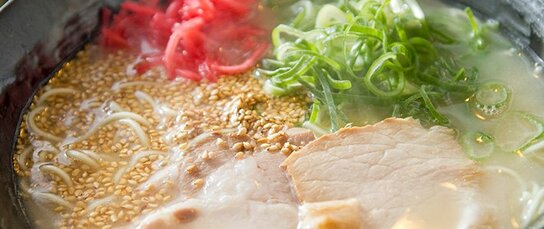
Hakata’s ties to the Asian mainland can also be seen the city’s proud street food traditions. Two members of the Nippon.com editorial team visited the city to sample some of the best-known examples of North Kyūshū’s cuisine.
Traditional Food Stalls: Great Food and Great People
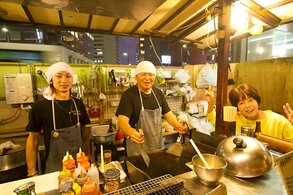
 “Nakachan,” one of Hakata’s many lively street stalls. (Located at Mitsukoshimae on the Watanabe-dōri in Fukuoka-shi.) The owner, Nakagawa Yōichi, is in the center.
The Chance to Make Your Own
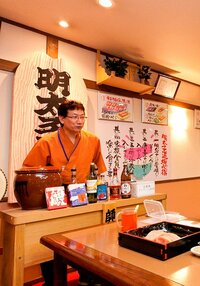 Tomonō Atsushi, instructor at the Karashi Mentaiko Dōjō (Fukuoka Kankō Kaikan Hakata, Hakata-ku, Fukuoka-shi).
Motsunabe: Hakata’s Filling and Nutritious Hot Pot
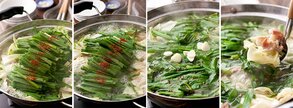 The “motsunabe” is brought to the table overflowing with fresh vegetables that gradually sink into the soup as the stew cooks in front of you.
I asked my colleague if there was anything she couldn’t eat. I needn’t have worried. “The Chinese eat anything,” she replied with gusto. “If it flies in the sky, and it’s not a plane, we eat it. If it’s in the sea, and it’s not a ship, we eat it!” I suggested motsunabe, a popular stew made in a hot pot (nabe) filled with soup, vegetables, and pork or beef offal (motsu). As one of the best-known local dishes, it seemed a promising choice—especially as even my omnivorous colleague admitted she hadn’t tried it before. We visited a restaurant called Hakata Akachokobe, diagonally across from the Kushida Shrine, one of the most important Shintō shrines in Hakata. The pot that was set down in front of us was brimming over with cabbage and chives. A small burner was lit underneath the pot, and we watched as the vegetables slid into the bubbling broth before our eyes. A sprinkling of garlic on the top, and the soup was ready to taste. We spooned a helping onto our plates, and the tender offal rose at last to the surface. So, I asked, how does it taste? “Delicious. And much lighter than I expected.”










 Read in other languages