


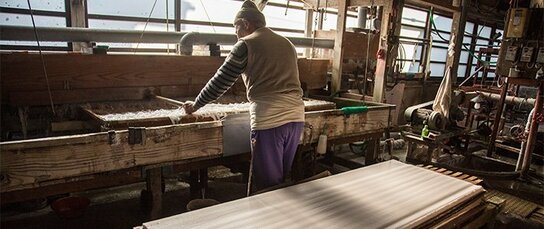
Small-scale workshops making washi by hand could once be found all over Japan. But the arrival of modern machinery as the country opened to the West in the late nineteenth century led to a rapid decline in the number of traditional papermakers. The village of Nishijima in Minobe, Yamanashi Prefecture, is one of the few places that have remained faithful to the old ways and is today a leading center of washi production.
“The Paper Is an Essential Part of the Artwork”
Nishijima lies in the foothills of Japan’s Southern Alps in the town of Minobe, Yamanashi Prefecture. Craftsmen have been making washi paper here for more than 400 years. Blessed with abundant pure water from the upper reaches of the Fuji River, generations of local artisans have made washi from the mitsumata paper mulberry tree, mainly during the nonfarming season.
Having survived the tumultuous social changes over the past century and a half, the village’s artisans now specialize in ultra-fine paper for calligraphy and painting. The paper is extremely delicate and fragile, and ink written on the paper tends to blur and smudge. Papermakers here have their reasons for deliberately producing paper with these qualities.
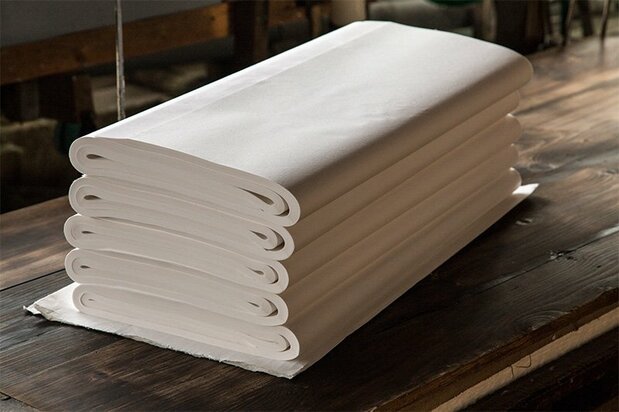
 Nishijima specializes in producing handmade washi art paper that is prized by painters and calligraphers.
In certain styles of calligraphy and ink wash (suiboku) painting, the artist’s aim is to produce a work that achieves a fine balance between sections of dark black ink, shadowy passages of muted washed-out gray, and the bright white blanks of the unpainted paper. “The paper is an essential part of the artwork,” says Kasai Shinji, a craftsman at Nishijima Washi, unfurling another sheet of fine art paper designed for Japanese-style painting. The paper is so thin it is impossible to peel single sheets from the dipping basin for drying.
“For a while after World War II it was difficult to obtain imported Chinese Xuan paper in this country,” explains Kasai. “That’s when we started making a version of it here in Nishijima to satisfy demand from artists and calligraphers. After a period of trial and error, we succeeded in coming up with a handmade washi version in the mid-1950s.” This experiment may have saved Nishijima’s washi makers from extinction. The new paper was well received and helped to bring life back to the village and its traditional craft. Six workshops produce handmade washi paper in the village today.
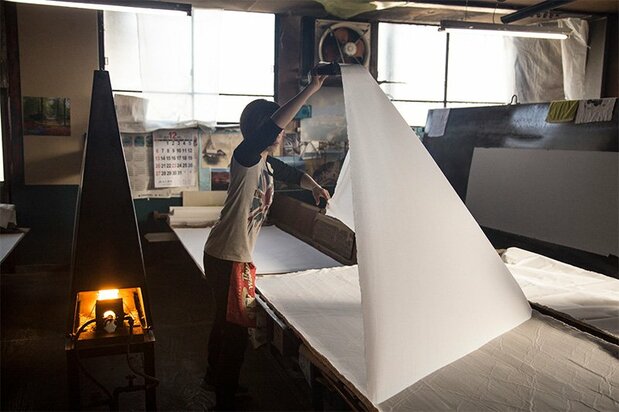 After it has been allowed to air-dry, the paper is immersed in water for half a day and then peeled off carefully, one sheet at a time, and dried again on a hot metal plate.


 Read in other languages