


Experiencing Nō Firsthand
Showing students masks, costumes, and musical instruments, she describes the most important props used in a nō play. No one is chattering, and no one has fallen asleep. Everyone is listening attentively, eager to hear what she has to say next.
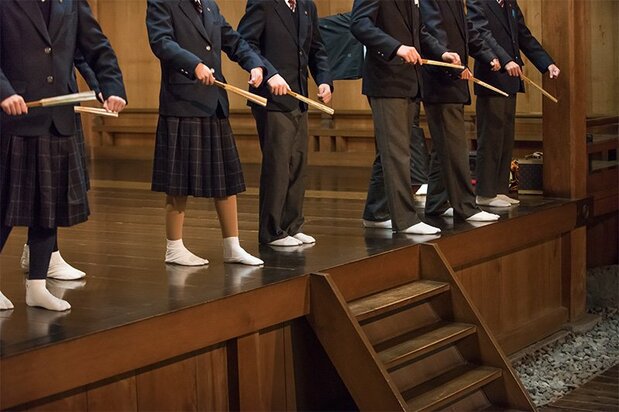
 The stage is considered sacred, and one must wear white tabi—no socks or bare feet are allowed. The hakobi, with heels flush with the floor, is the basic style of walking.
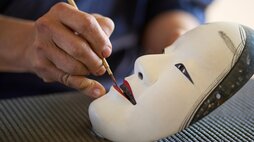
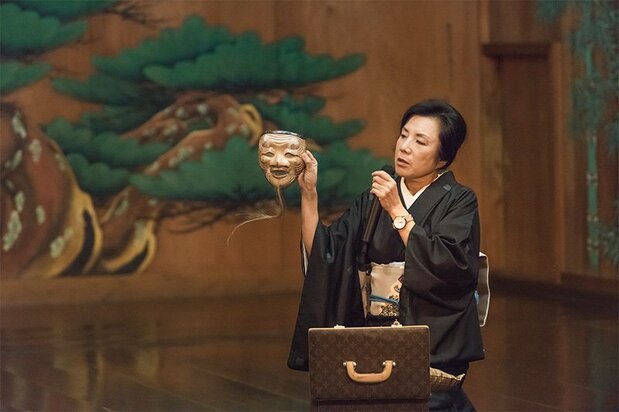 The mask used in the play Okina, for which actors are required to remain ritualistically pure before the performance.
“Do any of you recognize this face?” Kawamura says, holding up an okina mask. “It’s the River Spirit from the movie Spirited Away. The mask was also worn by the culprit in the Detective Conan anime series: Crossroad in the Ancient Capital.”
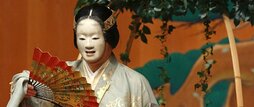
“How old do you think this character is?” she says, now holding up a ko-omote mask of a young woman. Most students believe it is for characters in their twenties or thirties. They are surprised to learn it is for a teenage girl—the same age as the students themselves.
“People assume that a mask can’t convey any emotions, but that’s not true at all. Tilted slightly downward, it has a sad expression; tilted slightly upward, there’s a look of elation. The shape of the mask didn’t change, so what changed was the emotion you ascribed to the mask’s expression. This is what nō is really about. The actor is responsible for only half of the theatrical experience; the other half is what the audience brings to the performance. When you watch a nō play, you’re participating in the creative process.”
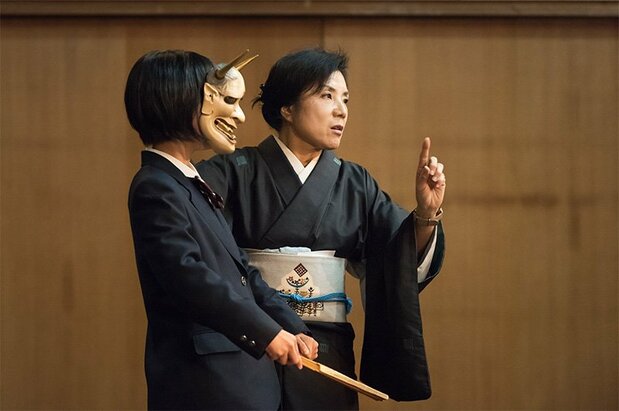 The hannya mask can transform even an innocent schoolgirl into a vengeful monster.
The horned hannya mask is usually thought of as depicting a demon, but it is actually the face of a woman. When Kawamura covers up its oversized mouth, the face that appears is that of a woman in tears.
“It’s the face of a woman forced to endure great sadness and pain. One day, it just gets too much, and this is what she looks like when she explodes,” Kawamura says, adding, “So you boys better be careful never to cause a girl such grief. You’ll be very sorry if you did!”
Secret to Survival
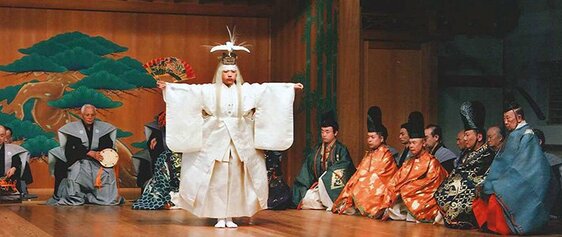
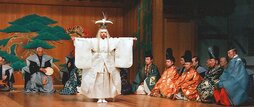
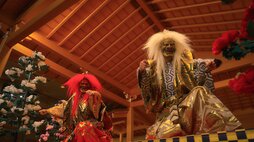
The workshop concludes with a dynamic performance of an excerpt from the play Funa Benkei by her son, professional Kanze school actor Kawamura Kōtarō. The scene depicts the ghost of Taira no Tomomori seeking to avenge the defeat of the Heike clan at the hands of Genji warrior Minamoto no Yoshitsune in the late twelfth-century Genpei War. Tomomori appears with a long naginata sword as Yoshitsune and his followers are fleeing their pursuers by boat in Osaka Bay.
“There are two main reasons that nō has survived for six and a half centuries,” Kawamura says. “One is that it continued to adapt and evolve over the years. The other is that its essence was transmitted from one generation of nō actors to the next not just through words or diagrams but as lived experience, particularly in the use of the body and voice.
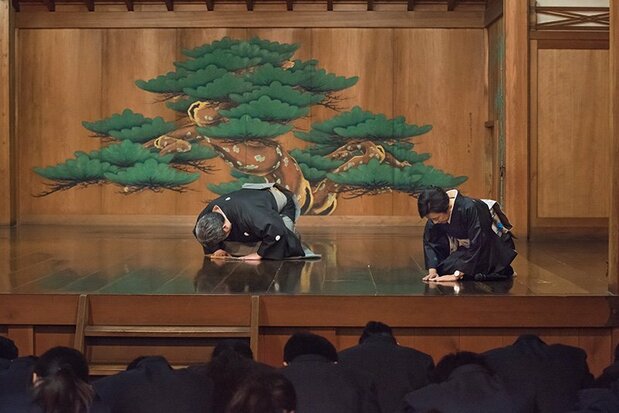 Both those leading the workshop and students in the audience bow at the end of the workshop to express gratitude for one another.
“No matter what big changes the future may bring, remember to keep your feet planted on the ground, and you won’t get blown away,” Kawamura notes in concluding the workshop. “Be sure to think and act for yourself and to keep moving ahead.” With those remarks, she bows deeply, and the students reciprocate with a chorus of thank yous.
“Your senses don’t lie to you. When you experience nō firsthand, you can’t help but sit up straight. There’s a sensation of having come into contact with something profound. I think that’s why the students all express gratitude after the workshop.”
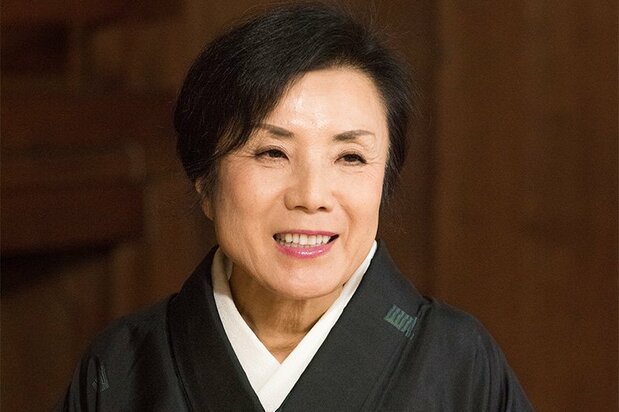
She receives many thank-you messages from the students. “I’ve promised grandma I’ll go see a nō performance with her this summer,” one wrote. And another commented, “Seeing how carefully nō masks and instruments were handled has convinced me to take better care of my soccer ball.”
Increasingly, Kawamura is asked to lead workshops for foreign visitors invited by the Foreign Ministry. She does so in English without an interpreter, choosing her words carefully to facilitate understanding for those unfamiliar with Japanese culture.
“I tell them repeatedly that nō is very simple. It’s that simplicity that fires the imagination. Nō can’t be fully understood intellectually. You have to feel it, and when you do, it can be a very powerful experience.”
The words may be hard to follow, for Japanese and non-Japanese audiences alike. But what is more important is to go beyond the text and give oneself to what is taking place onstage, appreciating the beauty of formalized movements, the chants and rhythms of the musicians, and the transcendental worldview of the plays. Not a few of her workshop’s participants have become fans of nō, encouraged by her advice to “feel” a live performance, rather than trying to understand it.Kawamura Nōbutai Nōgaku Omoshiro Workshop
- Address: 320-14 Yanaginozushichō, Kamigyō-ku, Kyoto
- Tel.: 075-722-8716, Fax: 075-722-8717
- Website (in Japanese): http://www.omosiro-noh-taiken.kyoto.jp/

 Read in other languages