


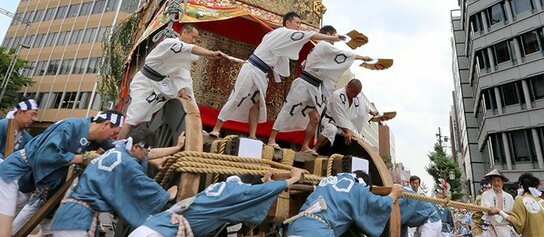
Every July tourists flock to the Gion Festival in Kyoto for the chance to see a parade of sumptuously decorated floats pass through the heart of the city. Nippon.com takes a look at the history and customs of this tradition-rich festival.
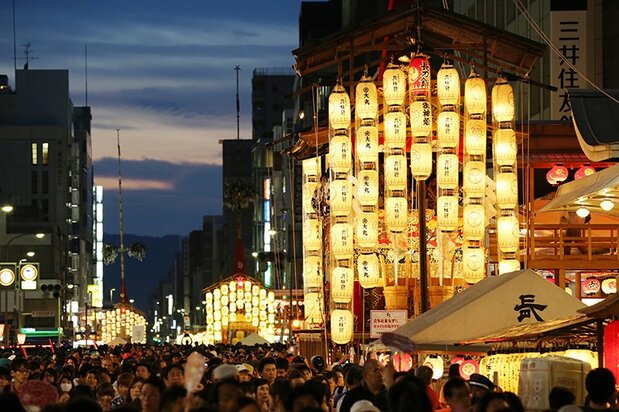
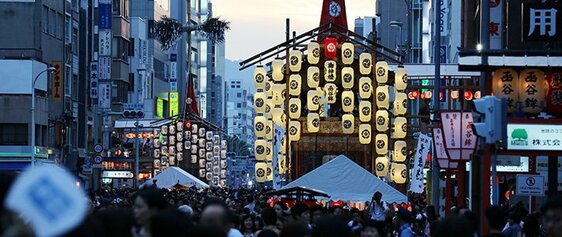
 Lanterns light up the main street of Kyoto as crowds take in the pre-parade atmosphere.
Central Kyoto Transformed
The sound of gongs, flutes, and drums echoes through the Kyoto night, mingling with the children’s songs used to sell amulets. The scene is the Gion Festival in Japan’s former capital, where musicians are preparing for this year’s centerpiece float parade on July 17. The festival lasts throughout July, but is at its liveliest during the parade and the three evenings beforehand, when the festival floats are on display and the stalls filling the lamp-lit streets are bustling. More than a million visitors each year come to see one of Japan’s most popular festivals.
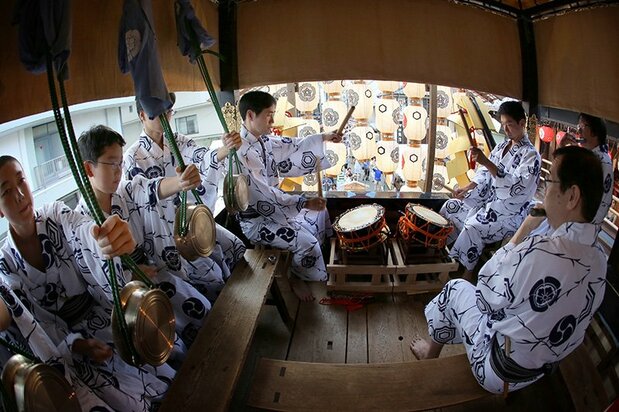 Musicians play inside a float on the day of the parade.
From July 14 until July 16, Kyoto’s main street Shijō-dōri, lined with department stores, takes on a very different appearance from usual. The evenings prior to July 16, counting backward, are referred to as Yoiyama (eve of the parade), Yoiyoiyama (eve of the eve of the parade), and Yoiyoiyoiyama (eve of the eve of the eve of the parade). Huge, lavishly decorated floats are exhibited on those evenings, including the immense Naginata Hoko float, which is 25 meters tall. The floats are displayed not only on Shijō-dōri, but also on the north-south streets that intersect with it. The nearby stalls sell a variety of goods, including fans, towels, and amulets.
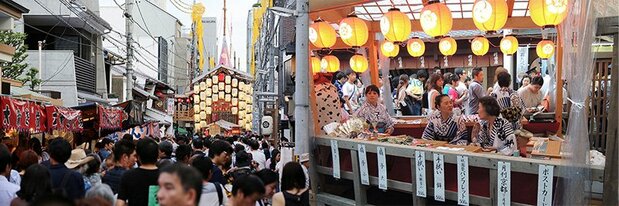 A stall selling fans and other festival goods alongside the main street of Shinmachi-dōri, with the Minami Kannon Yama visible in the background.
As darkness falls, many lanterns hanging on the side of the floats light up. People dressed in yukata, the casual summer robe traditionally associated with festivals, can be seen everywhere. At ten in the evening on Yoiyama (July 16), musicians begin marching and playing as part of a ritual prayer for good weather the following day. Festival-goers can hear the intermingling tunes as they stroll about.
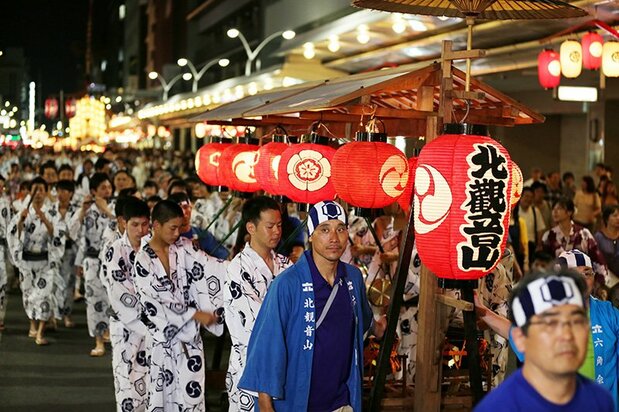 Musicians making their journey to the center of the city; they will not return to their district until after midnight.
A Breathtaking Scene
By the morning of July 17, the streets are suddenly calm again. All of the night stalls have been cleared away, making room for the float parade that is about to begin.
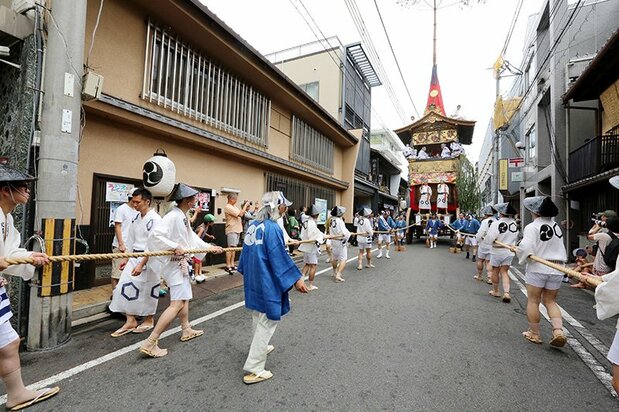 The Kita Kannon Yama float pulled by men in white haori jackets; others, wearing blue jackets, ensure the float is headed in the right direction. There are also people stationed on the roofs to make sure that the float, which is more than 20 meters high, does not become entangled with power lines.
There are two types of floats at the Gion Festival: yama (mountains) and hoko (spears). The yama floats, generally speaking, have no roof and carry elaborate dolls on their main sections. Meanwhile, the hoko floats are larger and have a roof and wheels, as well as a central pole that represents the spear that gives them their name; musicians play on a stage under the roof while the float is moving. A few of the yama floats, such as the Kita Kannon Yama float, also have a roof and wheels, so it is not always easy for an inexperienced observer to tell which type of float is which.
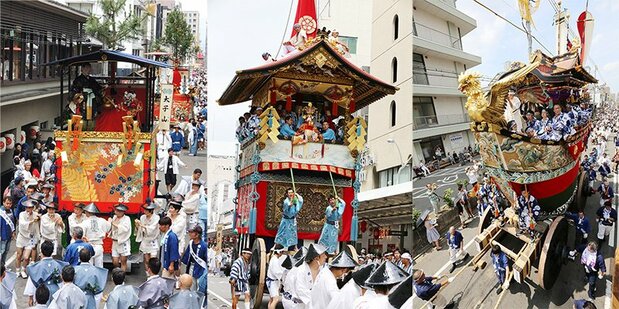 Dolls are carried on Kakkyo Yama (left) and Hoka Hoko (center) floats; the Fune Hoko float is shaped like a boat (right).
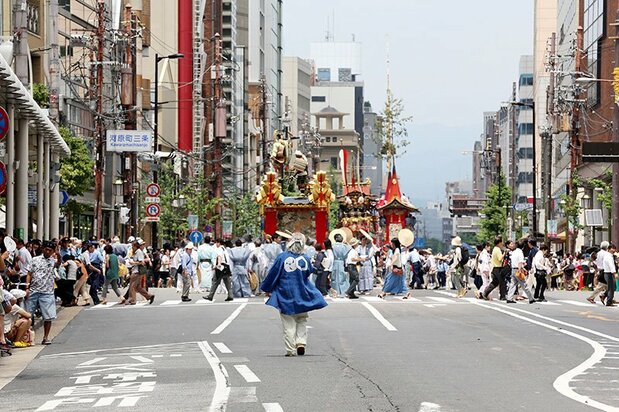 The procession moving along Shijō-dōri.
The line of 33 floats makes its stately progress to the rhythm of gongs and drums. A highlight comes when the giant hoko floats have to turn a corner. As the floats have rigid axles, the float teams have to line bamboo sticks under the wheels and slowly slide the vehicles around to make a ninety-degree turn. They are directed by men called ondotori who repeatedly shout yōitose! as a way of coordinating the team’s movements in unison. This is the breath-taking climax to the Gion parade.
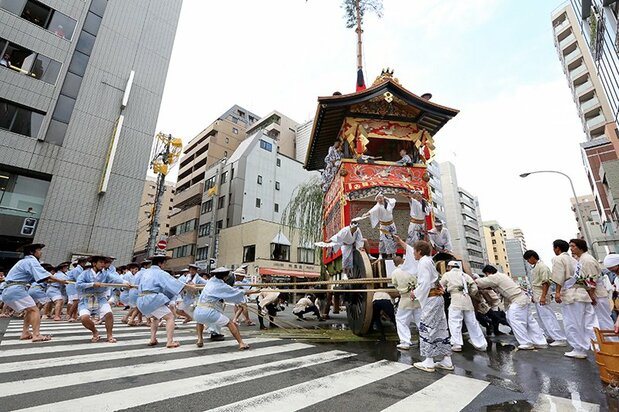 Kita Kannon Yama float turns the corner.
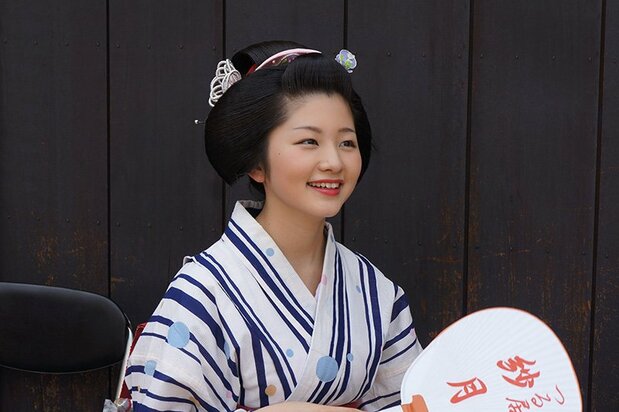 A maiko (apprentice geisha) dressed in a yukata enjoying the festivities.



 Read in other languages