


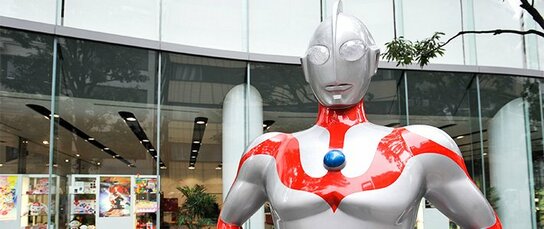
Ultraman Returns: An Attempt at Realism
Uehara was also involved in the launch of Kamen Rider, another tokusatsu classic based on a manga work by Ishinomori Shōtarō. When he was working on the script for the first episode, he was contacted by Tsuburaya Productions, and asked to come back and help them to revive the Ultraman character. He ended up working as the chief writer on Ultraman Returns, which ran from April 1971 to March 1972.
“I was quite nervous when they told me that Honda Ishirō, the director who made the original Godzilla, was going to be shooting the first two episodes,” Uehara says. In 1970, Tsuburaya Eiji died and the production team pulled together in solidarity to make something that would honor their mentor’s memory. Uehara decided that he would try something different from Kinjō’s blithely heroic version of the character. “I wouldn't have been able to pull it off if I’d tried. He had always imbued the stories with fantasy elements, so I decided to try and make the character as realistic as possible.”
The hero of the story is Gō Hideki, an ordinary young man and former auto repairman who is a member of the Monster Attack Team (MAT). Episode 33, “Kaijūtsukai to shōnen” (The Monster Keeper and the Boy), is a particularly memorable and controversial episode in which Uehara depicted the seething internal conflicts inside Gō.
The story is set in Kawasaki and details the relationship between a young orphan from Esashi in Hokkaidō and an old man (in fact an alien) who lives in a lean-to by the riverside. The episode depicts widespread discrimination against the two main characters, highlighting the frightening aspects of a mass group mentality. When the old man/alien is shot dead, the monster he has kept sealed underground is released. The citizens scream at Gō to do his duty as a member of MAT and deal with the monster as quickly as possible. But Gō hesitates to transform himself into Ultraman. “You’re the ones who brought the monster on yourselves!” he says.
Uehara says that when he wrote the script he imagined that the young boy from Hokkaidō belonged to the Ainu minority and that the elderly man represented the Zainichi Korean population. As an Okinawan and a member of a minority himself, he felt ineluctably drawn to side with the boy, the alien, and the monster. After the episode was shown, Uehara was moved out of his position as chief writer.
Ultraman as a Folk Tale for the Modern Age
Uehara went on to write scripts for numerous other popular children’s shows, including Ganbare!! Robokon and Himitsu sentai gorenjā (Five Rangers). Kinjō, meanwhile, worked on writing scripts and producing for Okinawan theater after his return home. In 1975 he helped to design and produce the main ceremony for the Okinawa International Ocean Expo, but was hurt when the expo came in for local criticism for its destructive impact on Okinawa’s seas. The following year, he died in a freak accident at the age of 37.
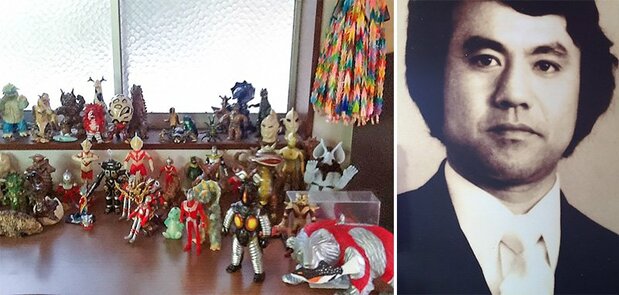
 Kinjō Tetsuo (right) was born in Haebaruchō, Okinawa. Today, the grounds of the Shōfūen restaurant house the Kinjō Tetsuo Museum, which used to be the study where he worked. The writer’s desk is decorated with Ultraman figurines left by visiting fans. (Photo: Kinjō Tetsuo Museum)
This summer, NHK asked fans to vote for their favorite episodes to mark 50 years since the original broadcast. In first place was Kinjō’s final script for Ultra Seven, “Shijō saidai no shinryaku” (The Greatest Invasion in History). Uehara’s “The Monster Keeper and the Boy” was in second place. “Those early series have some really passionate fans, from teens to people in their fifties,” Uehara reflects. “They say they find new meaning in the episodes every time they watch them.” Just as people today find various ways of interpreting old Japanese folk tales like Momotarō, Princess Kaguya, and Urashima Tarō, Uehara hopes that Ultraman too will be passed on as a classic that belongs to everyone, bringing its message of tolerance and wonder to each new generation.
(Originally published in Japanese on November 29, 2016. Interview and text by Itakura Kimie and Ōtani Kiyohide of Nippon.com. Banner photo: Ultraman stands guard outside Bandai headquarters. Tsuburaya Productions entered a capital and business alliance with Bandai in 2008.)




 Read in other languages