


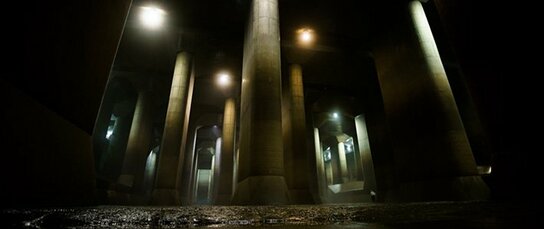
One of a Kind
Flood prevention works are becoming increasingly difficult to build above ground in the Tokyo metropolitan area, so many underground flood control facilities have been developed in recent years. Twenty-eight underground regulating reservoirs for 12 rivers are already in operation, and more than 10 others are planned or currently being built. Major projects include the Kanda River/Loop 7 Underground Regulating Reservoir, which has a tunnel that is 12.5 meters in diameter and 4.5 kilometers long, and the Furukawa Underground Regulating Reservoir, with a tunnel that is 7.5 meters in diameter and 3.3 kilometers long. Both are giant facilities that will greatly reduce flood damage.
Because they are underground flood control facilities, people often wrongly assume that they function in the same way at the Metropolitan Area Outer Underground Discharge Channel. Yet there are major differences.
“Regulating reservoirs reduce flood damage by temporarily holding water from overflowing rivers. The underground discharge channel, on the other hand, can not only hold water but also discharge it elsewhere, namely, the Edo River. That’s why it has a giant pressure adjusting tank and powerful turbine pumps,” says Yabe.
The discharge channel is therefore the only facility with an “underground temple.”
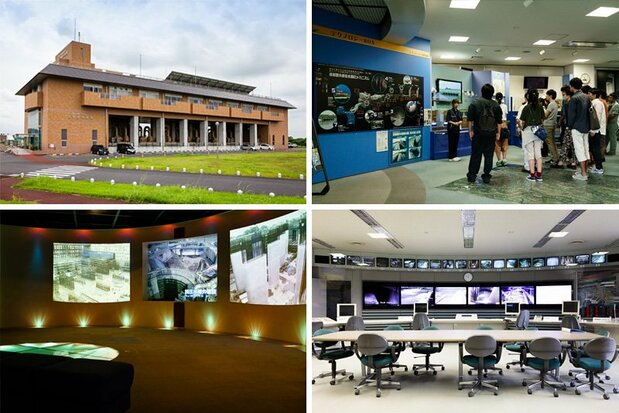
 Upper left: The Ryūkyūkan on the grounds of the Shōwa Drainage Pump Station contains an exhibition hall and is the gathering place for tours of the pressure adjusting tank. Upper right: Visitors hear an explanation of the facilities from a staff member. Bottom left: A room showing videos on three screens. Bottom right: Visitors can look into the actual control room.
Foreign visitor are welcome to participate in the tour, but they should either be able to understand Japanese or be accompanied by an interpreter. On the day of our visit, a woman from Taiwan told us she came to the tour directly from Narita Airport, still carrying her suitcase. She was excited about the visit, telling us that a friend had found out about it on the Internet and “just had to see it. I speak Japanese and she invited me. Actually being inside is a really powerful experience, and we were blown away by Japanese technology. We have a lot of typhoons and floods in Taiwan, too, so I’d love to have this kind of facility there.”
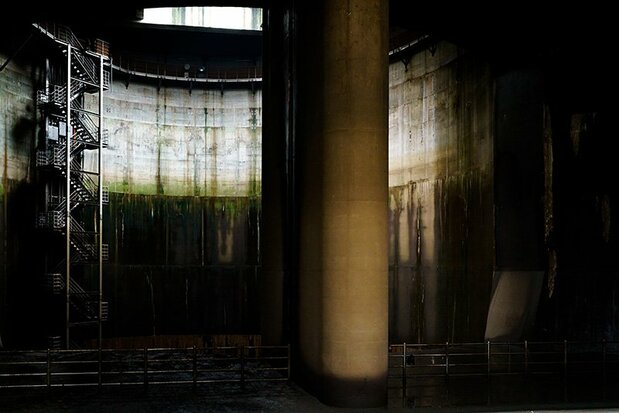 Containment silo No. 1 seen from the pressure adjusting tank. The view of this side is also very popular.
Yabe says that public relations activities are especially important because this is an underground facility.
“Since it’s underground and normally hidden from view, people are more likely to misunderstand its role and facilities. We thus try to cooperate as much as possible with filming and to offer tours. The pressure adjusting tank is what brings everyone here and is what people want to use in filming, but of course it wasn’t built for that purpose. The Metropolitan Area Outer Underground Discharge Channel is full of things that were built for the first time in the world and features the highest levels of technology. This has contributed to its awe-inspiring atmosphere and functional beauty whose esthetic appeal is truly universal.”
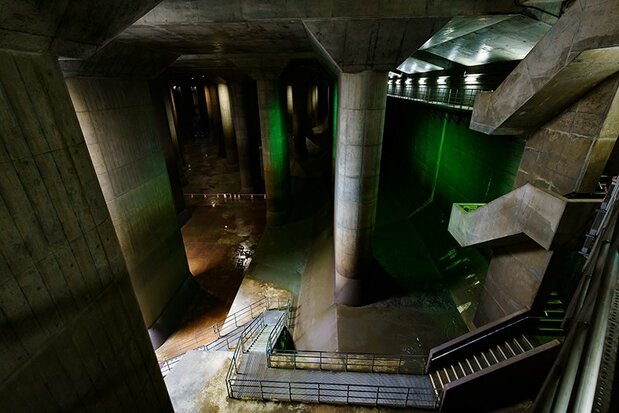 The pressure adjusting tank viewed from the top of the stairs.
Data
Metropolitan Outer Floodway Management Office, Shōwa Drainage Pump Station
- Address: 720 Kamikanasaki, Kasukabe, Saitama Prefecture
- Access: A 40-minute walk or a 7-minute taxi ride (about 3 km) from the north exit of Minami Sakurai Station on the Tōbu Noda LineNote: The Kasukabe City Community Bus, called the “Haru Bus,” goes near the office, but the days and times are limited.
- Ryūkyūkan hours: 9:30 am to 4:30 pm
- Entrance fee: Free
- For more information, visit the Metropolitan Area Outer Underground Discharge Channel website
With thanks to the Edogawa River Office, Ministry of Land, Infrastructure, Transport, and Tourism
(Originally written in Japanese and published on November 22, 2016. Reporting by the Nippon.com editorial department. Photos by Miwa Noriaki)









 Read in other languages