


From Fuji to Godzilla
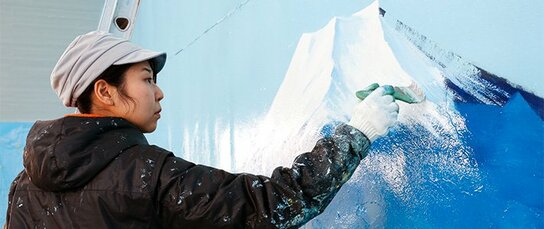
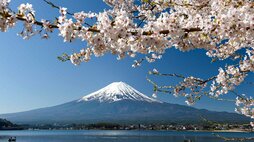
Perhaps unsurprisingly, the most difficult element was Mount Fuji itself. Tanaka had to pay particular attention to learn how to draw the undulating contours of the mountain. “Often, people depict Fuji as sharply rising, the way Hokusai did in his woodblock prints. But in fact, the slopes of the real mountain are not that steep. I like to paint pictures of Mount Fuji that have gentle curves. I like to think they will help people to relax.”
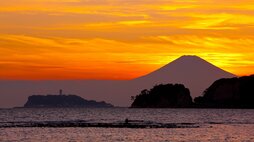
Tanaka draws on images of Fuji taken from picture postcards and travel agency brochures. She says she is always looking for a hint of how the mountain appears to ordinary people. “You could say that these images amount to a collective memory of Fuji.” Her aim is to paint an image of the mountain that will seem familiar enough to trigger a feeling of nostalgia in anyone who sees it. Sentō pictures cannot contain cherry blossoms, autumn foliage, or anything else that limits the image to a single season. The setting evening sun is also a no-no—the standard image is of the mountain against the backdrop of a bright, sunlit day.
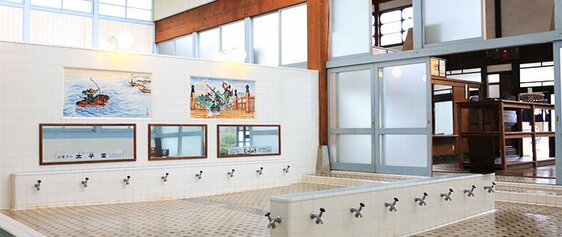
Tanaka says it is mostly in the Kantō region around Tokyo and neighboring Kanagawa and Saitama Prefectures where pictures of Fujisan are the default choice for paintings in public baths. This tradition apparently dates from the Meiji era spanning the late-nineteenth and early twentieth centuries, when a huge lookout viewing tower shaped like Mount Fuji in Asakusa and a panorama picture of the mountain as seen from a train in Kanda-Nishiki-chō were popular tourist draws. The bathhouse paintings are probably a reminder of these earlier attractions. Outside Kantō, many bathhouses do not have paintings on their walls, and are often decorated with mosaics or simple white-painted wooden paneling.
Tanaka started her own business in 2013, but insists she has plenty of room for improvement as an artist. “Maybe because of my character I tend to over obsess about the details of my paintings. Experienced artists have a better sense of where they need to concentrate their energies. This allows them to finish a painting much more quickly, which is something I am working on.”
Recently, certain groups have turned to bathhouses for publicity purposes. Last year a hot springs facility in Tokyo, the Ōta Kuroyu Onsen Daini Hinodeyu in Nishi-Kamata, commissioned Tanaka to do a special painting featuring Godzilla. The picture, which was on display for a limited time, was inspired by the film Godzilla Resurgence, one of last year’s Japanese box office hits.
“Quite a few of the major scenes in the movie were filmed in Kamata, and someone from the municipal office got in touch to say they wanted to use this opportunity to promote the area,” Tanaka says. The picture she came up with combines Godzilla with local landmarks as well as many elements of the sentō tradition. On the left of her picture is the iconic façade of Kamata’s sunrise shopping arcade, Honmonji temple in nearby Ikegami, and on the right Haneda Airport and the Tamagawa River, with Mount Fuji towering above them. When the campaign was over, Tanaka painted a new Fujisan over the top of the Godzilla picture.
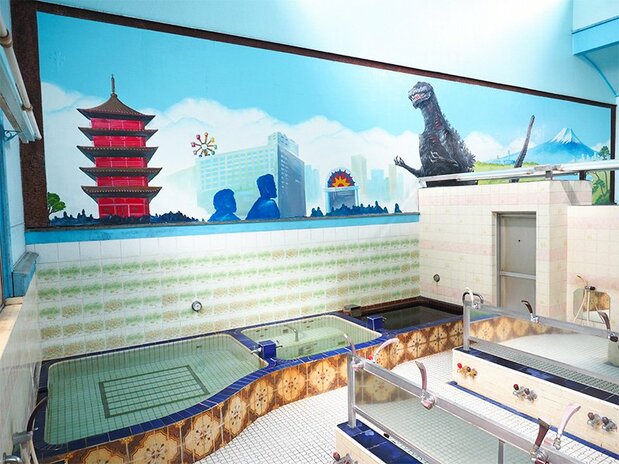
 The “Godzilla Bath” painting at Hinodeyu in Nishi-Kamata. This mural by Tanaka adorned the walls of the bathhouse from July to early November 2016. (© Toho Co., Ltd.)
Passing on the Tradition
Although the battle for survival among sentō is likely to continue into the foreseeable future, Tanaka is adamant that “sentō will never disappear altogether.” Recently, business people and cultural figures with a fondness for Japan’s traditional bathhouses have organized events to make more people aware of their appeal. Tanaka herself has lent a hand in these activities, taking part in children’s painting workshops and live painting events.
And recently sentō seem to be undergoing a resurgence of popularity among people in their twenties. Their fuddy-duddy images are beginning to change, and many young people now regard them as atmospheric places redolent with retro-chic and a desirable old-timey authenticity. Social media sites and dedicated web pages have succeeded in drumming up interest among sentō fans, and in one instance it saved a bathhouse that had been in operation since the 1950s from closing.
Despite these new undertakings, Tanaka says more could be done to promote sentō and dreams of introducing more foreign visitors to the attractions of the traditional neighborhood bathhouse. In recent years, posters and manuals have been produced to introduce foreign visitors to the baths and associated etiquette, and online video guides are now available in several languages. Tanaka says she would like to see more publicity on multi-language websites and wants to have public bathhouses included on city tours: “I’d like it if one day a visit to a neighborhood sentō is seen as a standard part of any tourist’s trip to Japan.”
(Originally written in Japanese by Itakura Kimie of Nippon.com and published on February 24, 2017. All photos by Ōkubo Keizō except where otherwise noted.)

 Read in other languages