


Neighborhood Creations
Iwakō has stuck to its business plan: create fun and inexpensive erasers. It does this by keeping things local. Prototypes and metal molds are outsourced, but all other aspects of production, from design to assembly to packing, are done in and around the factory.
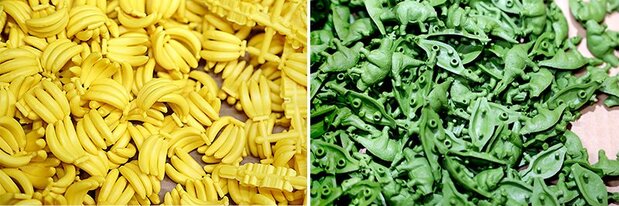
 Banana and dinosaur parts await assembly into finished erasers.
Iwasawa explains the initial process: “First we send the specifications for a new eraser to a designer, who creates a wax prototype. After tweaking the design, metal molds are then made. These generally take three to four months to complete and are the heart of the production process.”
Once the molds are in place, rubber-like thermoplastic is sprayed into them to form the various parts of erasers. These are then assembled into finished products by a team of neighborhood women working from home. Iwakō currently relies on residents from 250 homes near its Yashio factory.
Iwasawa insists that keeping production local is key. “Parts get worn and damaged if they have to be shipped from far away, which is why we base everything in the neighborhood,” he explains. “It’s a hard business model to copy, and is probably why we don’t have much competition,” he laughs. Still, he insists that keeping prices down to ¥50 per eraser is no easy task. “Material costs have risen by around 70 percent compared to when we started,” he says. “But we’re determined to keep our prices down so that children can afford to buy our erasers.”
Iwakō boasts a number of high-selling items, but Iwasawa says that the conveyor-belt sushi series tops the list. “We had regular sushi, but my grandchild came up with the idea to put it on a plate,” he chuckles. “They’re popular at souvenir shops.”
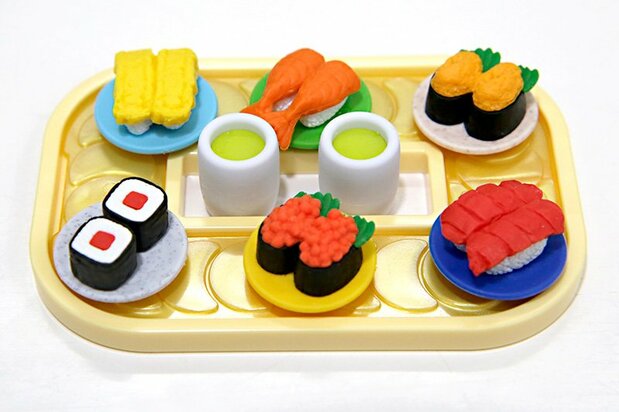 Iwakō’s conveyor-belt sushi series. The full set sells for ¥350.
Heading Abroad
Iwakō’s sprawling lineup makes it appear that the firm is willing to turn anything into an eraser. But in reality, it takes a cautious approach to development. One area the company has shied away from is tie-ups featuring popular characters from manga and anime. Iwasawa’s reasoning is simple. “One day they’re all the rage and the next they’re old-hat,” he exclaims. “We expect our products to sell for five or ten years, at least.”
The appeal of the erasers has made them popular promotional items used in safety campaigns run by police and fire departments. Dentists have also been known to hand out Iwakō erasers shaped like toothbrushes or teeth (complete with different-colored cavities) to young patients.
Iwakō has recently seen growing interest in its erasers beyond Japan’s shores. The firm first attended an international toy fair in Germany in 2011, and has since been working to build up its overseas network at stationery-focused events. According to company president Iwasawa Tsutomu, the firm currently has outlets in select locations across Asia and Europe, including Bahrain, Britain, China, Germany, Portugal, South Korea, and Taiwan.
But even as interest in Iwakō’s products spread abroad, the company says it will remain true to its roots of creating cute erasers at an affordable price.
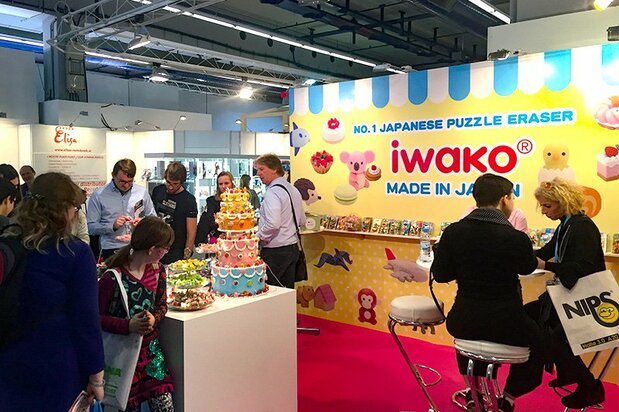 Iwakō’s booth at the January 2017 Paperworld International Trade Fair in Frankfurt, Germany. (Photo courtesy of Iwakō.)





 Read in other languages