


New Rivals
After joining the company, he was assigned to the team responsible for developing its proprietary Proguard stain-resistant technology. At the same time, he continued to play badminton competitively, participating in many domestic and international tournaments. He has won three bronze medals at world para-badminton championships and captured gold medals at the Peru Para-Badminton International in August 2017 in the men’s singles, doubles, and mixed doubles.
Nagashima still clearly remembers the day when wheelchair badminton became an official Paralympic event, starting with the 2020 Tokyo Games.
“It was around six in the evening on October 7, 2014. I received an email about the announcement from a fellow para-athlete, and I immediately checked the International Paralympic Committee site. When I saw the news about the decision, shivers ran up and down my spine. I knew then that my engagement with badminton would change radically.”
Until then, Nagashima was able to dominate the sport even with a part-time commitment. He had no coach, but true to his instincts as a researcher, he had honed the accuracy of his shots and learned to navigate his chair so that he could reach the shuttle with a single push of the wheel. He had no rival in Japan.
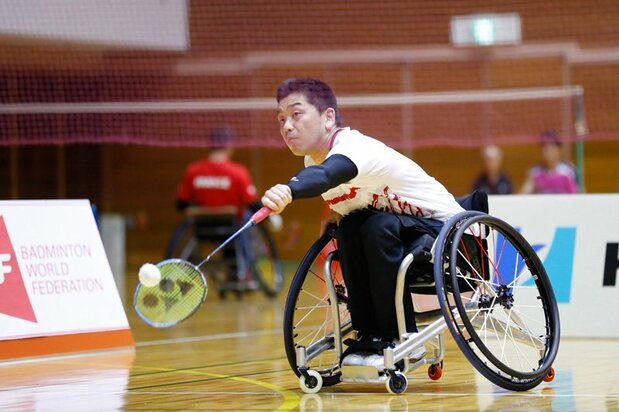
 Nagashima in competition at Japan Para-Badminton International 2017, held in September 2017 in Machida, Tokyo. (© Osada Yōhei/Aflo Sports)
But now that badminton had become a Paralympic sport, the number of younger and physically stronger players was bound to rise—all hoping to become heroes in the locally hosted Games. Nagashima thus asked to be transferred from the company’s office in Tokoname, Aichi Prefecture, to Tokyo to enable him to focus on his training.
“There may be more rivals now, but I definitely want to win a spot on the national team. I hope to win a medal and join the victory parade in Ginza as a way of repaying all the encouragement and support I’ve received from my family, friends, and colleagues.”
His ultimate goal, though, is not to win a Paralympic medal. It is to demonstrate that even a person with a disability is capable of performing at the highest levels of athletic competition while assuming responsibilities for a leading company’s core functions.
“Lixil offers a full range of home products, so the technology I’m helping to develop is used not just in toilets but also in bathroom sinks, sliding glass doors, window screens, and the like. There’s still a lot to learn and research, and the same is true for badminton. I intend to continue pursuing both work and competitive sports for many years to come.”
I have no doubt Nagashima will devote his working and competitive life to making diversity and social inclusion not just a catchy slogan but a fact of life.
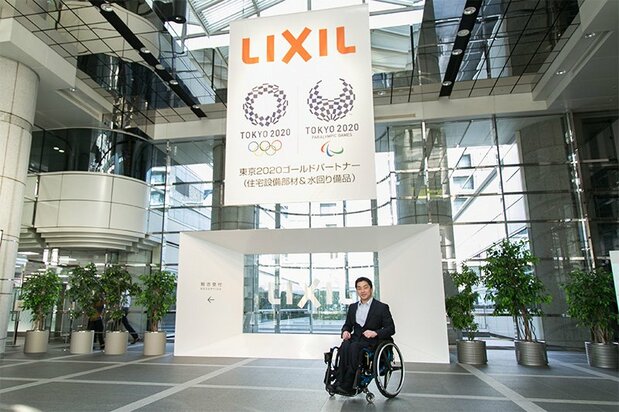 In the lobby of the Lixil Wing building in Tokyo.
(Originally written in Japanese and published on January 19, 2018. Photographs by Kawamoto Seiya except where noted.)







 Read in other languages