



Tearing Down Japanese Grammar
The first stage for Saitō was discarding current ideas and redefining Japanese grammar. For example, with the verb taberu (to eat), the negative imperative taberu na is not the only way to tell someone not to consume something. Saitō gives the following examples of increasingly forceful orders.
食べるなよ taberu na yo (Don’t eat it.)
食べるなって言ってんだろ taberu na tte itten daro (I told you not to eat it.)
食べたらぶっ殺す tabetara bukkorosu (I’ll kill you if you eat it.)
Japanese also often does not have a clearly stated subject, such as “I” or “you.” However, even if the pronoun itself is missing, the verb form can make it clear—something that AI needs to be able to pick up on.
While Saitō was working on the voice for Seaman and recording the plethora of scenarios, he noticed issues to do with pitch in Japanese.
“Seaman couldn’t tell the difference between the rising pitch of the kurabu [club] where you go dancing and the falling pitch of the kurabu where you do activities after school. There’s a difference too between saying taberu and asking if someone wants to eat with a rising tone, taberu?” Saitō explains how pitch has its own rules, giving the example of a father asking his daughter who she wants to marry. When she says “Takashi,” he suggests the father’s dismayed response “Takashi?” could be assigned a value of 2, say, to denote his level of disagreement. This grammar, which is not to be found in textbooks, is required for accurate voice recognition.
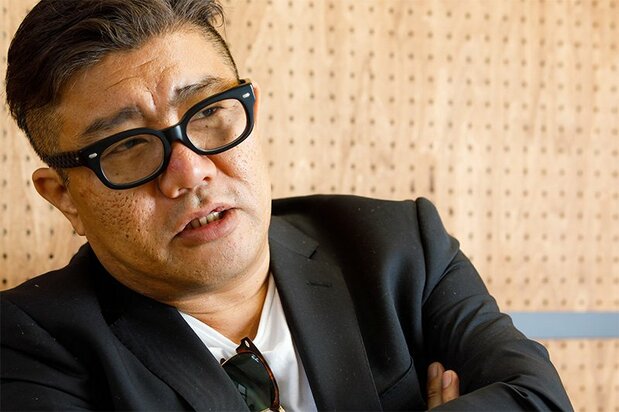
 Saitō has his eyes—and ears—on the next stage of intelligent machine interaction.
By redefining grammar, assigning numerical values to it, and incorporating these into a program, Saitō believed he would be able to teach an AI Japanese.
“A year and a half after positing that what is currently considered Japanese grammar does not reflect the reality, I am recording the conjugations of this new grammar every day and forming them into a system with my staff. I ran my theory past Professor Uchida Satoru at Kyūshū University’s Faculty of Languages and Cultures, and he was greatly impressed. Now he’s part of the project.”
Despite the praise, Saitō felt some discouragement from his conversation with Uchida.
“As a game creator, I find it fundamentally fascinating to tear down existing structures and build new ones on top. Once I broke gaming conventions with my new games and now I’m destroying grammar to make a new version. So, having someone understand my idea without getting angry—or even to say that it’s already been suggested—was a little disappointing, in a way. I don’t think the elite, who were raised on textbooks, could make this kind of weird AI. Building a road to a fresh destination is a job for someone like me in the entertainment business.”
Protecting Japan’s AI Industry
Will the local-language Amazon Echo capture the Japanese market?
“I see myself in the volunteer corps fighting to protect Japan’s AI industry from foreign forces. It’s obvious that native Japanese speakers should make a Japanese conversation engine. And if we succeed, it should be easy enough to make English and other language versions.”
I have tried the Japanese version of Amazon Echo. It may have been a problem with how I spoke to the machine, but I felt that it would have been quicker to search for the weather or turn the music on myself than to make myself understood using the speaker.
It seems that we are still in the early days of voice recognition. If an AI is developed that—as Saitō hopes—can do more than respond to simple requests, how will that change everyday life?
Saitō “Yoot” Yutaka
Chief executive officer of OpenBook Inc., director of the Seaman Artificial Intelligence Research Center, and designer of games including SimTower, Seaman, Ōdama, and Aero Porter. Has also written books, such as Hanbāgā o matsu 3 pun no nedan (The Price of Waiting Three Minutes for a Hamburger), Makkintosshu densetsu (The Legend of Macintosh), and Ringo no ki no shita de: Appuru wa ika ni shite Nihon ni jōriku shita no ka (Beneath the Apple Tree: How Apple Broke into the Japanese Market).
(Originally published in Japanese on February 13, 2018. Text by Kuwahara Rika of Power News. Photographs by Imamura Takuma unless otherwise stated. Banner photo: Seaman creator and AI researcher Saitō Yutaka.)











 Read in other languages