


Growing Acrimony
Perhaps as a consequence, the quality of Japan’s research has been deteriorating in recent years. In a six-page article titled, “What Price Will Science Pay for Austerity?” the March 2017 issue of Nature magazine bewailed Japan’s dwindling science budget, pointing out that Japan’s share of papers in the Scopus abstract and citation database “fell by more than a third over 10 years”; that “early-career researchers face an uncertain future, as universities reduce the number of permanent staff positions and shunt more faculty into short-term contracts”; and that the Japanese government reduced funding by “cutting the management expenses grant programme by about 1% a year between 2004 and 2014.”
According to November 2018 news reports, Kyoto University President Yamagiwa Juichi, who is also president of the Japan Association of National Universities, was at loggerheads with Kanda Masato, deputy director general of the Ministry of Finance’s Budget Bureau, over allocations of the management expense grants. The two reportedly locked horns over a ministry proposal to use weighted allocation methods in disbursing \100 billion—around 10% of such grants—depending on the extent to which each university had advanced reforms.
The uneven allocation began in 2016 with a much smaller share—just ¥30 billion—of total grants, but the percentage has been rising, and some suspect that the entire amount may one day be distributed on a competitive basis. Total grants have been slashed by 1% a year since 2004, resulting in a reduction of approximately ¥140 billion to ¥1.1 trillion. If 10% of this total is to be disbursed on a weighted basis, therefore, some national universities could see their allotment decline by a significant margin.
The Finance Ministry is inclined to encourage management efficiency and competition among national universities—which were able until recently to focus on developing human resources and nurturing S&T seedlings—due to a dwindling national population and mounting pressures for fiscal consolidation.
Deputy Director General Kanda reportedly suggested to Kyoto University’s Yamagiwa that access to abundant funds without competition and rigid, narrow-minded university management were factors behind the dwindling global share of academic papers. He encouraged strengthening universities’ financial footing by diversifying revenue sources, building a high-productivity research system, making social contributions commensurate to the tax money universities were receiving, and establishing an evaluation system conducive to fairer allocations of government funds.
Yamagiwa countered that that the incorporation of national universities and cuts in management expense grants were a mistake and that the institutions were being made to bear the brunt of the government’s fiscal austerity policy. Introducing competition for those grants resulted only in the lowering of research standards, he added, as scholars are forced to “waste their time” in seeking to boost the competitiveness of their universities. Such complaints have been voiced by many other researchers in Japan.
Universities must continue to compete for research and administrative grants while also earning high marks under such programs as the Global Centers of Excellence and World Premier International Research Center Initiative, which are likely to affect their rankings and future growth.
The national universities are, again this year, advocating uniform disbursements of management grants and subsidies for the upgrading of facilities, but financial authorities are unlikely to accommodate such requests.
Many More Laureates to Come?
The second S&T Basic Plan covering the period 2001–05 cites as its goal the “creation of wisdom” by “publishing a profusion of excellent papers that match investment, by increasing the percentage of internationally renowned papers, . . . and by producing just as many Nobel Prize winning scientists as the most technologically advanced European countries . . . (as many as 30 Nobel laureates in the last 50 years).”
This goal has not appeared in subsequent basic plans, but should Japan continue to produce laureates at the same pace as the past three decades, it may indeed be attainable. Given that the Nobel Prize is awarded for pioneering work that no one had ever considered, though, research in such fields is often a gamble with a high probability of failure. Honjo Tasuku’s discovery of PD-1, too, was at first inconclusive, but he persisted in his study of this “interesting” protein for more than 20 years until he achieved a breakthrough in cancer immunotherapy. His original research into immunoglobulin class switching, meanwhile, is as yet unfinished.
A member of the Council for Science, Technology, and Innovation was heard to remark that basic research, in recent years, can often lead immediately to business opportunities. Such a comment by someone responsible for drafting Japan’s science and technology policy exposes how ignorant policymakers tend to be of the temporal realities and needs of Nobel-winning research.
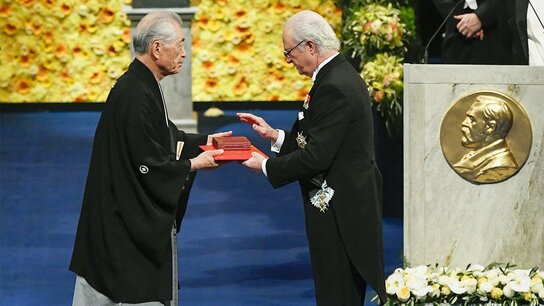
(Originally published in Japanese on January 24, 2019. Banner photo: Honjo Tasuku of Kyoto University receives a medal and certificate for the Nobel Prize in Physiology or Medicine during the award ceremony on December 10, 2018, in Stockholm, Sweden. © Jiji.)




 Read in other languages