


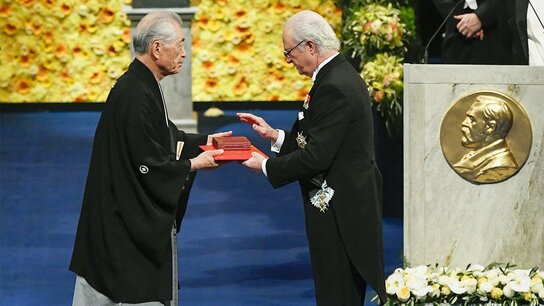
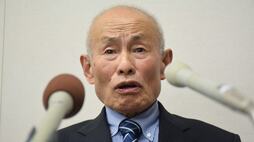
The December 2018 Nobel Prize award ceremony in Stockholm was closely watched in Japan, as one of the recipients was Honjo Tasuku of Kyoto University, who received the prize in medicine for a cancer therapy called the checkpoint inhibitor. He was Japan’s eighteenth laureate in the sciences over the past 30 years, but given the state of natural science research and trends in science and technology policy, the chances of continued success appear rather slim.
Poor Research Environment
Japan experienced a dry spell of 13 years in science-related Nobel laureates after Tonegawa Susumu was awarded the prize for physiology or medicine in 1987. The spell was broken by Shirakawa Hideki, who won the chemistry award in 2000, and the table below lists the years when subsequent winners (including Japanese-born laureates) announced the research findings for which they were honored.
Year of Announcement of Nobel-Winning Research (Post-2000 Winners)
| 1960s | Nambu Yōichirō, 1960 (2008) |
| Shimomura Osamu, 1962 (2008) | |
| 1970s | Kobayashi Makoto and Masukawa Toshihide, 1973 (2008) |
| Shirakawa Hideki, 1977 (2000) | |
| Negishi Eiichi, 1977 (2010) | |
| Suzuki Akira, 1979 (2010) | |
| Ōmura Satoshi, 1979 (2015) | |
| 1980s | Noyori Ryōji, 1980 (2001) |
| Tanaka Kōichi, 1985 (2002) | |
| Akasaki Isamu and Amano Hiroshi, 1986 (2014) | |
| Koshiba Masatoshi, 1987 (2002) | |
| 1990s | Ōsumi Yoshinori, 1992 (2016) |
| Honjo Tasuku, 1992 (2018) | |
| Nakamura Shūji, 1993 (2014) | |
| Kajita Takaaki, 1998 (2015) | |
| 2000s | Yamanaka Shin’ya, 2006 (2012) |
(Years in parentheses indicate date of prize)
Two laureates conducted their research in the 1960s, six in the 1970s, five in the 1980s, four in the 1990s, and one in the 2000s, and most were not recognized by the Nobel Committee until more than 20 years after the publication of their pioneering work. This suggests that recognition of the full value of scientific research does not come quickly. A conspicuous exception to this rule was Yamanaka Shin’ya, who was awarded the prize in 2012, just six years after his discovery of induced pluripotent stem cells.
Be that as it may, the achievements of Japanese scientists are rather surprising, given that the environment for natural science research was inferior to those enjoyed by their colleagues in the United States and other industrially advanced countries in the 1970s and the 1980s. Even by global standards, their research was unique, unorthodox, and deeply consequential. Indeed, there were many other eminent Japanese-born scientists whose work went unrecognized by the Nobel Committee, including virologist Hanafusa Hidesaburō, who demonstrated how viruses can cause cancer; cell biologist Masui Yoshio, who successfully isolated materials that control the process of cell division; and neuroscientist Numa Shōsaku, who conducted pioneering research on neurotransmitters and ion channels.
Belated Launch of a Basic S&T Policy
Scientific research continues to occupy an important place in Japanese policy, perhaps owing to the perception that the country’s underdeveloped technologies were a factor in its defeat in World War II. In the White Paper on Science and Technology 1995: 50 Years of Postwar Science and Technology in Japan, issued half a century after the end of the war, the evolving focus of the nation’s policy priorities was summed up as follows:
(From War’s End Through) the 1950s: Science and Technology for Survival and Reconstruction and Recovery of Economy
The 1960s: Science and Technology for Economic Growth and Expanding the Socioeconomic Infrastructure
The 1970s: Remedying the Strains of Rapid Growth and Responding to a Changing World
The 1980s: Emphasizing Creative Science and Technology and Responding to New Issues
The 1990s: Striving to Become a Nation Based on Creative Science and Technology
Seen at a glance, the shifting focus of science and technology policy is quite interesting. The goal of becoming a “nation based on science and technology” had already appeared in the 1980 white paper, but this aim was pursued in piecemeal fashion by the various ministries until the early 1990s, when a comprehensive, government-wide policy was formulated.
It was in 1995 that a policy of striving to become a nation based on creative science and technology, thereby creating value and ensuring an affluent society, was outlined. This was also the year when the Science and Technology Basic Law was enacted, launching efforts to advance a coordinated science and technology policy. Five-year “S&T Basic Plans” to identify directions for the coming decade began being drawn up the following year.
The basic plans spelled out such policy objectives as the employment of scientists at national research institutes on a fixed-term basis, support for 10,000 postdocs, and closer exchange and collaboration among industry, academia, and government. In a lecture in 2004, former Liberal Democratic Party Diet member Omi Kōji—a cabinet minister in charge of S&T policy during the enactment of the Science and Technology Basic Law—pointed out that as a small, resource-poor nation, Japan had no choice but to restore the competitiveness of its science and technology innovations to remain a global leader in the twenty-first century.
The second S&T Basic Plan, adopted in 2000, called for prioritized research and development to address key national and social issues, identifying four areas for strategic investment in advancing the country’s basic S&T policy, namely, life sciences, information and communication technologies, environmental sciences, and nanotechnology and materials. R&D resources were subsequently targeted, through selection and concentration, to these priority areas.
In 2001, the Council for Science and Technology Policy was established to enable a top-down approach to the drafting and general coordination of S&T policy under the chairmanship of the prime minister. Its name was changed to the Council for Science, Technology, and Innovation in 2014, reflecting its emphasis on tackling more practical challenges. The current fifth Basic Plan covers the period through 2020, and while it contains such buzzwords as “society 5.0,” its main thrust remains largely unchanged from previous basic plans.
A Counterproductive S&T Policy
Paralleling the advancement of an S&T policy were sweeping reforms of higher education, notably of national universities.
It goes without saying that core S&T activities are undertaken at national universities, as clearly revealed by the affiliations of natural science Nobel laureates to date. Such universities have focused on basic research, rather than applied research or technological development, and have been tasked with discovering and nurturing the “seeds” with high potential for growth.
University education reform, meanwhile, was launched in the 1990s. In 1991, the Standards for the Establishment of Universities were revised to introduce greater flexibility in the curriculum, such as by abolishing the requirement for subject areas to be clearly delineated. Greater emphasis was placed on specialized subjects, rather than general education, prompting criticism that liberal arts education was being neglected. Graduate education was prioritized; instead of attaching graduate schools to four-year colleges, undergraduate divisions were now regarded as extensions of graduate-level research universities. The national universities welcomed these moves, enabling them to increase the number of graduate students and to claim bigger research and administrative expenses.
As a result, the number of graduate students jumped from 98,000 in 1991 to over 200,000 in 2000, but there was not an accompanying rise in the overall number of teaching personnel; there were more professors and assistant professors, but many universities were forced to operate with fewer teaching assistants and lecturers. This not only suggests that quantity came at the price of quality but resulted in a glut of doctorates unable to find employment. The support promised for 10,000 postdocs in the Basic Plan, ironically, largely went to helping such overqualified graduates make ends meet.
In 2004, national universities were incorporated as independent legal persons, promising greater autonomy from education authorities. Universities were still entitled to necessary funds from the government, however, while they proceeded with realignment and integration, introduced private-sector management approaches, and prioritized the allocation of operating expenses based on external evaluation. The expected benefits of incorporation, though, have yet to materialize.
Some of the problems that have emerged include funding gaps not only among different universities but also between departments of a single university. Schools are now allowed to tap a broader range of revenue sources, but a culture of donation has yet to take hold in Japan, and most universities still rely on the government for administrative expenses provided uniformly to all schools and on peer-reviewed research grants. There is also a tendency for external evaluations to be little more than formalities.
Unfortunately for Japan’s scientists, the more the government tries to strengthen S&T policy and promote higher education reform, the less room they seem to have to pursue their research interests. Government efforts to promote scientific research, ironically, only appear to deprive researchers of their freedom and enthusiasm.




 Read in other languages