



Reinvigorating Tired Traditional Industries
In Autumn 2016, Maruwaka unveiled his own original brand of Japanese tea at Nakaniwa. The following April, he opened Gen Gen An, a tea shop in Shibuya, Tokyo.
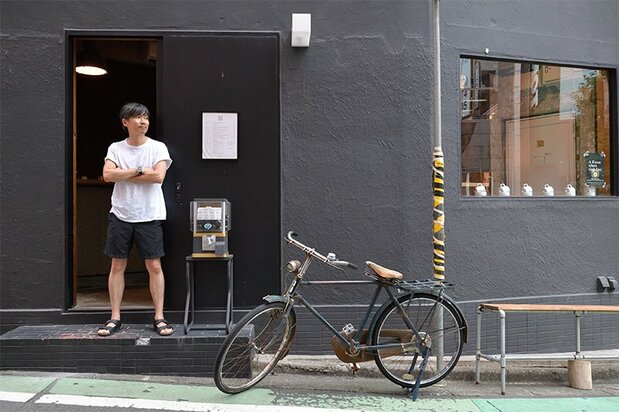
 Outside Gen Gen An.
“I haven’t given up my involvement with handcrafts,” says Maruwaka. “To me, Japanese tea is a part of that. I got interested in it because it makes an easy-to-carry souvenir or gift, something that anybody can get ahold of. When I was trying to see what kinds of green tea would be popular in Europe, I realized that a lot of different kinds of knowledge is bound up with Japanese green tea, such as culture, history, and the thoughts and feelings of the tea makers. And I felt that it might be possible to extend ties between various peoples and Japanese culture further than before by bringing people together through this knowledge.”
An event followed which changed that instinct into a certainty. While on commission to conduct a workshop on Aritayaki ceramicware for the Musée des Arts asiatiques–Guimet in Paris, the ceramics artisan introduced Maruwaka to Matsuo Shun’ichi, a tea master from Ureshino in Saga Prefecture. Matsuo was an up-and-coming genius who, less than a decade after inheriting his family’s tea field business, had won the Japanese Minister of Agriculture, Forestry, and Fisheries Prize, considered the most prestigious prize for green tea. According to Maruwaka, Matsuo was also looking to further extend the potential of Japanese tea.

“As we talked, I realized that the problems confronting traditional Japanese handcrafts were the same as those confronting Japanese tea, which is itself a traditional Japanese industry,” says Maruwaka. “Matsuo personally walks through tea fields throughout the country, drinking hundreds of kinds of green tea, conscientiously researching the relationships between environmental aspects like soil and sunlight and the flavor of the tea, and incorporating what he learns into his own tea-making. In more modern language, he is developing new products on the basis of market research. This sort of thing is a given in the corporate world, but it’s almost never seen in the realms of traditional Japanese industry, typified as it is by small-scale family businesses. On the one hand, I sensed that things couldn’t go on this way much longer. At the same time, though, I became certain that there must yet be tremendous latent potential in green tea.”
Traditional Japanese handcrafts and Japanese tea both face declining markets and the proliferation of inexpensive, low-quality products. There are fundamental structural problems, going beyond changes in preferences or diet, that have led to a situation where most Japanese can no longer tell which is the real thing: quality green tea made with traditional agricultural techniques, or tea made with additives to bring out the colors and sweetness of cheap tea leaves.
“If I’m going to do this, I want to compete on the basis of the taste of genuine green tea,” Maruwaka says. “Cultivating tea leaves as one would go about raising one’s own children, with an emphasis on natural agricultural techniques, should result in tea leaves that just naturally take on the terroir, the particular environment of the place where they are grown. Careful blending to control the aroma and astringency of each type of leaf can create green tea with a memorable taste, one that stands head-and-shoulders in individuality over what Japanese today have in mind when they think of green tea.”
Matsuo’s green tea even meets strict EU standards on use of agricultural chemicals, where many Japanese teas have failed in the past. “It really makes you wonder about the ways that much of the green tea that is sold in Japan gets made,” says Maruwaka with a grimace.







 Read in other languages