



Veteran director Ōbayashi Nobuhiko was told he had terminal cancer just before the filming of his latest film, Hanagatami, but lived to see it completed and is still thinking about his next project. In this interview, he talks about cinema and its connections with war and peace.
Child of a Militaristic Nation
“I must be a very rare case among the world’s directors in that I made my first film as a child before ever seeing one.” Ōbayashi Nobuhiko, director of the cult horror comedy House, explains that he played with an eight-millimeter camera belonging to his doctor father when he was just three years old. This was in 1941, as Japan moved toward its fateful attack on Pearl Harbor. Ōbayashi was seven when the war finished in defeat. As he talks, he continually returns to discussion of this time.
“At seven, you’re still a child, but for that reason you’re able to calmly observe the adult world. I understood perfectly the grotesque and meaningless nature of war. I’d attended the schools of a militaristic nation for two years, learning that I should fight and die splendidly for my country, but I wasn’t part of the prewar or wartime generation. At the same time, I wasn’t quite in the postwar generation either. Because of this, the Japanese adults who abruptly switched to talking of peace when the war was over were the ones I trusted the least. While I respected directors like Ozu Yasujirō, Kurosawa Akira, and Kinoshita Keisuke, I thought of the 35-millimeter film cameras they used as tools of the aggressors. So I wanted to establish myself as a filmmaker with the 8-millimeter camera, which I identified as being on the side of victims.”
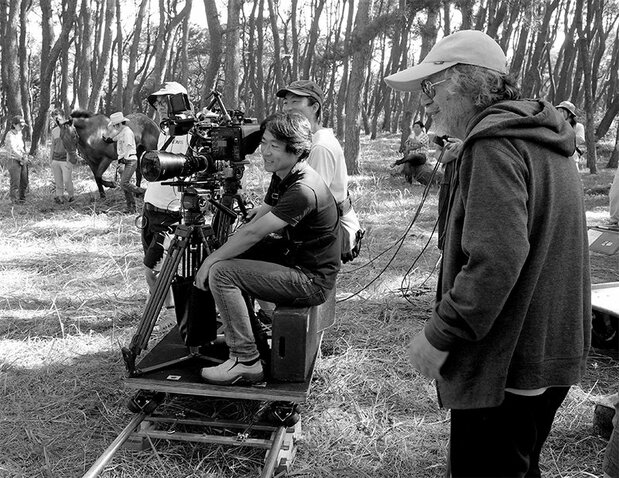
 Shooting Hanagatami. (© Ōbayashi Chigumi / PSC)
Staying Clear of “Systems”
In 1956, Ōbayashi began studying film at a Tokyo university. Although he dropped out in 1960, he continued to make 8-millimeter films, showing them in art galleries and other venues, as one of Japan’s first independent filmmakers. He won the special jury prize at Exprmntl 3, a 1963 Belgian experimental film festival, for his 16-millimeter work Tabeta hito (An Eater). His theatrical debut came with House in 1977. In the four decades since, he has made over 40 full-length films.
Before stepping up to the cinematic release of House, he made many of his own experimental films. At the same time, he was active in the television commercial production industry that thrived along with Japan’s rapid economic growth. He is said to have produced more than 2,000 commercials in a decade from the late 1960s to the late 1970s. The most famous ads featured international film stars like Charles Bronson, Sophia Loren, and Catherine Deneuve.
“You could say that I was a commercial director, but I never introduced myself like that. For me, ads were just short films. I never thought about films divided into different genres. It’s just the film business that has this system of putting fiction in one box and documentaries in another. Systems were what we hated most. They led to the war. Peace is dependent on how free people strive to be from systems. So I always think as hard as I can about how to keep a distance from them when I’m shooting a movie.”






 Read in other languages