


Hopes for Visits to South Korea and Taiwan
NOJIMAOfficially speaking the emperor’s visits to other countries are not diplomacy, but in practice they often have diplomatic significance, and the term “imperial diplomacy” is used in connection with them. What is your feeling on this matter as someone who served for many years on the front lines of Japan’s diplomacy? Also, how do the government and the imperial family reach decisions on the destinations for the emperor’s visits?
IKEDA The emperor’s visits to other countries are not directly related to political diplomacy but are directed at building friendship and goodwill on a broad basis. But for both Japan and the countries that the emperor visits, these are official events with special weight and importance.
It is up to the government to decide on the destinations, but there are cases in which the emperor himself would like to visit a particular country should the opportunity arise, and such sentiments can be conveyed to the government in a natural manner.
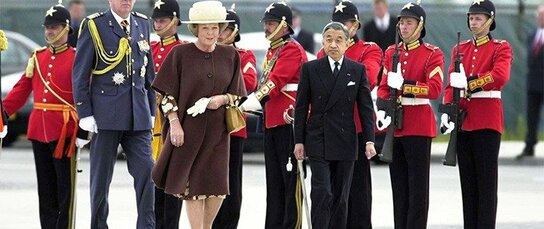
For example, before I left Japan to take up my post as ambassador to the Netherlands, I was invited to a tea party in the Imperial Palace, where I was shown a letter that the emperor had received from Queen Beatrix. She wrote in detail concerning the circumstances behind her inability to attend the funeral ceremonies for Emperor Shōwa, explaining that she had wished to be present but could not because of the strength of anti-Japanese sentiment in the Netherlands. Her own thoughts about Japan were quite clear from this letter. The fact that the emperor had me read this letter was a clear indication to me of his own interest in the Netherlands.
Of course there are various views within the government, and I believe that the basic practice in the postwar period has been for the destinations to be decided through discussions among people in the cabinet, the Ministry of Foreign Affairs, and the Imperial Household Agency.
 Photo by Takahashi Ikutomo of Nippon.com.
It seems to me that after his 2000 visit to the Netherlands, the emperor displayed eagerness to visit locations related to the prewar and wartime periods. Previously his trips had mainly been to Western countries, but after 2000 his destinations included places like the Philippines, Saipan, Palau, and Hawaii.
IKEDA The trip to the Netherlands may be seen as having marked a turning point. One can sense that the emperor harbors special feelings about some of his trips—occasions that have something in common with his visits of consolation to the areas hard hit by the March 2011 Great East Japan Earthquake. For Emperor Shōwa, who had personally experienced the period of upheaval [during the war years], it was difficult to deliver explicit expressions of repentance and consolation to the souls of the victims. It seems to me that the current emperor has a clear idea of how he should act in providing consolation.
NOJIMAThough the emperor has traveled to China and the Netherlands, completing the round of imperial visits to Japan’s major foes in World War II, there has still been no imperial visit to either South Korea or Taiwan, both of which were ruled by Japan as colonies. These are difficult destinations, each for its own reasons.
IKEDA I see South Korea and Taiwan as being in a completely separate category from other destinations for imperial visits. The new administration in South Korea has continued to be wary toward Japan. Under such conditions, there’s no telling what the reaction to a visit would be. If there were a fundamental shift in the situation on the Korean Peninsula, I believe sentiment toward Japan would also change, but circumstances are likely to remain difficult for some time to come. In Taiwan, meanwhile, I’m sure the emperor would receive a great welcome. But domestic and international conditions are complex, and reaching a conclusion will be far from easy. In any case, South Korea and Taiwan are of special significance, and though it will not be simple, I hope that opportunities for visits will emerge at some point in the future.
(Originally written in Japanese and published on July 20, 2018. Banner photo: Queen Beatrix sees Emperor Akihito off at Schiphol Airport as he concludes his visit to the Netherlands on May 26, 2000. © Jiji.)(*1) ^ These enemies were known in wartime Japan collectively as ABCD, an abbreviation for American, British, Chinese, and Dutch.
(*2) ^ “Protocol Between the Government of Japan and the Government of the Kingdom of the Netherlands Relating to Settlement of the Problem Concerning Certain Types of Private Claims of Netherlands Nationals”



 Read in other languages