



Solar Power Generation for Schools
One more demand-side innovation to be considered is the application of solar power to generate electricity for educational institutions, especially elementary and junior high schools. Now that Google is making books available in digital form and various other sources of information can be accessed over the Internet, each school no longer needs to maintain a large library. If students are provided outstanding online facilities and English instruction, they will be able to access information from anywhere in the world. Moreover, most elementary and junior high schools are used only in the daytime. Thus, when repairing the schools damaged in the March 11 disaster, a policy of aggressively introducing solar power should be introduced. It would have at least three ripple effects. First, the prices of solar panels would significantly fall because of the large-scale orders. Second, regional economic recovery would be boosted by the reactivation of public works. And third, Japan could become a valuable model for countries now engaged in economic development because they are eager to build an educational infrastructure, particularly Internet facilities.
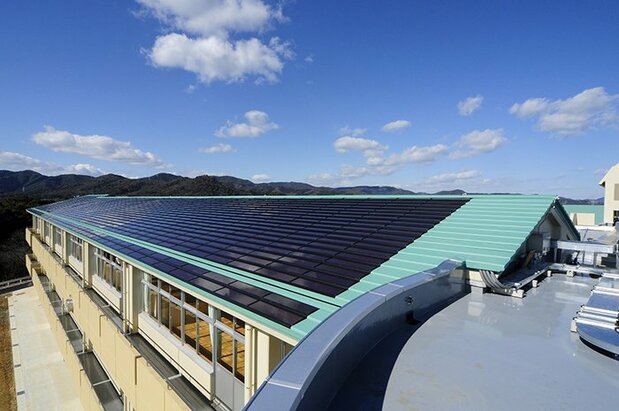

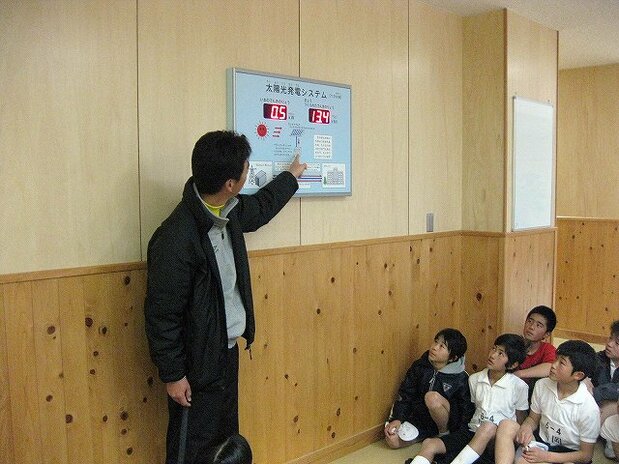
The addition of solar panels to elementary and junior high schools is one part of a government-led effort to promote “eco schools” equipped with environmentally friendly facilities. In addition to reducing the burden on the environment, this initiative involves incorporating educational materials for teaching about environmental issues. (Photo: Ministry of Education, Culture, Sports, Science, and Technology)
Eco Cities and Affirmative Action
Promoting urban planning should be seen as one of the most important elements in energy development for the nuclear-free, low-carbon society I have been discussing. For the purpose of reconstruction, I recommend that the government designate at least 10 municipalities for transformation into eco towns and smart cities. This does not need to be limited to municipalities in the badly battered areas of the Tōhoku region. If cleaning up the damage from the nuclear power accident is going to take a prolonged period of time, municipalities in other parts of Japan that have taken in Tōhoku evacuees could also be selected. As I will discuss later, highly self-reliant local governments should draw up plans and the central government should provide them with reconstruction funds to begin as soon as possible the construction of cutting-edge cities that bring together the world’s most advanced energy-saving technologies.
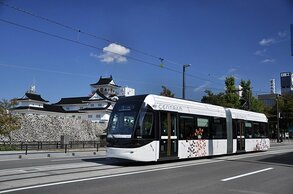 The Centram light rail system was introduced in the city of Toyama, starting in December 2009, to help create a public transportation network that is both people-friendly and environmentally considerate. (Photo: City of Toyama)
In any event, the construction of eco towns and smart cities is sure to begin before long now that a variety of tentative plans have been formulated. Here I would like to point out how a policy of “affirmative action” would be highly desirable in pursuing this construction. What I have in mind is a rule that 30% of the procurement orders made by the central and local governments should go to newly established companies, local businesses, and foreign firms. Japan has experienced revolutionary change twice in the past—first when it embarked on modernization at the time of the Meiji Restoration of 1868 and next when it engaged in reconstruction after World War II. In both cases new social strata served as the driving force and the stimulus from other countries in an open-door environment energized the transition. When the central and local governments start building eco towns and smart cities, accordingly, they should channel 10% of the funding to up-and-coming companies established within the past three years, 10% to middle-ranking small and medium-sized local businesses, and 10% to foreign firms. Such affirmative action would apply to designing and procurement, including the acquisition of construction materials, equipment and tools, and hardware and software for communication technologies.







 Read in other languages