


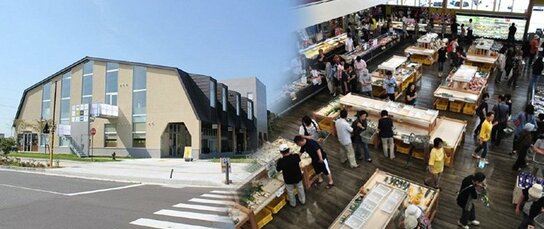
How can Japan revive its struggling local economies in the face of depopulation and severed budget constraints? Speaking from long personal and professional experience, Kinoshita Hitoshi calls for a shift from subsidy-dependent community development to a sustainable model driven by private enterprise.
As Japan’s population continues its inexorable decline, the nation’s regional communities are facing tough economic challenges. Kinoshita Hitoshi has spent more than 16 years studying and spearheading the revitalization of declining shopping districts and regional communities in Japan. Over the past few years he has become a driving force for innovative redevelopment solutions as chief executive officer of the Area Innovation Alliance, which he established in 2009 to pool the resources and know-how of community development businesses nationwide. We asked Kinoshita to present some examples of best practices based on his own experience and share his views on the essential ingredients for sustained regional revitalization.
The key for local communities going forward will be how well they can leverage their existing assets and resources and design development projects that can generate profits and guarantee a return on investment. They need to establish a circle of growth and development by implementing projects that make money and reinvesting the profits in new projects. Distributing more big grants to local governments will accomplish nothing as long as administrators keep investing them in programs that lose money, because local communities cannot sustain those programs without more and more subsidies. This is the cycle of dependence that has dominated regional development in the past. We need to shift to a positive cycle of self-sustaining growth.
So, what are these self-sustaining programs that can recover their costs and translate into long-term gains for regional communities? Here I present some examples of four tried and true approaches to revitalization and rehabilitation of regional communities, particularly central commercial districts. These are (1) neighborhood renovation and marketplace development, (2) commercially oriented development of public spaces, (3) area-wide facility management, and (4) public-private partnerships using the principal-agent model.
Neighborhood Renovation and Marketplace Developmen
The first approach centers on the cooperative redevelopment of vacant or underutilized commercial properties by local merchants, property holders, and other community stakeholders.
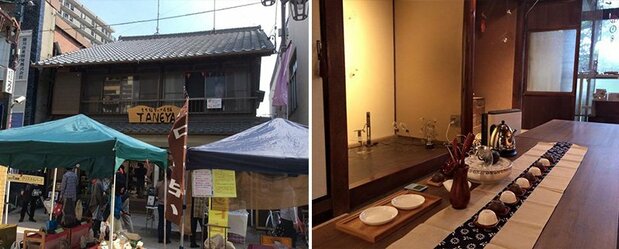
 Taneya, a shared commercial space occupying a renovated historic building in the Kachigawa district of Kasugai, Aichi Prefecture, houses Café Momotoki among other businesses.
One example is Taneya, a shared storefront in the Kachigawa district of Kasugai, Aichi Prefecture. Here five merchants, including a café, a yoga studio, and an IT business, are sharing a formerly vacant pre–World War II storefront. The investment plan called for limited renovation of the wood-frame building, with the goal of recovering the costs within two years through the rent paid by the tenants. The approach to renovation was meant both to hold down those costs and to preserve the historic ambience, which customers have found novel and refreshing. Big, shiny, new commercial developments are no longer a formula for success.
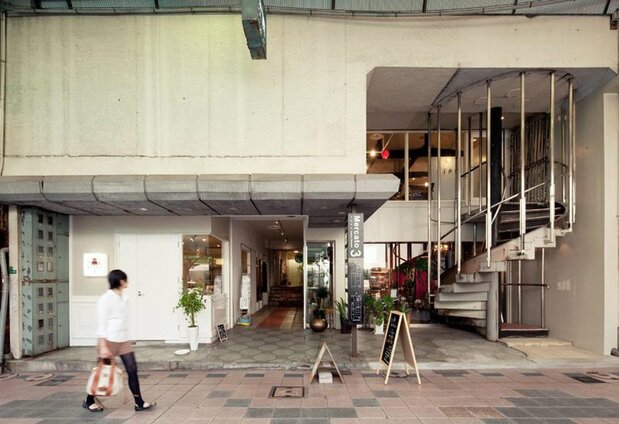 Mercato 3 in Kitakyūshū, Fukuoka Prefecture.
A similar project is Mercato 3, a redeveloped arcade near Kokura Station in Kitakyūshū, Fukuoka Prefecture. In this case, a 50-year-old building in a declining commercial district was renovated after lying vacant for about a decade, with a view to recovering the costs within four years. The space is now occupied by a diverse group of young, creative, and ambitious entrepreneurs, including restaurateurs and interior decorators, whose fresh ideas have boosted the volume of commercial traffic in the district by more than 50%.
When you look at failed commercial development projects, they almost always begin with the construction plan and then start soliciting tenants. Our basic approach is to begin by lining up a core of prospective merchants with good commercial potential, figure out what sort of customers they can attract and how much those customers will spend, and plan backwards from there, tailoring the construction budget and architectural concept to the projected revenues.
Once you gather a group of interesting merchants attracted by a certain concept, the value of the real estate will go up. That attracts more interest in the property, and the value continues to rise. In this way a piece of property that no one was using not only generates new economic activity but gains value itself as an asset, and ultimately enhances the value of the entire neighborhood.
Using existing resources is also a key to attracting private investors. Community revitalization need not be about massive construction projects involving huge infusions of taxpayer money. When you reuse existing structures, you can minimize costs and operate more efficiently. And if you keep designing and implementing projects with a high return on investment, you can attract private capital and avoid dependence on public investment. This is essential.










 Read in other languages