


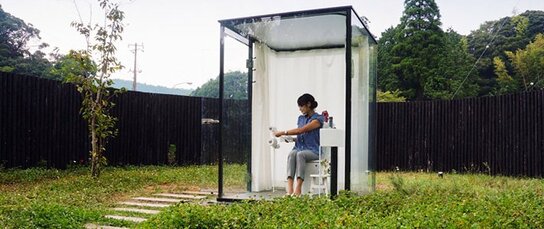
8. Japan’s Oldest Toilets
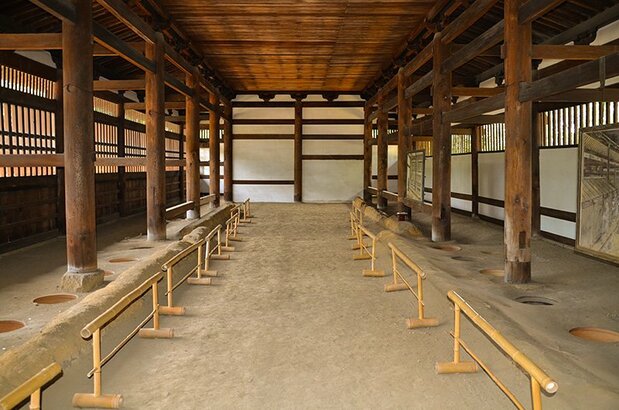
 Photo from Japanese Toilets and More.
Japan’s oldest toilets still in existence can be seen at the temple of Tōfukuji in Higashiyama, Kyoto. The room is huge, at 35 meters long and 14 meters wide, and has been designated an important cultural property. For this reason, it is only possible to look, and visitors cannot make use of the historic holes.
MARITOMO The room can be used by 100 people simultaneously. In the old days, sewage could be sold as “night soil,” or fertilizer, so it provided an important source of income for the temple. For this reason, there were many rules for use, and it’s said that for Zen priests, going to the toilet was a part of ascetic training.
9. Zen Toilets
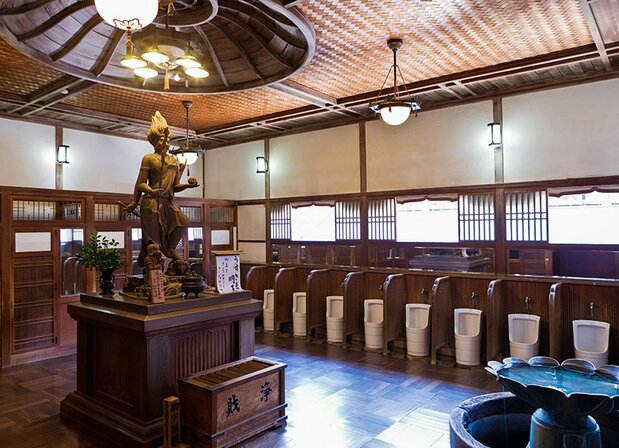 Photo from Japanese Toilets and More.
These toilets are at a Zen training hall in Fukuroi, Shizuoka Prefecture. The restroom is dedicated to Ususama Myōō, known as a toilet deity with powers of purification.
MARITOMO Unusually, this is a “mixed toilet” for use by all genders. As well as the Buddhist statue, there is a saisen-bako, or box to make offerings to the temple. In other countries, many toilets require a small payment. Making a donation in that spirit may bring you good fortune.
10. Toyota Toilet
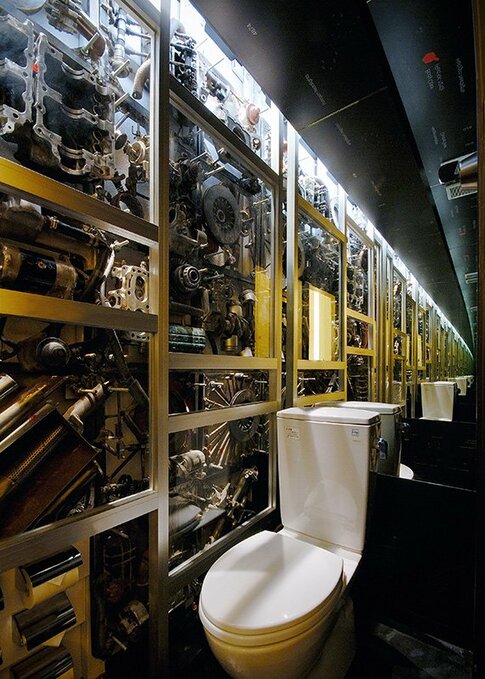 Photo from Japanese Toilets and More.
The popular ramen chain Ippūdō has been expanding overseas. The restroom at one of its Japanese branches, on Honmachi-dōri in Nagoya, Aichi Prefecture, pays tribute to Toyota, which is based in the prefecture.
MARITOMO Instead of simply lining up some automobile-related goods, it was an amazing brain wave to hack up a real engine and create a beautiful display on one wall, using the parts as objets d’art. Ippūdō cuts no corners at restrooms in its other stores too, like the one in Kurashiki, the home of Japanese jeans, which has denim wallpaper.
11. Retro Room Toilet
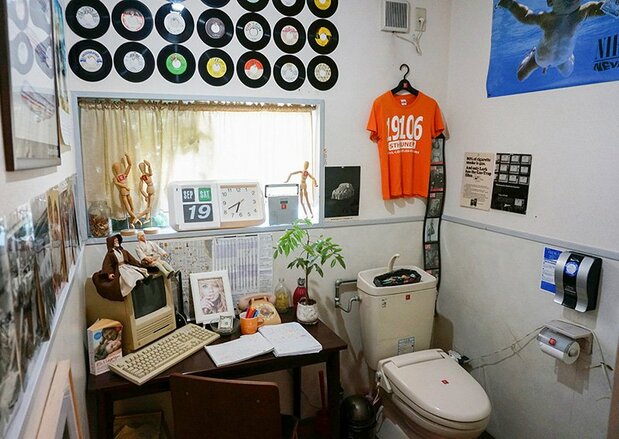 Photo courtesy of Maritomo.
This restroom is based on the playful concept of a room belonging to the character “Peter,” a 27-year-old from Seattle who is a big fan of the 1980s. It is the brainchild of the owner of Sundubu Tōfu House, a restaurant in Okayama, Okayama Prefecture.
MARITOMO The owner wanted customers not just to enjoy the food, but also to come away from the restaurant with a story to tell. With so much attention to detail, users might wonder if they’ve wandered into someone’s apartment instead of the restroom. It’s a fun approach to overturning preconceived ideas of what a toilet space is meant to be.
12. Sentō Toilets
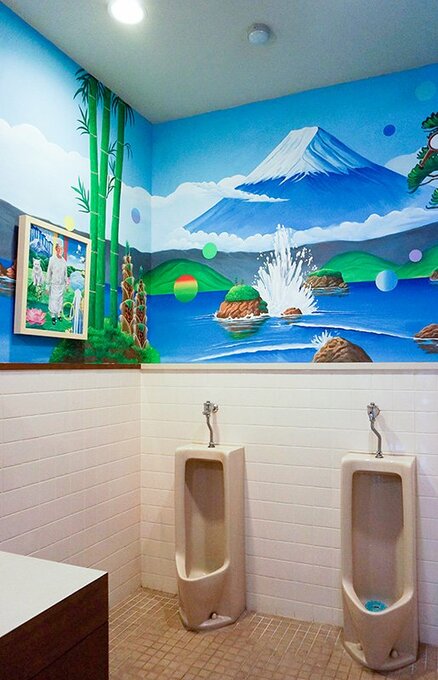 Photo courtesy of Maritomo.
This restroom has a picture of Mount Fuji, as is commonly seen in sentō, or public bathhouses. It is located at Nidaime Yoichi, a restaurant in Ōita, Ōita Prefecture, famed for its ryūkyūdon, chopped fish and green onions on a bed of hot rice.
MARITOMO This is an exhibit in the 2015 Ōita Toilennale, a festival that targeted urban revitalization through a fusion of toilets and art. You can relax as you relieve yourself, as if you’re gazing at Mount Fuji while soaking in a hot tub.
Maritomo’s book, Nippon no toire hoka (Japanese Toilets and More), is published in Japanese by Aspect and costs ¥1,000 plus tax. It includes photographs of fun and interesting restrooms around the country that she has discovered over more than a decade of toilet hunting.
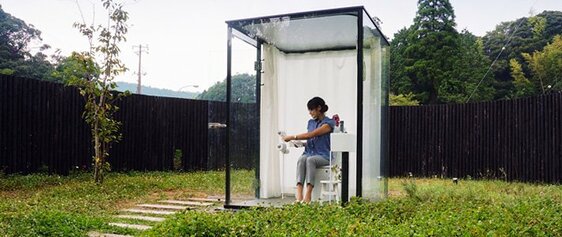
(Originally published in Japanese on January 27, 2017. Text by Nippon.com with editorial supervision and photographs by Maritomo. Banner photo: Garden Toilet.)



 Read in other languages