


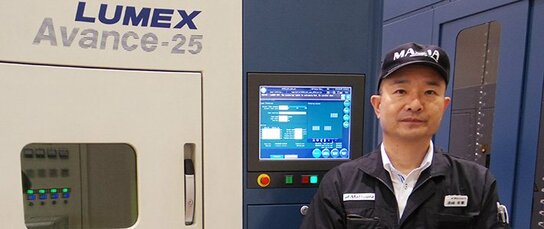
Panasonic Pioneers Lumex Use
The first to get involved in using Lumex was its co-developer, Panasonic. In mass-producing its home electronics products, the company begins by manufacturing high-precision, durable molds. Metal or plastic is then poured into these molds to produce the various parts and materials.
Making these molds and dies requires great skill and can take up to two months to complete, costing as much as tens of millions of yen. There is no room for error when it comes to producing this fundamental manufacturing technology. And each time a new product is developed, new molds are needed, which can add up to major costs.
Panasonic looked to Lumex as a way to become more competitive globally by significantly reducing costs compared with previous manufacturing methods. The plan was to first use the technology for electrical sockets and ventilation fans, later expanding to include dryers and shavers.
Lumex enables high-quality modeling with a large degree of freedom. It is suited not only to the creation of dies and molds, but also to the manufacture of the metal parts themselves. Some companies have gone beyond using it for prototypes to also employ it for the actual manufacture of parts for automobiles, smartphones, and other products. Lumex also shows promise as a means of manufacturing custom-made parts in small lots. Already it is being used in the medical sector to make artificial bone and dental implants, and demand is anticipated in the aerospace industry for the production of aircraft and aircraft-engine parts, as well as rocket components.
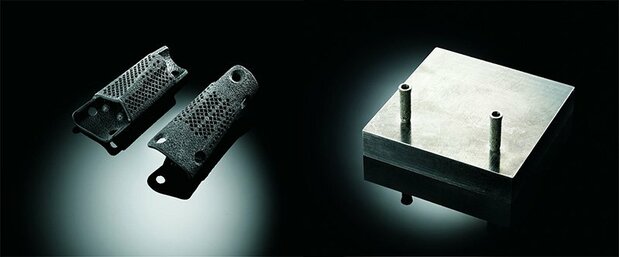
 Customized titanium bones (left) and implants (right) made using the Lumex machine. (Photographs courtesy of Matsuura Machinery.)
Mitsubishi Heavy Industries has been looking into the use of metal 3D printers as a way to manufacture parts for its new flagship launch vehicle for satellites, whose trial launch is planned for 2020. Meanwhile, General Electric and other leading makers of airplane engines are preparing to use these devices in the manufacture of engine parts.
Expanding Global Sales
Exports currently account for 70% of Matsuura’s sales. The company has sales offices in Britain, Canada, Germany, Taiwan, and the United States, along with a distribution network in 31 countries. Matsuura’s sales place it sixty-eighth globally among machine tool manufacturers (as of July 10, 2014, according to a survey conducted by Gardner Business Media).
It was a winding road that has brought Matsuura to its current position as a global corporation, with many bumps along the way. In the 1970s, in particular, the company suffered a double-blow from the so-called “dollar shock” of 1971 that was followed three years later by the “oil shock.” This combination nearly brought the company to its knees.
What saved the company was a vertical machining center (a machining device with the main spindle oriented vertically), which the company developed at that time when its back was against the wall. No one else in the world had created a vertical machine back then; all of the other centers were horizontal types. But the price of Matsuura’s new device was ¥40 million to ¥50 million, placing it out of the reach of smaller businesses.
The plan to develop the vertical machining center stemmed from the advice of Ōga Norio, president of CBS/Sony Records at the time (and later president of Sony). He told the president of Matsuura the importance of “developing products with special characteristics that no one else is developing, particularly ones that are likely to sell well in the United States.” In March 1974, Matsuura launched its first vertical machining center in Japan. Its ¥16 million price tag made it affordable for smaller firms.
The new machine benefited from an order made by the US-based machine tool trading company Methods Machine Tools. Its president at the time, Clement McIver, noticed the new vertical machining center at an exhibition in Nagoya and immediately recognized its potential. Right away, he placed an order for 10 machines, with the intention of buying more later. This was a windfall for Matsuura at a time when the company could maintain itself and its workforce by just selling five units a month. Eventually, a contract was signed to sell McIver’s company 14 machines per year. It was a historical moment for Matsuura.
In the case of its Lumex machine, Matsuura concluded an exclusive sales agreement with Mitsubishi Corporation, and North American sales began in January 2014. The first target was the American die and mold industry, with sales handled by Mitsubishi Corporation’s US subsidiary, MC Machinery Systems (MMS), which has a strong customer base in the North American die and mold industry. Matsuura decided to partner with MMS after determining that special sales knowledge and specialty applications different from those for machining centers were necessary.









 Read in other languages