


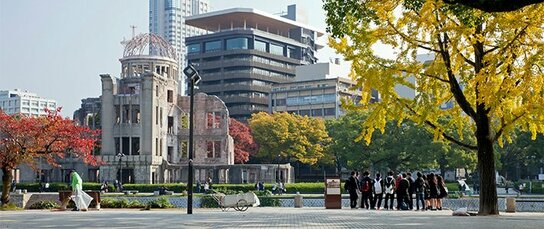
Passing on the Messages
The A-bomb successor project has been welcomed by many hibakusha, including Kasaoka Sadae. She gave a video testimony for the museum, but in her view, speaking directly to people has far greater impact.
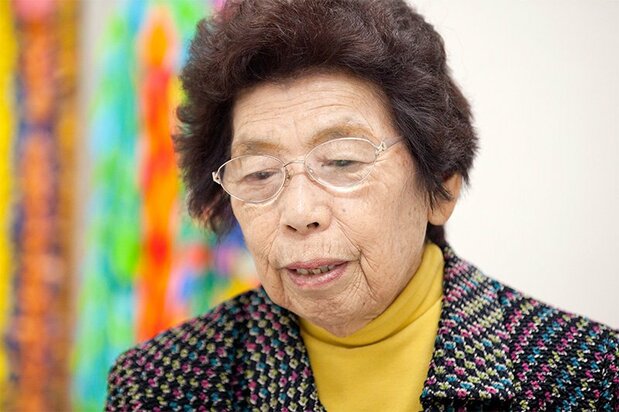
 Kasaoka Sadae, now in her eighties, still sees great value in talking about her own experience.
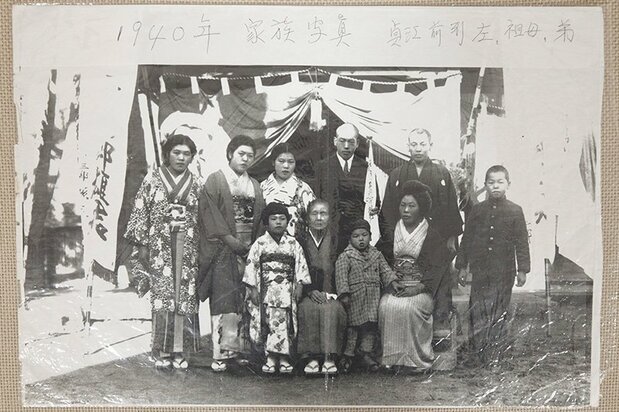 Kasaoka, front left, with her family in 1940.
“There’s no comparing the two” exclaims Kasaoka. “From the start I’ve told children to listen with their hearts. I don’t even mind if they nod off, just as long my words reverberate in their bosoms. You can’t create the same degree of connection with a video.”
To date Kasaoka has mentored six A-bomb successors. She says she carefully went over scripts they produced and demanded amendments to make sure the accounts truthfully reflected her experience. Despite the challenges, though, she was motivated by the understanding that she has limited time left to share what she remembers. Knowing that successors will keep hers and other testimonies alive for future generations gives her hope.
A Heart-to-Heart Connection
Hosomitsu Norie was among the first wave of participants to join the project. She had previously worked at an NPO campaigning to abolish nuclear weapons and had grown concerned at the indifference many youths showed toward the stories of atomic bomb survivors. She initially balked at the long training period and the weighty responsibility, but eventually overcame her apprehension, feeling that even if she could not complete the training, it was more important to do what she could to help bolster the program.
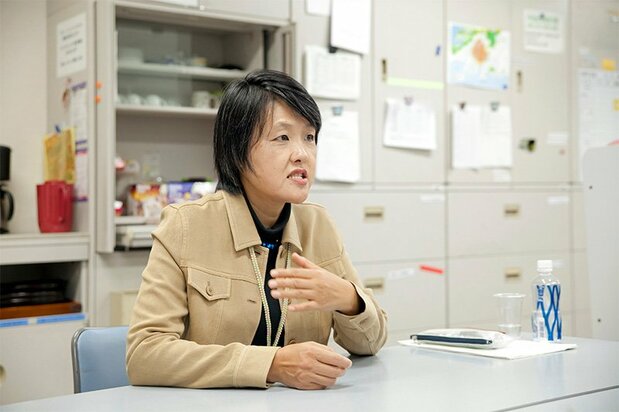 Hosomitsu Norie talks about becoming an A-Bomb successor.
Prompted by a strong sense of duty, she completed the training in the minimum number of three years while holding down a regular job. During that time, she attended testimonials given by Kasaoka and other hibakusha as many as four times a month and persistently interviewed her mentors. Her hard work paid off, and she was designated an A-bomb successor in April 2015.
Hosomitsu currently gives lectures at the museum every month and a half. She says she is confident in her presentation skills and does not do much in the way of follow-up training. “The experiences of the hibakusha are engrained in my body and soul,” she says. “Their stories flow out of me.”
Although she strives to accurately relate the experiences of her mentor hibakusha, she understands the limitations of her position as a surrogate. “I still get nervous,” she says. “Only survivors truly understand the scale of suffering wrought by the atomic bomb. The best I can do is honestly convey their stories.”
For Hosomitsu, the connection with hibakusha mentors is spiritual. “If it were just a matter of explaining the experience of a hibakusha, that could be done by reciting a script, or by showing video testimonials,” she says. “But as A-bomb successors we pass along the feelings and emotions of hibakusha. We spend hours watching and listening to our mentors until their experiences become part of us.” Smiling at Kasaoka, she adds, “Through my involvement in the program I have developed a deep affection for her not just as a hibakusha, but as a friend.”
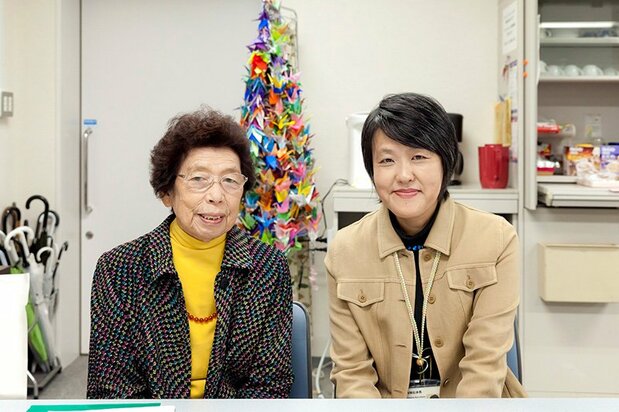 Kasaoka, left, and Hosomitsu.


 Read in other languages