


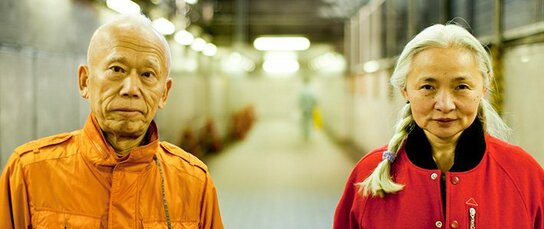
A Portrait of Artistic and Family Struggle
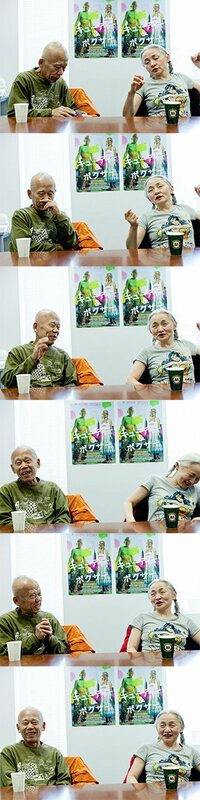

Ushio’s approach to the relationship seems to be summed up in his statement, “It’s up to the average to support people of genius.” Indeed, during the first half of Cutie and the Boxer, Noriko appears mainly as a wife, a mother, and at times an art assistant to her husband. But as the film progresses, the comics she draws, featuring a clearly autobiographical “Cutie” as the main character, become a core theme advancing the narrative.
The two agree that in filming the documentary, Heinzerling also underwent considerable change. Ushio notes: “When Zach first showed up, he was this skinny, good-looking kid—and a slowpoke when it came to his work. I had to take the lead by performing for him. I’d shout out that it was time to rub myself down with a dry towel or something. Pull off my clothes on the spot and start massaging myself for his camera.”
“An artist is an exhibitionist,” adds Noriko. You can’t get all self-conscious just because someone is filming you. And Ushio has had plenty of experience dealing with media types over the years.” However, as she notes, all of his over-the-top performances ended up on the cutting room floor. Despite the filming taking more than four years, the final product is primarily about the final year of that period. “At first Zach would come by a couple times a week, and he’d be shooting things like the dirtiest spots on our floor or in our sink. The cat’s tail. I figured we’d never get a movie out of him. You could shoot footage like that for a decade and have nothing to show for it.”
Heinzerling was just 24 years old when he began working with the Shinoharas. Over the course of nearly five years, he built up a relationship of trust with his subjects as he developed his own skill for spinning the tale of their relationship.
Noriko explains the director’s growth. “Eventually, he became almost like a piece of furniture in our house—something we paid no attention to whatsoever. Zach likes to say that it took time for me to open my heart to his observation, but from my perspective, it also took him time to develop as an observer.”
Ushio agrees. “That guy matured during the time he spent with Noriko and me. He was just a regular kid. Grew up eating good food in a regular home. So at first he had the most ridiculous questions for us. ‘Are you two not in love with one another?’ or ‘Could I film you having a couple’s spat?’ or the like. I wondered what the hell he thought he was doing.”


“There’s no way he could film us fighting if he wasn’t living right there with us,” adds Noriko. She had her own suggestions for the documentary: the scene where she and Ushio put on boxing gloves soaked in paint and flail away at each other and the animated scene using her pictures of Cutie. But she remains unsatisfied with the final cut of the film, though: “Our real life has been much more wretched than you can see in this movie. I mean really, we have no idea what’s going to happen to us next. Our immediate future is like a black void!”
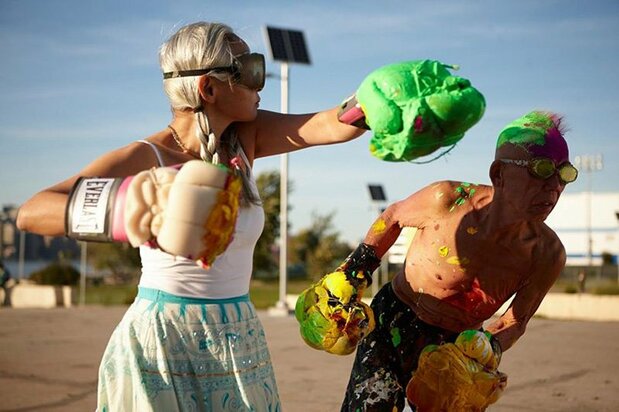 The action scene from Cutie and the Boxer. © Ex Lion Tamer, Inc. All rights reserved.
“So what?” objects Ushio. “It’s still the kind of movie that leaves people in tears! We toured America giving preview showings of it, and every single time we walked into a theater after the credits rolled, we’d get a standing, weeping ovation. I was shocked to see this power that movies have to attack people right in their heartstrings! It’s something that pictures don’t have.”
Things have changed for Ushio since the film came out, with people calling his name when they see him on the street. “I’m a celebrity now, so I’d better start acting like a proper star. If this helps me sell a bunch of pictures, well then, that’s going to be great!”
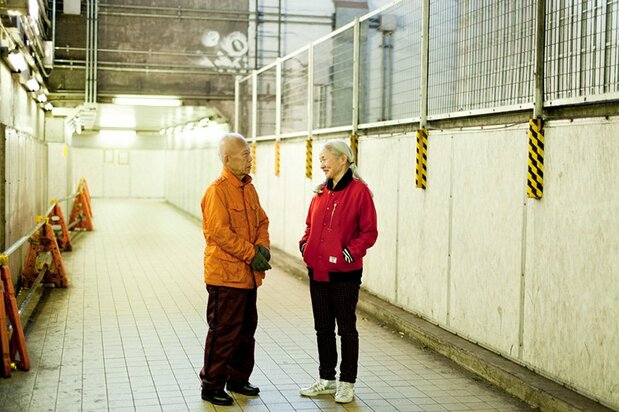
The path an artist takes may seem like a pleasant one, but the Shinoharas show that it can literally require putting your life on the line. They have not chosen to seek cheap recognition through ostentatious self-exposure or by catering to the whims of the art market. They clearly value above all else the thrill that comes from the act of creation itself. A successful film is now sharing their lives with audiences around the world, but it seems unlikely that this gift from that demon known as art will deter Cutie and her Boxer from pursuing the love and conflict that have driven those lives so far.
(Originally written in Japanese by Fukasawa Keita based on a December 15, 2013, interview. Interview photos by Igarashi Kazuharu.)
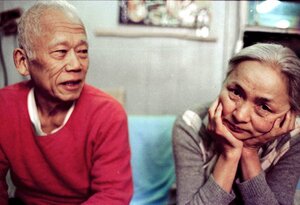 • Cutie and the Boxer is playing in select theaters in Japan. For details, see the website (in Japanese): www.cutieandboxer.com
• Courtesy King Records and Parco.
• Distribution by Zazie Films and Parco.
© 2013 Ex Lion Tamer, Inc. All rights reserved.




 Read in other languages