


The Cabaret Years
INTERVIEWER You’ve been through some hard times as an artist.
NATSUKI Looking back, the hardest thing for me was that I was a bad singer. Sure, I have two or three hit songs under my belt. If I had talent, though, I think the hits would have continued and I would have become a singer who could fill concert halls. My songs, my voice—they just didn’t have the magic. So I ended up singing in cabarets for about eight years. There were many rough moments, like people shouting abuse at me and other unnerving experiences, but those were things I could get around. It was my lack of singing skills that I found most distressing.
At one point I resolved to stay in this line of work through my twenties, even if my career didn’t take off. When I heard my thirty-year-old voice I told my agency that I was done, and then later I was invited to go into theater.
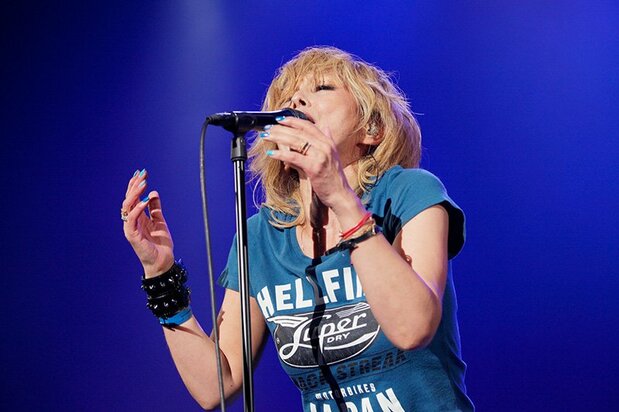
 Natsuki Mari at the One of Love Project Gig concert. (Photograph by Ryūgo Saitō.)
INTERVIEWER That was in the 1980s.
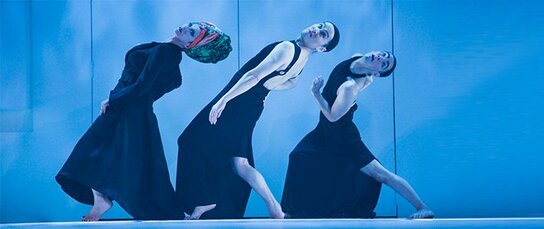
NATSUKI Yes. I finally found what I wanted to do in my forties, and that was the Impressionist. My entire career until then had been like a prologue. In theater, it was nice that I progressed from small-theater productions to musicals, and working with stage directors Ninagawa Yukio and Suzuki Tadashi also helped set my acting career on a smooth trajectory. I’ve been fortunate. There now are three main aspects to my work— the Impressionist, singing, and One of Love Project—and it would be ideal if I could make a living and a business out of the three.
Discovering Voice Acting
INTERVIEWER You did the voice of the witch Yubāba in Miyazaki Hayao’s Sen to Chihiro no kamikakushi (Spirited Away).
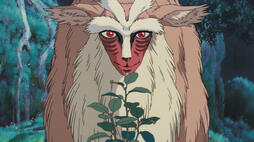
NATSUKI In 1990, I went to New York for six months, where I learned how to market myself. I had sent a video of my Impressionist shows to Studio Ghibli, asking them to take a look. I think it was producer Suzuki Toshio who saw it and contacted me. After hearing my voice director Miyazaki Hayao created the characters Yubāba and her twin sister Zenība for me, and that’s how I got cast.
Until then I had never seen anime, let alone Ghibli films. Having no idea how incredible it was to be in a film by Miyazaki Hayao, I did it as just another job. But then everyone was amazed that I had voice acted in a Ghibli film. So I went to see Spirited Away in a movie theater, and it was good. The film even won an Oscar, and I’m glad I did it. So that’s the story.
INTERVIEWER Delivering with your voice must require considerable expressiveness.
NATSUKI I’ve come to enjoy voice work since doing Spirited Away, because with voice acting you can’t create a strong presence unless you make full use of pitch, intensity, and tempo—the basic elements of acting—and channel all of that into your character. At the risk of being misunderstood, I might say it’s about technique. I’ve learned a lot from voice work, and I enjoy narrating even now.
INTERVIEWER You’re also an advisor to the Tokyo Organizing Committee of the Olympic and Paralympic Games.
NATSUKI I’m guessing that former Prime Minister Mori Yoshirō [president of the Organizing Committee] thought of me because he remembered that I won the Minister of Education’s Art Encouragement Prize for New Artists when he was education minister.
Coming from the entertainment industry, my first thought regarding the Olympics has to do with the opening ceremony. The athletes have beautifully honed bodies, and I’ve always wondered why they have to wear uniforms that make them look so unshapely at the opening ceremony. We should have the uniforms made by talented young Japanese individuals who are active abroad, leave it in the hands of a promising designer, or something like that.
“I Always Think of Myself as a Rookie”
INTERVIEWER Your stage performances these days are very energetic and have a strong following among young women. How do you keep up all that energy?
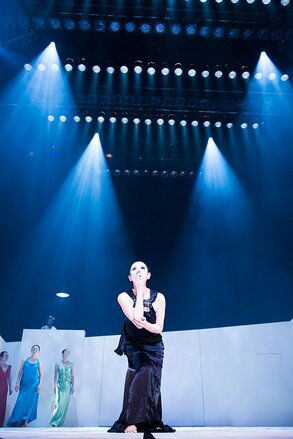 The Impressionist NÉO Vol. 2: Cinderella. (Photograph by Hiro Kimura.)
NATSUKI At my roots, I see myself as being untalented. That’s what prompted me to start my own Impressionist show in 1993—as an “escape from despair”—and I’ve continued to work on the series since then. I always think of myself as a rookie and do whatever piques my interest. I don’t stick to a single field. Instead, I discover more aspects of myself by taking different approaches, and that may be why I appear energetic.
INTERVIEWER You take on new challenges all round.
NATSUKI Yes. I sing, I act, I create—and I’ve spent the last four decades discovering myself through all of that.
INTERVIEWER Today you’ve come to exude a strong presence and confidence.
NATSUKI I probably come across as doing what I like. It isn’t easy maintaining a coherent image of who Natsuki Mari is content-wise—I keep coming up with new ideas, so I’m all over the place, and everything that I do ends up being a bit half-baked. At some point, I sold myself on the idea that the only way for me was to capitalize on my strength as an all-rounder.




 Read in other languages