


Remembering History’s Personae Non Gratae
Central to Gluck’s film is the plight of history’s personae non gratae, most notably the Jews during World War II. Not coincidentally, such experiences and memories are an integral part of Gluck’s own family history.
“When my father was 17, he lied about his age and joined the navy because he wanted to fight the Nazis. My mother was interned at the Rohwer War Relocation Center in Arkansas along with others of Japanese ancestry. All those wartime stories I heard from my father and mother are part of my internal database.” According to Gluck, this background allowed him to supply context and help his actors give a convincing performance.
Gluck was also mindful of something his mother told him when he was in high school, which he never forgot: “The misfortunes in our lives can lead to good fortune.” As she explained, the experience of relocation and internment as a Japanese American was a bitter one, but many young nisei were able to leave the camps by joining the military, working on nearby farms, or going to Eastern and Midwestern colleges. In fact, a considerable number were placed in such colleges with the help and financial support of the US government—on the condition, of course, that they swear allegiance to the United States. Gluck’s mother, who had been a typist before her internment, ended up studying dress design at Hunter College in New York, and it was in New York that she met her future husband, Gluck’s father. “If they hadn’t met, I wouldn’t have been born.”
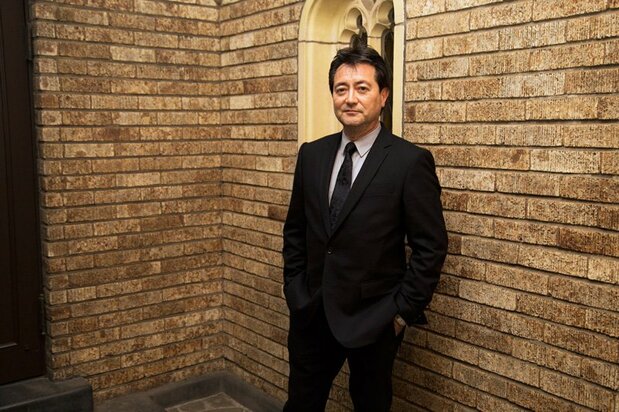
 Cellin Gluck felt a strong personal connection with the story and historical setting of Persona Non Grata owing to the wartime experience of his Jewish and Japanese American parents and his own experience growing up a foreigner in Japan.
Cellin Gluck’s father was a Japanophile and archeologist specializing in ancient Persia. Cellin was born in Wakayama Prefecture and spent most of his youth in Hiroshima and Kobe, although the family also lived in Iran at one point. Although raised in Japan and fluent in Japanese, Gluck was regarded as a gaijin (foreigner) and he identified strongly as an American. Before he traveled to the United States as a college student, he never thought of himself as an Asian American. He was actually taken aback when someone invited him to join the university’s Asian American student organization.
In the past, Gluck liked to think of himself as a “third culture kid”—a term used to refer to people who spent formative years outside of their parents’ native country and are able to bridge the gap between the two cultures. “Nowadays,” he says, “I prefer to think of myself and similar offspring as ‘multicultural kids’ or ‘global kids.’”
In addition to the focus on Sugihara’s own actions, Persona Non Grata includes a historically based depiction of the liberation of concentration camp survivors from one of the Dachau sub-camps by the all-nisei 522nd Field Artillery Battalion. The 522nd was an offshoot of the 442nd Regimental Combat Team, a fighting unit composed almost entirely of soldiers of Japanese ancestry, many of whom had previously been relocated to internment camps as enemy aliens. The 442nd Regiment was renowned for its valor. It was the most decorated unit for its size and length of service in the history of American warfare, and its casualty rate was also among the highest.
Gluck put his heart and soul into the scene in which Japanese American soldiers rescue a young Jewish concentration camp survivor, an episode fraught with personal significance. For movie-goers, even a passing knowledge of the director’s unique family background should lend added emotional impact to the scene and to the film in its entirety.
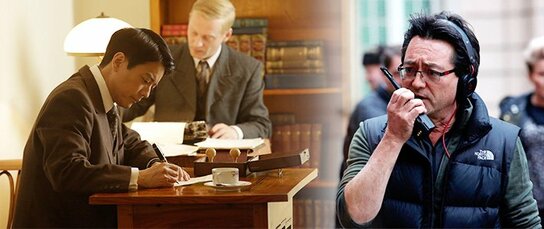
(Translated from an interview by Harano Jōji, representative director of the Nippon Communications Foundation, on November 24, 2015. Banner photos: A scene from Sugihara Chiune [Persona Non Grata]; director Cellin Gluck on location in Poland. Photos courtesy of Sugihara Chiune Production Committee.)


 Read in other languages