


Why Do We Fall in Love?
INTERVIEWER Your Name puts more emphasis on entertainment than your previous works. Was it a very different production environment from what you were used to?
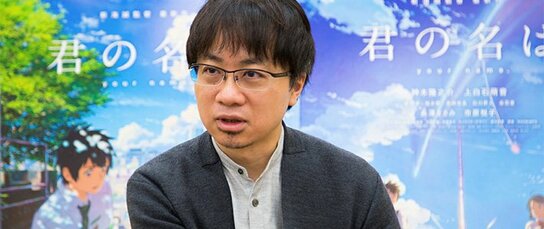
SHINKAI I produced my debut work, Voices of a Distant Star, entirely on my own. For all my other works since that, I’d been working in my own studio with my own small staff. With Your Name, however, more people were involved than ever before, and some had plenty of star power of their own. It was my first experience working with, for instance, a popular band like Radwimps, in a way that was very close to being a collaboration.
Our team of animators was also first class. I think any fan of Japanese anime will be stunned when they see the credits. Our character designer, Tanaka Masayoshi, works mainly in TV anime, and has a solid fan base of his own. Our animation director, Andō Masashi, is one of the great figures in the anime world. At Studio Ghibli he was supervising animator for both Princess Mononoke and Spirited Away. Other people with different roots were good enough to join in as well, people from animation companies like Production I.G. and Shaft.
INTERVIEWER One thing all of your works have in common, from the very first up through Your Name, is the way in which—at the same time that they’re depicting the painful longings and separation between people—they are imbued with an almost cosmic breadth.
SHINKAI The nature of relationships between individuals, the relationship of feelings, was the single biggest theme of my adolescence. Why do we fall in love with someone? Why doesn’t that person we love love us back? They were these totally commonplace concerns, but to my adolescent self they were a vast mystery, like the mystery of the very cosmos itself.
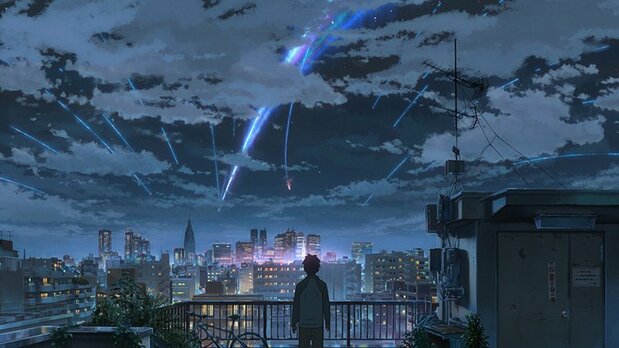
 Taki watching the flight of a comet over Tokyo. (C) 2016 Your Name Film Partners
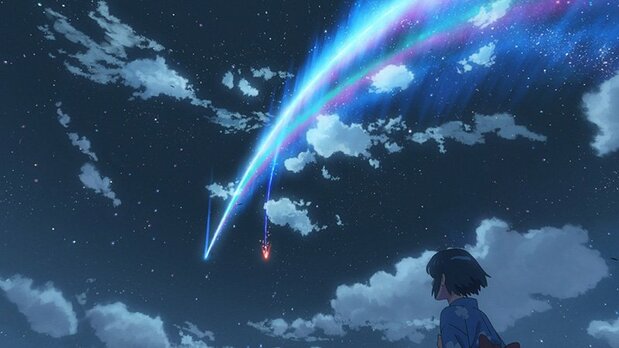 The comet splits apart before Mitsuha’s eyes on festival night. © 2016 Your Name Film Partners
Even today, when I’m married and have a child of my own, there are still moments when I suddenly feel that same bewilderment I felt when I was an adolescent. I think that this distance, this gap between people’s feelings, is something I will keep on depicting as one of my themes in the future.
And one more thing. Back in my youth I used to muse about why I was born, and what was the one role that only I could play. I wanted to feel that my own life was not just emptiness, that—even if it was only for an instant in the great current of time—my life was connected to a greater destiny. I don’t believe in any specific religion, but that feeling may be a sensation close to believing in a god. So given all that, I do have a desire to write stories that can bind together that tiny scale of one individual’s feelings and the vast scale of the cosmos and the stars.
INTERVIEWER You’ve also written some novels. Do you want to put your energy into writing more fiction in the future?
SHINKAI At this point in time I’m just writing novelizations of my own movies, and I’ve never once thought that I have any intrinsic value as a novelist. I think people have been good enough to read my books just because I made the anime. But I do like to read and write fiction. In fact, I spend more time reading fiction than I do watching films or anime. So I do want to someday write a novel for its own sake. But I also have a stronger feeling that I have to create works that my audience truly wants. Maybe what I am needed for, right here and now, really is animation after all.
(Originally published in Japanese on December 5, 2016. Interview and text by Itakura Kimie and Katō Megumi of Nippon.com. Photos by Ōtani Kiyohide.)


 Read in other languages