


The End of the Corridor
Ōbayashi says he recently remembered a haiku by Watanabe Hakusen (1913–69), who evaded the eyes of wartime authorities while continuing his poetic activities.
戦争が廊下の奥に立つてゐたSensō ga / rōka no oku ni / tatteitaWar was
standing at the
end of the corridor
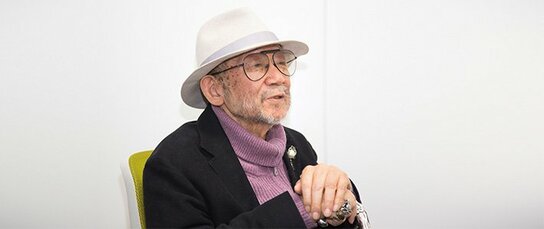
“Young people today have this sense that conflict is coming. Ask them and they will clearly say, ‘We are the children before the war.’ I might say that the film Hanagatami connects the forgotten postwar and the era of the coming war. Talking about past wars acts to create future peace. As we’re the last generation to remember the war, we have a duty to convey what it was like.”
Apparently the film has struck a chord with young viewers. “It seems to have an urgency for them, so they can’t think of it as being someone else’s business. Today’s world is increasingly convenient, comfortable, and efficient. But I’d say that half the time these changes have made humanity unhappy rather than happy. Things that make life more convenient are also easily used for bad purposes.
“In an advanced information age, people no longer take responsibility for information. Knowing or not knowing is all that’s important. People tend to value both essential and irrelevant information equally, and a result is that all kinds of information seem like they have nothing to do with the person receiving them. But when we present information as someone’s experience within a film, it gains the power to make people think. I make films to convey experiences that can’t be understood through information alone, putting viewers within a story and making them feel for themselves the horrors of war.”
On to the Next Project
Hanagatami is an excellent film. Ōbayashi’s innovative direction applies abundant digital effects in what is a kind of compilation of the director’s themes. Viewers feel the power of the characters’ desperate fight in the energy that pours from the screen. But the director does not consider his job done. He is coolly considering his next project.
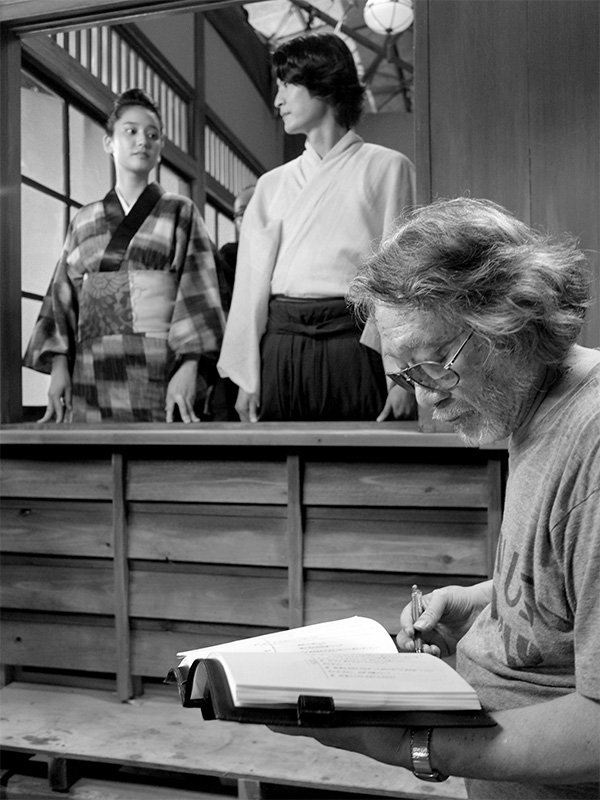
 Ōbayashi Nobuhiko with script in hand on the set of Hanagatami. In the background are Yamazaki Hirona (left) and Kubozuka Shunsuke. (© Ōbayashi Chigumi / PSC)
“I’ve lived as long as I have thanks to chemotherapy, which has extended my existence beyond my own ability to survive. With today’s medicine, it’s hard to die even of something like cancer. It depends how effective the medicine is, but they say it works better with optimists and people who live happily without worrying. It’s the same power of ’truth from falsehood‘ that you get with film.
“The possibility of a ’happy ending‘ has given me the courage to live. Even after I received my diagnosis, when I went to the film set, I felt well again. And I’ve lived on for seventeen months since then so I could finish making the movie. Now I think I’m ready to come to grips with the atomic bomb—that question with still no global solution that the film directors who came before me were unable to tackle.”
(Originally published in Japanese on January 29, 2018. Based on a December 18, 2017, interview at the studios of Niconico Live. With thanks to Dwango for cooperation. Photographs courtesy Ōbayashi Nobuhiko’s agency PSC. Reporting and text by Matsumoto Takuya of Nippon.com.)
Hanagatami
Released in Japan in December 2017. View the Japanese-language trailer below.
(© 2017 Karatsu Film Project / PSC)





 Read in other languages