


The Meiji Restoration and a New Connection with Shintō
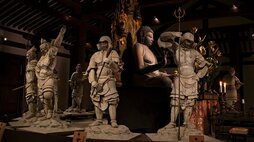
The syncretism that defined Buddhism and Shintō in Japan for centuries was lost forever with the shinbutsu-bunri movement to separate the two traditions following the Meiji Restoration and the wave of anti-Buddhist destruction that followed (haibutsu-kishaku). In the days when the imperial court was still based in Kyoto, there was a Buddhist altar called the O-kurodo (Black Door) inside the Imperial Palace. As part of the movement to divide Buddhism and Shintō into separate spheres, this was relocated shortly after the Meiji Restoration to the Sennyūji Buddhist temple in Kyoto, which had served as a funerary temple to the imperial household for many centuries.
The Meiji Restoration fundamentally changed the relationship between the emperor and the two religious traditions of Shintō and Buddhism. In the early years following the Restoration, the new regime looked to establish a system of government in which the emperor would exercise real sovereignty himself. The government took steps to establish a modern nation state with Shintō as one of its defining axes. As part of these changes, Buddhism was swept away from its traditional role within the imperial household. Prince Yamashina Akira was a Meiji-era head of a cadet branch (shinnō) of the imperial family who had formerly been prince-abbot of a Buddhist temple traditionally associated with the imperial family. He personally expressed his wishes for a Buddhist funeral, but the Meiji government refused to allow this.
By contrast, the imperial household’s relationship with Shintō became closer than ever. In 1870, the new emperor, then 16, became the first emperor in history to visit Ise Shrine, considered the most important Shintō shrine in the country. It is not clear why no emperor had visited the shrine before, but this first visit served to deepen the burgeoning association between the imperial household and Shintō. As part of preparations for the visit, 195 Buddhist temples along the route were destroyed.
What Emperor Meiji himself made of all this is impossible to know. He was still young, and may not have held any strong opinions about religion. But one thing is certain: the nativist scholars and reformers who wanted to reposition Shintō as one of the central axes of a new Japanese state successfully squeezed out Buddhism from its traditional place at the heart of the imperial family.
The Meiji government also took steps to deal with Shintō outside the framework of religion. Although a Bureau of Shrines and Temples (shajikyoku) was initially established inside the Home Ministry, this was later divided into a bureau for Shintō shrines and a bureau of religion. From an early stage, Shintō was treated differently from religions like Buddhism and Christianity.
By this time, the 1889 Constitution of the Empire of Japan had already acknowledged freedom of religion. One of the reasons for separating Shintō from other religions and treating it as something set apart from a religious framework in this way was to allow the government to make it compulsory for the entire population to take part in Shintō rituals as part of its program of national ethics (kokumin dōtoku).
The emperor would perform a role akin to that of chief priest, performing rites at the three court shrines in honor of the ancestral deities, the spirits of emperors past, and the myriad deities of the heavens and earth. The people, at the same time as praying to the gods, would also worship the emperor who was their chief priest and representative. This was the system established during the Meiji era.
The Emperor as Symbol
The present emperor is apparently quite enthusiastic about performing the court ceremonies and rituals. This was something that emerged during the recent debate about his wish to abdicate, when some of the experts consulted said that so long as the emperor performs these rituals, there is no need for him to perform any other duties.
But the truth is that since the start of the modern age, emperors have been expected to do much more than perform a ceremonial, quasi-religious role of this kind. With the exception of Emperor Taishō, who was unable to carry out his full duties because of illness, the other modern emperors have all traveled widely on numerous official tours. In the years after World War II, Emperor Shōwa (Hirohito) became the first emperor to interact with ordinary citizens. Emperor Akihito has made numerous journeys to areas affected by natural disasters and to World War II battlegrounds.
Under the Meiji Constitution, emperors also had to exercise imperial sovereign power (tennō taiken). Although no longer required (or allowed) to play this role, under the postwar Constitution emperors have continued to perform a function at various state occasions. The role expected of the emperor is a heavy one, which involves much more than mere religious ritual in the privacy of the palace.
Under the current Constitution, the emperor is regarded as the symbol of the state and the unity of the people. But the constitution does not define precisely what is intended by the term “symbol.”
In his message to the people concerning his wish to abdicate, the emperor said: “I have spent my days searching for and contemplating on what is the desirable role of the Emperor, who is designated to be the symbol of the State by the Constitution of Japan.”
Since the Constitution contains no clear guidance on what it means for the emperor to be a “symbol of the state,” in other words, it has been left to the emperor himself to figure it out for himself. In his televised message, he said that: “I have felt that my travels to various places throughout Japan, in particular, to remote places and islands, are important acts of the Emperor as the symbol of the State.”
When I heard the emperor’s message, it occurred to me that the actions he had come to see as important aspects of his role as symbol had a lot in common with bodhisattva practice (bosatsu-gyō) or altruistic acts for the benefit of others in Buddhism. This refers to actions taken to save others even at the cost of sacrificing oneself.
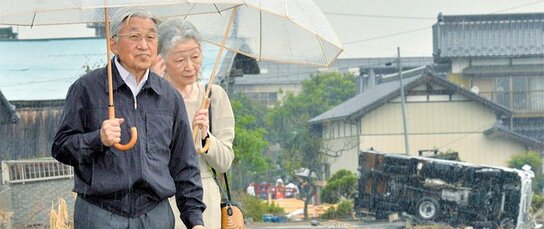
Together with the empress, the emperor has been among the first to visit disaster areas, often while the areas remain in a state of danger, and has also visited former battlegrounds where local populations do not always have positive feelings about the Japanese emperor. On one occasion when Akihito was crown prince, an angry demonstrator lobbed a Molotov cocktail at the imperial cortege. The fact that he has continued such an itinerary well into old age suggests that he and the empress have been fortified and supported by a strong sense of faith.
The idea of self-sacrifice for the salvation of others does not exist in the world of Shintō. Buddhism, by contrast, has espoused this teaching from the earliest stages of its history. Of special importance in Japanese Buddhism is the Lotus Sutra, one of whose lines refers to “not begrudging one’s bodily life” in the striving for salvation for all. One should be prepared to give up one’s body and life for the sake of others.
Today, the emperor has no power to influence national government policy. But he needs something to help support his actions as the symbol of the state. This is the role that faith can play. Perhaps it is only natural that he has looked for support to the Buddhist faith with which previous emperors had such a deep relationship for many generations.
(Originally published in Japanese on February 28, 2018. Banner photo: Emperor Akihito and Empress Michiko at Jōsō, Ibaraki Prefecture, on October 1, 2015, close to the point where the Kinugawa river burst its banks, causing serious flooding in the Kantō and Tōhoku regions. © Jiji.)

 Read in other languages