


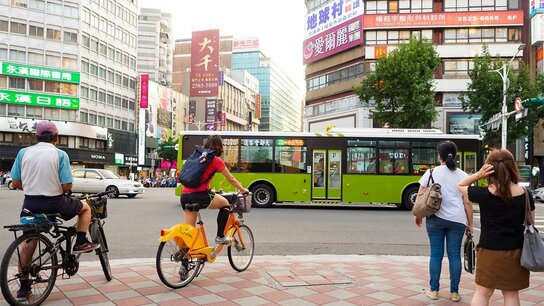
Living with Two Identities in Taiwan
Let me share some of the startling experiences I have had while living in Taiwan.
When people in Taiwan refer to me as “Japanese,” it gives me an awkward sense of discomfort. The same happens when people in Japan call me “Taiwanese.”
One time I attended a meal at the invitation of a Taiwanese acquaintance, who was hosting the event. I did not know any of the other guests, and a friend of my acquaintance went around introducing me to them as “a Japanese who can speak Chinese.” I had said that I was half Taiwanese, but it seemed that the message had not quite gotten through.
On another occasion I was answering questions about the Taiwanese living in Japan, and the person I was talking to asked me, “Why do you think about Taiwan, even though you were born and grew up in Japan? Shouldn’t you be thinking about Japan?” It may not have been a deeply considered question. But Taiwan is where my father was born and raised, and I cannot avoid caring about it. In fact, I care about it even to an excessive degree: I often talk about “going back” there and refer to myself as a “Taiwanese born in Japan.” This is quite baffling to people who have lived in Taiwan their whole lives.
When in Japan, I pick up the Japanese news without conscious effort, and I breathe the Japanese atmosphere. But in order to find out about Taiwan I have needed to go there from Japan and actively look for information.
Though I may not be expressing it well, I think of myself as being neither a “perfect Japanese” nor a “perfect Taiwanese.” I realize that nobody is a perfect specimen of any nationality or ethnicity and that the notion of “normal” Japanese, Taiwanese, or whatever is an illusion. And I still feel troubled at times about my own identity. I believe that I am whole as the sum of my two parts. So I was shocked to be asked, “Why do you think about Taiwan?” This question surprised and perplexed me.
Still, this and the other dissonant encounters I have cited all occurred when I was introducing myself or speaking to somebody for the first time. Once the initial stage is over, I make friends with people, and they all listen intently to what I say in my accented Chinese. And I consider all these encounters to be valuable experiences made possible by my first long-term stay in Taiwan. I intend to work on my Chinese pronunciation and see how far I can get in overcoming the accent that Taiwanese hear.
(Originally written in Japanese and published on March 10, 2019. Banner photo © Carlos/Pixta.)






 Read in other languages