


Tokyo, Oct. 20 (Jiji Press)--The Japan Aerospace Exploration Agency, or JAXA, successfully launched an H3 rocket carrying the Martian Moons eXploration, or MMX, probe on Tuesday.
The No. 10 H3 rocket lifted off from the Tanegashima Space Center in Kagoshima Prefecture, southwestern Japan, at 4:41 a.m. About 1 hour and 11 minutes later, the rocket successfully placed the MMX into its planned orbit, completing a successful launch. Following three consecutive successful launches, the H3 rocket's success rate has risen to 80 pct.
The MMX is slated to collect sand samples from Phobos after landing on the Martian moon, and return to Earth in 2031. If successful, it would be the world's first sample return mission from a Martian moon and the first round-trip voyage to the Martian system. Expectations are high that the MMX mission will provide insights into the origins of Mars and its moons, as well as the origin of life on Earth.
"We have confirmed that the probe is in a stable condition," Yasuhiro Kawakatsu, professor at JAXA's Institute of Space and Astronautical Science and the leader of the MMX mission, said at a press conference after the launch. "I would like to thank everyone who has supported the project and all those involved in the rocket launch."
Makoto Arita, manager of JAXA's H3 project team, said, "I am delighted that we were able to open the first chapter of the historic MMX mission with the H3 rocket."
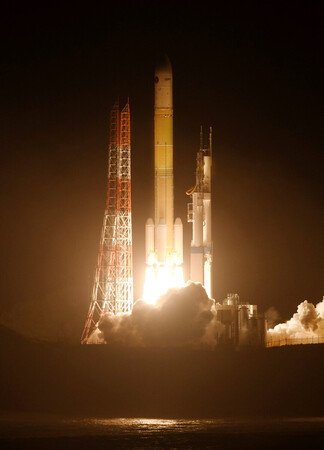
 The No. 10 H3 rocket carrying the Martian Moons eXploration, or MMX, probe lifts off from the Tanegashima Space Center in Kagoshima Prefecture early Tuesday.
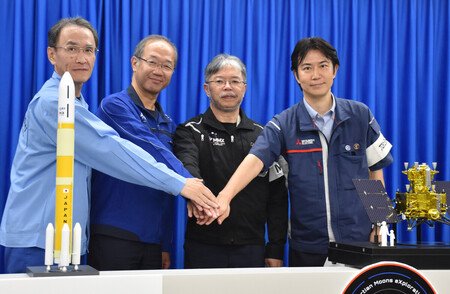 Makoto Arita, manager of JAXA's H3 project team (second from left), and Yasuhiro Kawakatsu, professor at JAXA's Institute of Space and Astronautical Science who leads the MMX mission (third from left), pose for a photo after a press conference at the Tanegashima Space Center in Kagoshima Prefecture on Tuesday morning.
[Copyright The Jiji Press, Ltd.]








 Read in other languages