Fugu: Japan’s Seafood Delicacy with a Dangerous Reputation
Food and Drink Culture History Lifestyle- English
- 日本語
- 简体字
- 繁體字
- Français
- Español
- العربية
- Русский
A Treasured Fish with a Taste of Danger
Winter is the best time of year to enjoy the fruit of the sea. Pacific bluefin tuna (kuro-maguro), Japan’s most popular red-fleshed fish, is in season, as is the fugu, or puffer fish. Fugu has a slightly chewy texture, and a distinctive flavor that gradually diffuses in your mouth. It is perfect in hot pots, served raw as sashimi, or deep-fried as karaage.
Although fugu tastes amazing, it is best known for containing tetrodotoxin (TTX), a deadly neurotoxin, in its ovaries and other internal organs. TTX is said to be up to 1,000 times more poisonous than potassium cyanide, and consuming as little as 1 or 2 milligrams of it can lead to death. In addition, it is thermostable, meaning that even cooking the fish containing it does not reduce its toxicity.
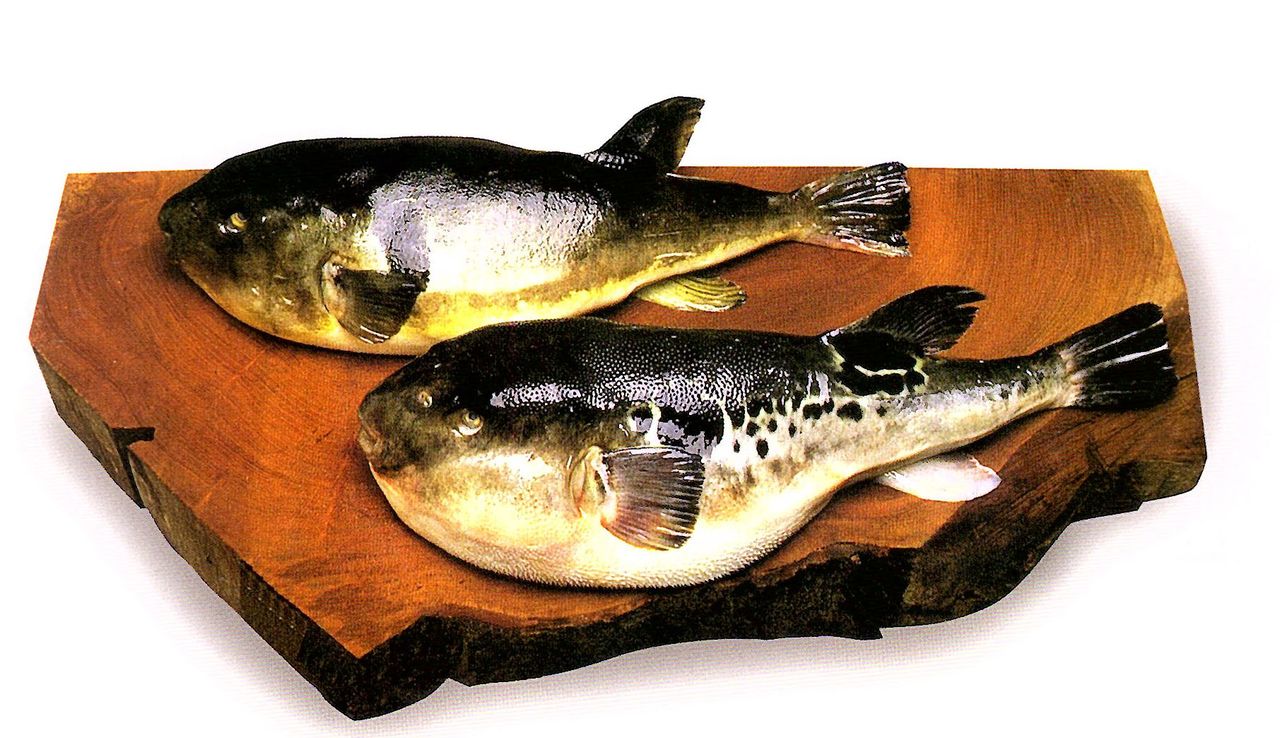
The only parts of the purple puffer (mafugu, at top) that are edible are the muscles and testes, but the skin of the tiger puffer (torafugu, bottom) is also edible. (Courtesy Tsukiji Tentake)
If ingested, TTX causes a prickling sensation that spreads from the lips and tongue to the fingertips. In mild cases, victims suffer headaches and vomiting, but in severe poisonings, it triggers paralysis of the nerves, leading to respiratory distress and death within four to five hours. Sadly, there is no known treatment or antidote for the toxin.
Prohibition
Fugu are distributed widely in the world’s oceans, from the tropics through the temperate zone, with more than 400 recognized varieties. Over 50 varieties of fugu are found in Japanese waters, of which 22 are eaten. The parts that contain the toxin vary between species—for example, the skin of the tiger puffer is edible, but the purple puffer’s skin is poisonous.
The fish has been consumed in Japan since ancient times—fugu teeth and bones were unearthed at an archaeological dig at Ubayama Shell Mound in Ichikawa, Chiba Prefecture, dating back to the mid-Jōmon period (ca. 10,000–300 BCE). It is not known whether Jōmon people knew how to distinguish between edible and inedible fugu parts, or simply took the risk.
Toyotomi Hideyoshi (1537–98), Japan’s second great unifier, famously prohibited consumption of fugu. During military expeditions against Korea (the Imjin War, 1592–98), 150,000 troops were mobilized from western Japan, establishing a camp in the location of present-day Karatsu, Saga Prefecture. While awaiting dispatch, many soldiers unknowingly prepared and ate fugu as they would any other fish. After witnessing multiple soldiers die from fugu poisoning, in 1598, Hideyoshi issued his edict prohibiting its consumption.
Secret Dining by Commoners
The prohibition remained in place during the Edo period (1603–1867) that followed. If the head of a samurai family died from fugu poisoning, the entire family was severely punished—their house title was extinguished, and hereditary stipend confiscated—on account of “sacrificing to gluttony a life that belonged to the lord.”
But commoners continued eating the fish. The book Ryōri monogatari (Culinary Tales), from early in the seventeenth century, includes a recipe for preparing miso-flavored fugu soup. It describes the method to remove the poisonous parts: “skin the fish and discard the entrails . . . wash it until there is no trace of blood . . . then steep it in sake.”
In a classic late-Edo rakugo (comic storytelling) piece entitled Fugu Nabe (Pufferfish Hot Pot), a merchant and his customer seated to dine on the perilous dish are engaged in a deferential to-and-fro: “Please, you first,” “No, please, go ahead.” Both want to eat it, but neither wants to be the poison-taster. They strike upon the idea of feeding some to a beggar who comes to the door. After some time, they check on the beggar, who appears fit as a fiddle. Warily, they begin to try the dish themselves, only to find it is so delicious they cannot put their chopsticks down. When the pot is empty, the beggar returns. The diners tell him there is no more left to give him, to which he shows them his uneaten food and replies, “If that’s so, I’ll make do with this portion you gave me earlier.”
The punchline suggests that even a hungry beggar would not risk his life on the fish.
(© Pixta)
Matsuo Bashō (1644–94), the renowned wandering poet, composed the following scornful haiku:
Fugujiru ya / tai mo aru no ni / mufunbetsu
How reckless, to eat fugu stew when sea bream is right there.
In contrast, another poet, Kobayashi Issa (1763–1828), who discovered the delectability of fugu in his fifties, wrote:
Fugu kuwanu / yatsu ni wa mise na / Fuji no yama
He who eats not fugu is not worthy of gazing on the peak of Fuji.
The Dawn of Licensing Examinations
After the prohibition on fugu was lifted following the 1868 Meiji Restoration, people again began to eat it openly. In 1887, when Itō Hirobumi (1841–1909), Japan’s first prime minister, was visiting his hometown in what is now Yamaguchi Prefecture, he stopped in at a restaurant and requested fish. The proprietress was troubled, because she had not been able to acquire good fish due to rough seas. Prepared to face the worst, she served him the prohibited ingredient.
Surprised at the pleasant taste, Itō repealed the prohibition the following year, and granted the restaurant Japan’s first license to serve fugu in the modern era. Thereafter, the number of establishments serving the fish grew, particularly in Shimonoseki (Yamaguchi Prefecture), Kitakyūshū (Fukuoka), Osaka, and other parts of western Japan.
Fugu only became popular in Kantō after the introduction of Japan’s first licensing examination in Tokyo in 1949. Later, all Japan’s prefectures formulated regulations and devised examinations to ensure the safety of fugu dining.
Examination content varies among prefectures, but comprises a written test of fundamental knowledge and a practical test, which includes a visual component requiring examinees to distinguish between varieties of the fish and to cut and trim actual fugu, separating the edible from the inedible parts.
Fugu blood is also poisonous, and chefs must use a separate area solely for fugu preparation to ensure that the liquid does not come into contact with other ingredients. Handling the toxic components is strictly regulated even after they are discarded—they must be kept in a locked refuse container and disposed of at designated handling facilities.
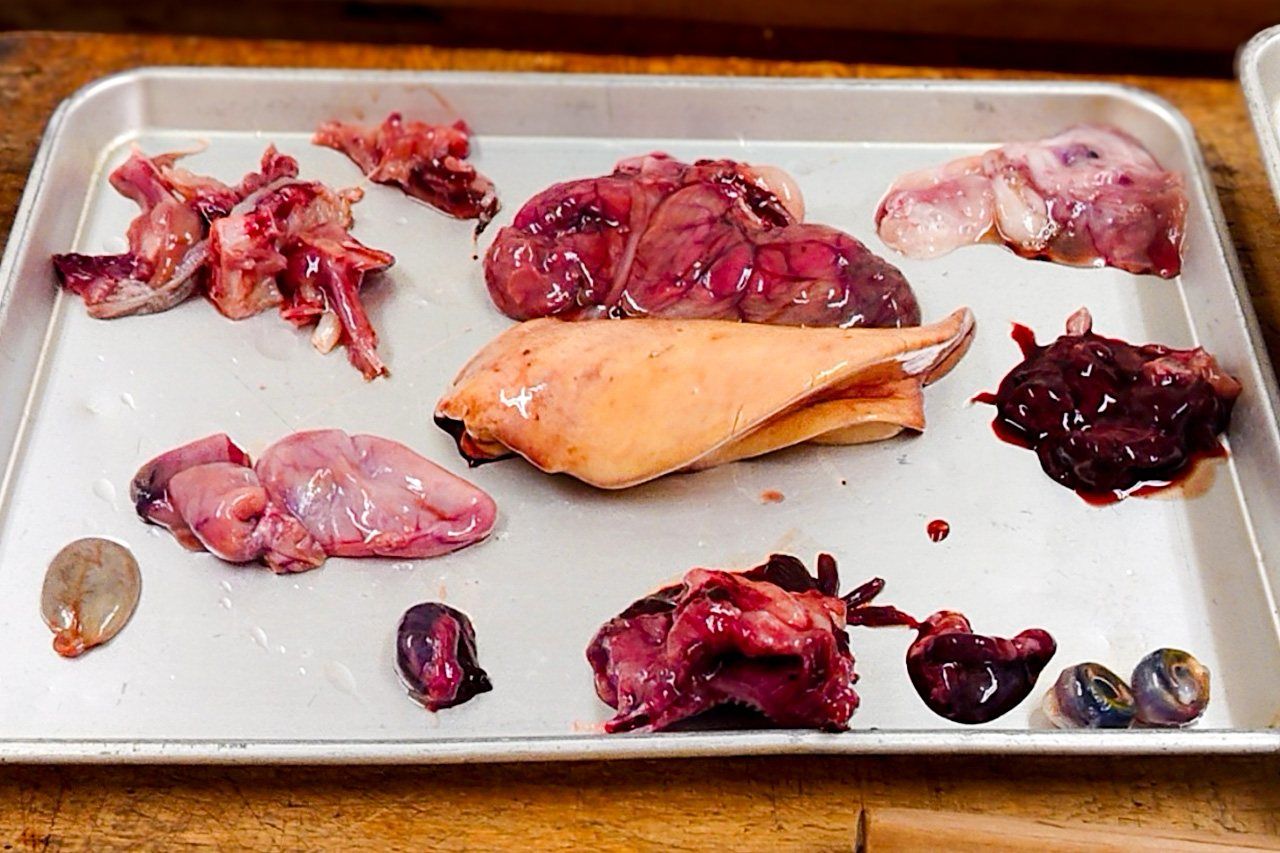
Inedible parts of fugu, including the yellowish liver in the center and the kidneys above it. (Courtesy Tsukiji Tentake)
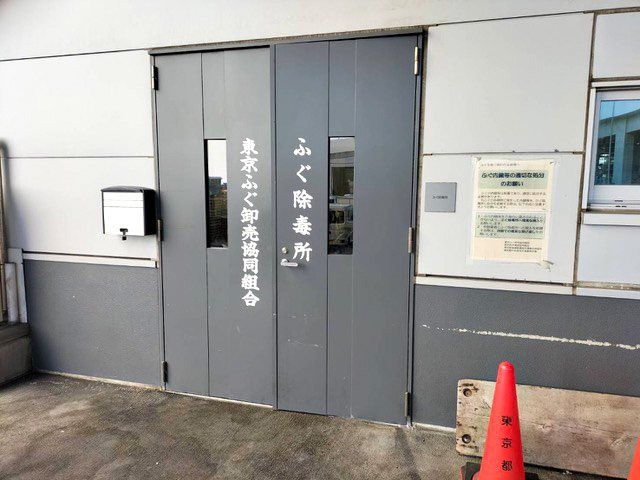
The fugu poison-disposal facility at Toyosu Fish Market. Restaurateurs and others bring the poisonous innards of fugu here for safe disposal. (© Gotō Reiko)
Thanks to the systems in place to ensure the correct handling of fugu, it is no longer considered unsafe. Nowadays, fugu poisoning incidents generally only occur when amateur fishers mistakenly believe they can distinguish nonpoisonous species or that they can safely remove the toxic organs without proper training.
Now Served at Sushi Train Restaurants and Izakaya
In the past, restaurants could not serve fugu unless they had an appropriately licensed chef in-house. Now, safely prepared, pre-sliced fugu is readily available through wholesale and retail channels, enabling any restaurant to include it on their menu.
No longer an exotic product, fugu is now available at sushi chain restaurants and izakaya dining pubs, and even found on supermarket shelves, both as sashimi or prepackaged for hot pot.
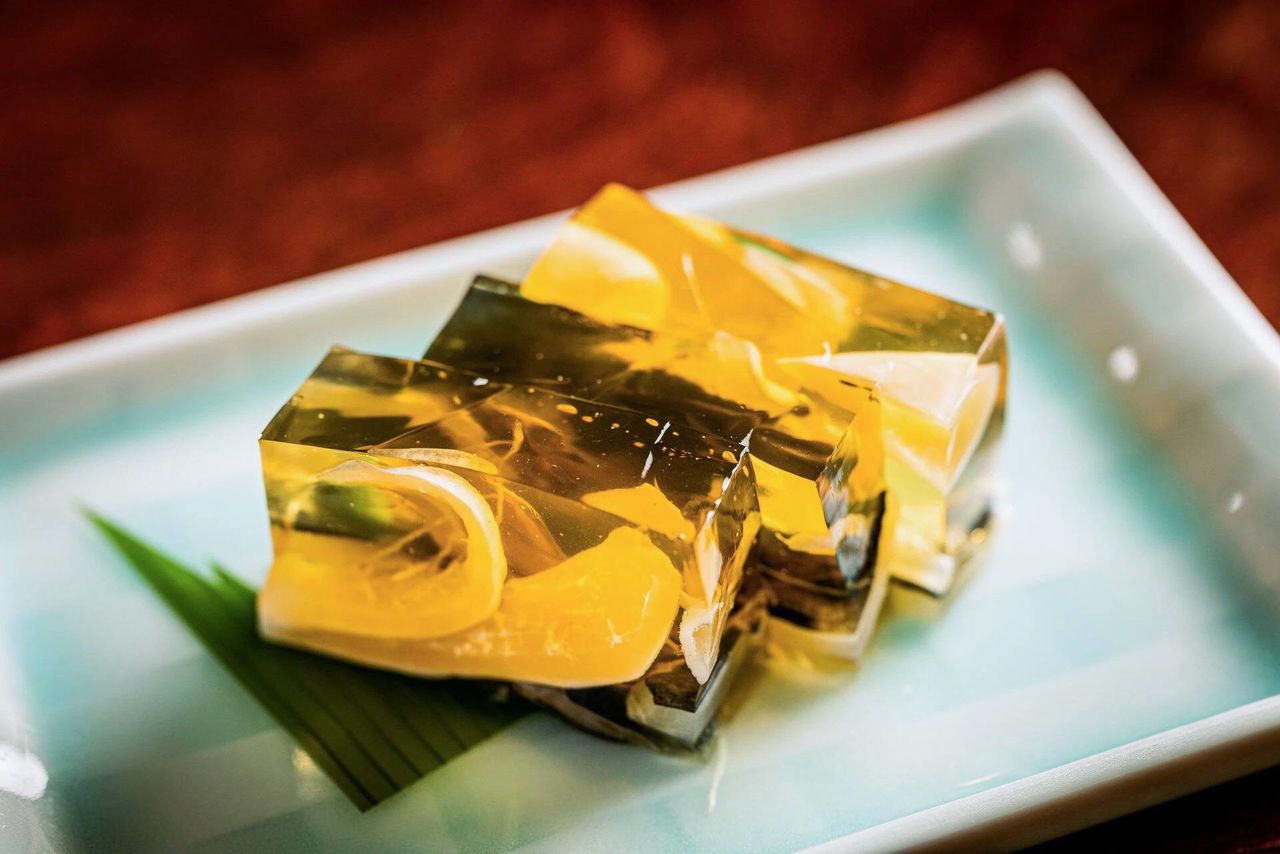
Collagen-rich nikogori jellied fugu. (Courtesy Tsukiji Tentake)
Jokingly Compared with Firearms
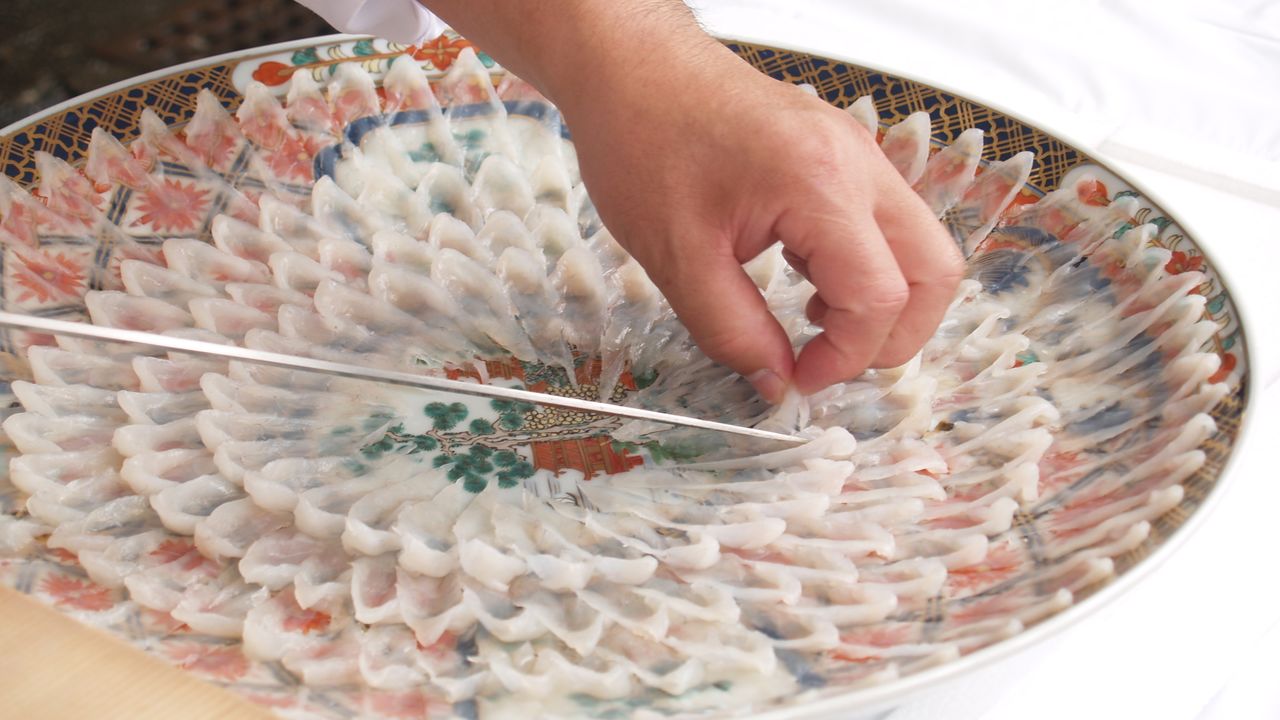
Sashimi and hot pot are the most popular fugu dishes. Because the flesh is muscular and elastic, sashimi is sliced so thinly that the pattern of the serving dish is visible through the translucent fish. Chefs show off their skill by arranging the pieces in the shape of a chrysanthemum.
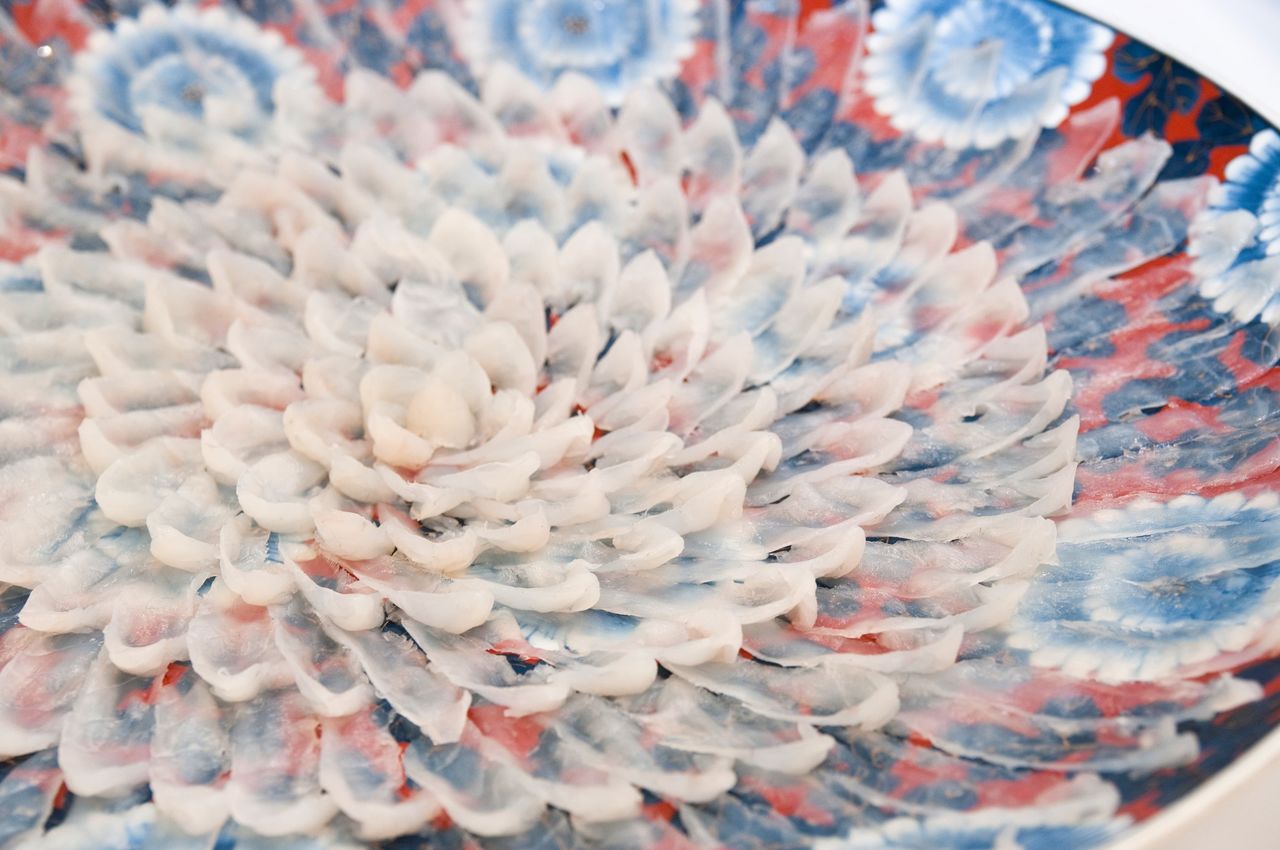
The beautiful design of the serving dish is visible through the translucent sliced fugu. (Courtesy Tsukiji Tentake)
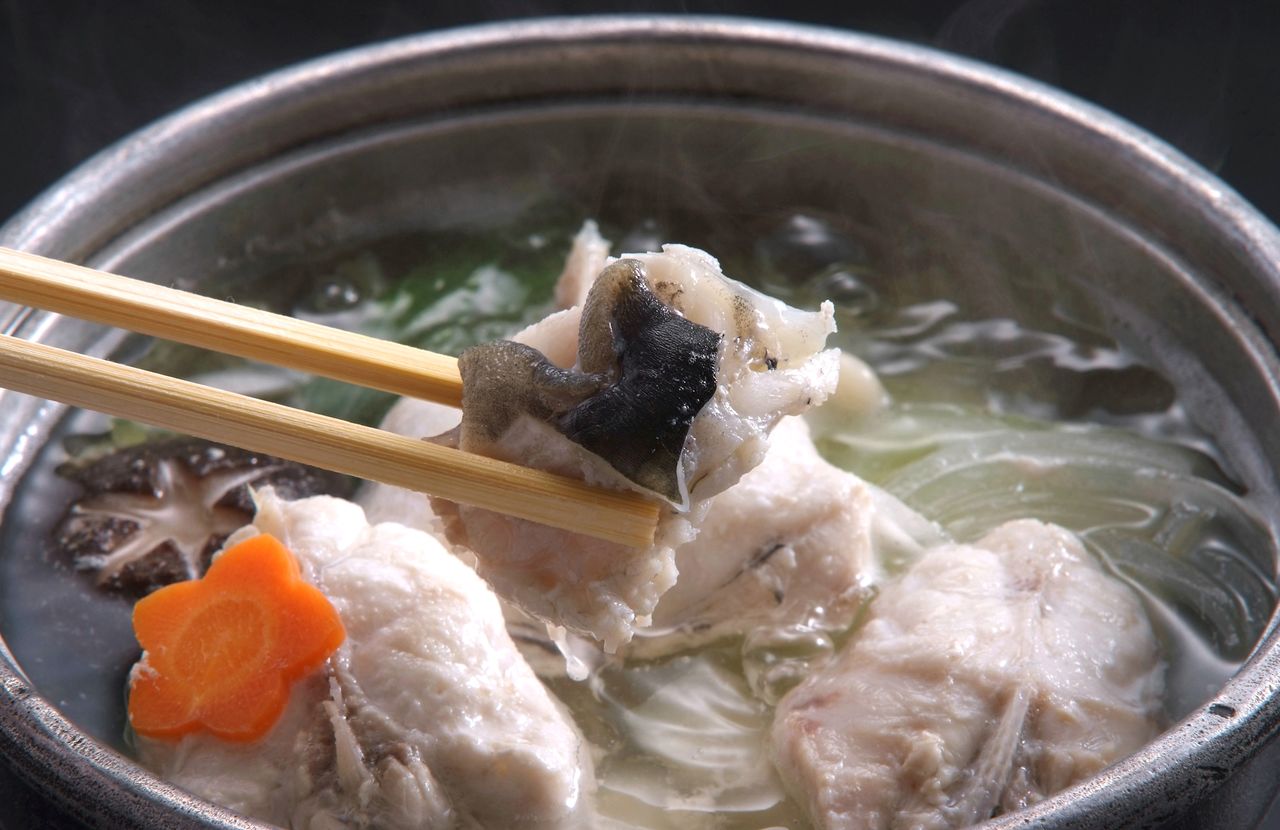
When served as a hot pot, the bones are left in to create a richer tasting broth. If tiger puffer is used, the collagen-rich skin is also included. In winter, the testes are considered a delicacy. A fugu hot pot meal typically culminates in adding rice to make zōsui porridge, to savor every drop of the broth’s umami. Interestingly, fugu hot pot is often called fugu chiri, a term used for hot pot made with white-fleshed fish, possibly referring to the way the fish curls up (chiri-chiri) when cooked.
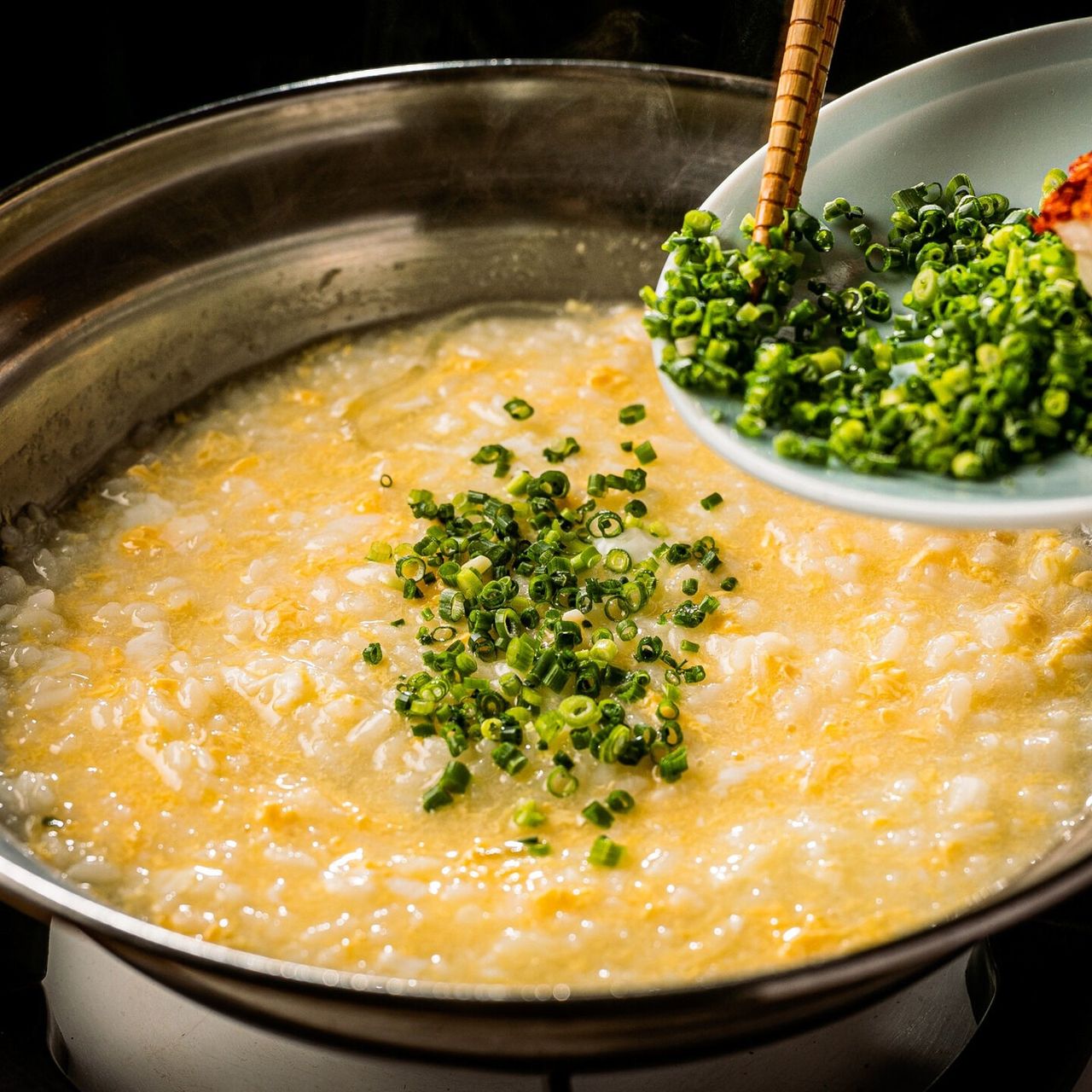
Savoring the broth of fugu hot pot by adding rice to make zōsui porridge. (Courtesy Tsukiji Tentake)
In Kansai, fugu sashimi is called tessa, and fugu stew is known as tetchiri. Both words are based on the word teppō (gun), also slang term for fugu, because either one could shoot you dead.
Japanese tend to think of fugu as a winter delicacy, but because it is a migratory fish, it can be caught year-round in different areas. In recent years, the prized tiger puffer has even been caught in waters as far north as Chiba, Fukushima, and Hokkaidō, but because there are no facilities in these areas to safely remove and dispose of the poisonous components, it is often sent to Yamaguchi’s Shimonoseki for processing. Today, Shimonoseki fugu is the best-known brand across Japan.
Data Sources
- Risk profile of natural toxins in pufferfish toxin from fish (Japanese) from the Ministry of Health, Labor, and Welfare.
- About fugu (Japanese) from Shunpanrō.
(Originally published in Japanese. Banner photo: A plate of thinly sliced fugu sashimi. Courtesy Tsukiji Tentake.)