



Model Cities for a Graying Society
The decreasing birthrate and graying of the Japanese population has already resulted in serious problems in some parts of Japan. This trend is particularly severe in the Tōhoku region, which meant that many elderly people were among the victims of the earthquake and tsunami. This demographic shift is by no means limited to Japan, however. The total fertility rate, which indicates the average number of children born to a woman during her lifetime, was below 2.0 in many member countries of the Organization for Economic Cooperation and Development during the 2005–10 period. South Korea had the lowest rate (1.22), followed by Japan and Poland (1.27 each), Germany (1.32), Italy (1.38), Canada (1.57), the Netherlands (1.74), Britain (1.84), and France (1.89). Any country in which women on average do not bear more than two children will see its population decline. Only in a few OECD countries did the rate exceed 2.0, such as New Zealand (2.02), the United States (2.09), and Mexico (2.21).
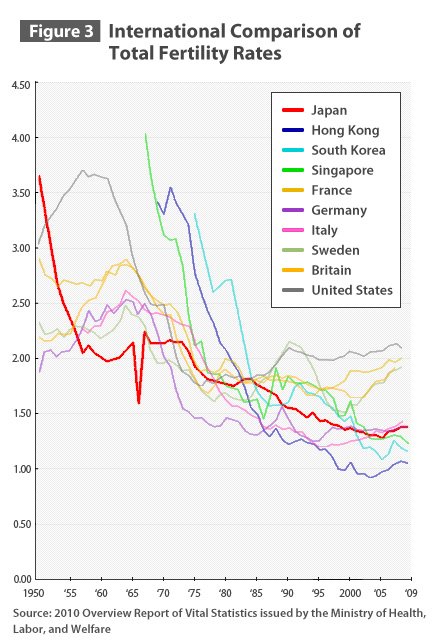

Japan’s neighbor China also has a declining population. Its total fertility rate is 1.77, but in cities where the nation’s one-child policy has been most strictly applied since its introduction in 1979, a rate of around 1.0 has indeed been maintained. As a result, China’s population is graying even faster than that of Japan. We can see, then, that the critical problems associated with a decreasing birthrate and graying population are common to developed countries and are also emerging in highly populous China. Japan is merely at the front of the pack that is moving down this road.
Given the severity of the demographic shift in the Tōhoku region, the construction of eco towns and smart cities should include the creation of advanced systems of medical care and welfare, making them responsive to the needs of the elderly. If that is done, the community-building efforts could become a model not just for Japan but for the whole world. And if smart cities are designed to be highly amenable, with homes, workplaces, educational institutions, and entertainment facilities located close to each other, the cities will attract not just senior citizens but young people as well, probably boosting the birthrate as a result.












 Read in other languages