


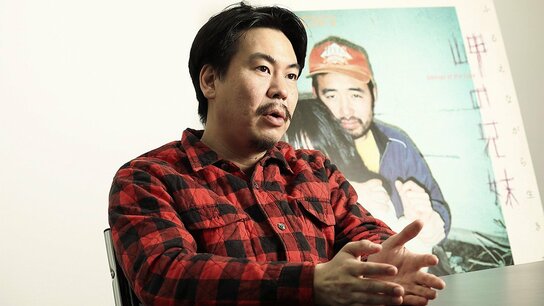
Siblings of the Cape, which came out in Japan on March 1, shocked festival audiences with its treatment of an intellectually disabled woman’s sexuality.
The Raw Power of Humanity
Show me a film director, and I’ll show you someone who grew up wanting to make movies and then went ahead and did it. This may be a truism, but it really struck me during my interview with Katayama Shinzō, who made his directorial debut with Siblings of the Cape. When I asked Katayama about how he came to direct films, he gave me a matter-of-fact account of how he gained experience in the industry. As the conversation turned to the making of his own film, however, he suddenly became enthusiastic. I could tell that the project was his baby.
“I’ve wanted to make films ever since I was a teenager. I just loved movies and saw loads of them. I did also consider becoming a manga artist, as I read a lot of manga as well, but I decided against it as I am not much of an illustrator.”
After completing high school, Katayama enrolled in a course in scenario writing. Rather than making a big move to Tokyo, he decided to study somewhere within commuting distance of his family home in Toyonaka, Osaka Prefecture. After studying for a year, while working part-time to support himself, Katayama did eventually move to Tokyo, where he enrolled in a weekend course run by film director Nakamura Genji. The deciding factors were simply the course’s low fees and the fact it would allow him to work during the week.
Katayama gives the impression that he casually slipped into the world of filmmaking and ended up remaining there. However, his work on film sets would lead to encounters with people who would shape his future. He gained real-life experience as an assistant director under talented, young directors like Bong Joon-ho and Yamashita Nobuhiro.
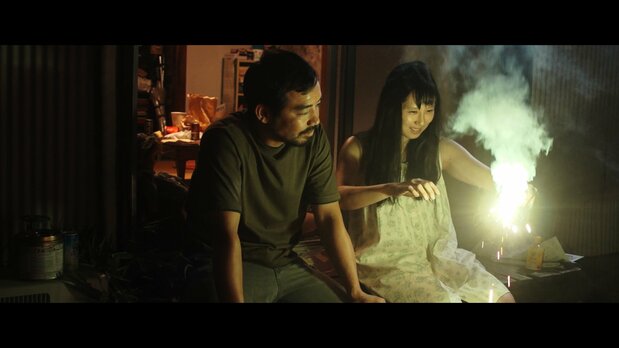
 Scene from Siblings of the Cape. (© Katayama Shinzō)
A Decade in the Making
A defining experience was the year Katayama spent in South Korea at the age of 27 while filming Bong Joon-ho’s Mother (2009). A screenplay Katayama wrote while in Korea formed the basis for his debut film.
Siblings of the Cape is the story of an intellectually disabled woman who is cared for by her brother. The brother, himself physically disabled, finds himself penniless and unable to pay rent after losing his job. Desperate to make ends meet, the brother ends up pimping out his sister for money.
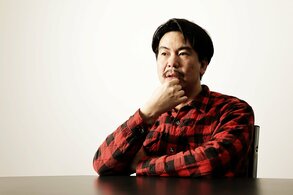
Katayama explains, “In Hanamura Mangetsu’s collection of short stories, Yamori Usumidori [Gecko Green], there is a story in which a pimp sells an intellectually disabled woman he met on the street to a brothel. It’s like Kim Ki-duk’s movie Bad Guy (2001). I’d always wanted to make a film based on that idea.”
After beginning work on the script, Katayama read Yamamoto Jōji’s nonfiction work Ruihan Shōgaisha (Disabled Reoffenders), and was inspired by the accounts of disabled women.
“There are these women who are repeatedly imprisoned for prostitution,” he recalls. “They say that only their clients make them feel like real women. They get hooked on the thrill of prostitution. This idea interested me: that there are women who take up prostitution for the money but end up doing it for the sex. I wanted to depict that transition.”
Deciding that he wanted to turn his screenplay into a film, Katayama approached actor Matsuura Yūya, whom he met while working on Yamashita Nobuhiro’s My Back Page (2011). However, the story still didn’t feel quite right.
“Talking to Matsuura got me into thinking that I should make the film about a brother and sister,” he continues. “Rather than focusing on the experience of either the pimp or the disabled woman, I was interested in the dynamics of the relationship between the man and the woman. I decided that making the film about a brother and sister would help keep it fast-paced, because a pair of siblings already has an established relationship. If you make the film about a couple of strangers, you need to start with an exposition that fills in the characters’ backgrounds and explains how they met.
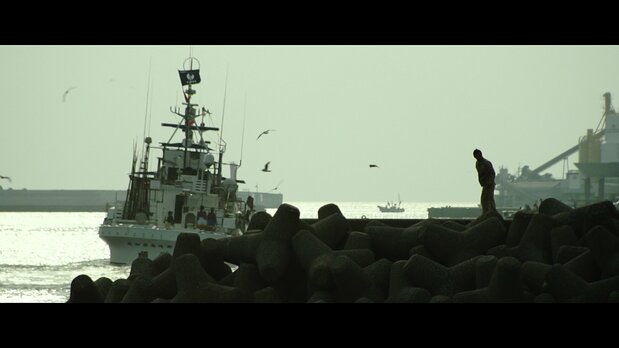 Scene from Siblings of the Cape. (© Katayama Shinzō)
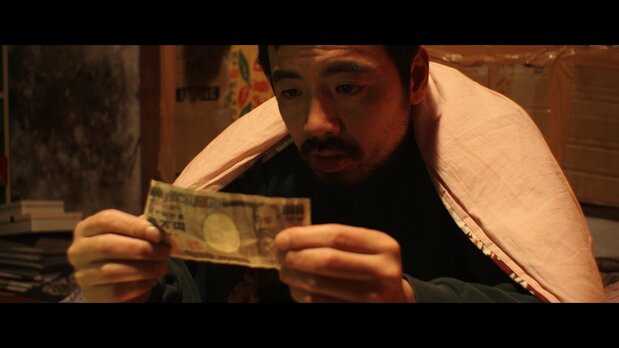 The brother, Yoshio, played by Matsuura Yūya. (© Katayama Shinzō)
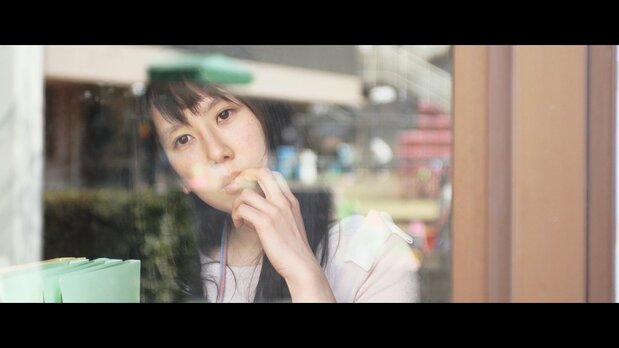 The sister, Mariko, played by Wada Misa. (© Katayama Shinzō)








 Read in other languages