


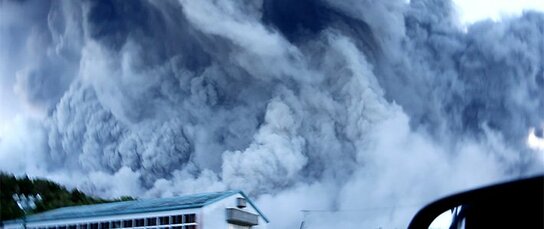
Japan is home to 10% of the world's active volcanoes, and a surge in small-scale volcanic activity has had the nation on edge in the wake of the 2011 Great East Japan Earthquake. We talked to Nakada Setsuya, one of Japan’s leading volcanologists, about the recent spate of eruptions and its implications.
INTERVIEWER There’s been a surge in the number of volcanic eruptions in Japan over the past couple of years. What’s your take on all this activity?
NAKADA SETSUYA First let me explain my perspective on volcanic activity. There’s a certain regularity to volcanic eruptions. Small ones occur very frequently. Gigantic eruptions like the one that formed the Mount Aso caldera occur only once in 10,000 years or so. The fact that a volcano hasn’t erupted in a long while doesn’t mean that volcanic activity has ceased. The pressures continue to build, and eventually the volcano has to erupt to compensate.
Ominously Quiet
The VEI [volcanic explosivity index] measures the explosive energy of volcanic eruptions based on the volume of material ejected. It’s an 8-point scale, with each successive interval representing a tenfold increase in energy. A VEI-4 eruption is classified as large, while a VEI-5 or VEI-6 eruption is considered very large or colossal. In Japan, VEI-5 eruptions typically occur a few times per millennium, while the average frequency for VEI-4 eruptions is once in roughly 30 years.
Overall, Japan’s volcanoes have been ominously quiet for the past two or three centuries. The last VEI-5 eruption was almost three centuries ago, around 1730 [Mount Tarumae in Hokkaidō]. And there hasn’t been a VEI-4 since the eruption of Mount Hokkaidō-Komagatake in 1929.
It’s important to understand that at some point that energy has to be released. What we really need to be concerned about are VEI-4 and VEI-5 eruptions. Volcanologists are keeping a very close watch because they believe Japan is overdue for an eruption on that scale.
The eruptions we’ve seen lately are really minuscule by comparison. The recent Mount Aso eruption was a VEI-1, and so was the eruption of Mount Ontake last year [see chart below]. A cluster of small-scale eruptions like this isn’t sufficient grounds for concluding that we’re entering a period of intense volcanic activity.
However, it is true that since 2014, these small eruptions have been occurring with greater frequency than in the previous few decades. I have a feeling that this could be the prelude to a period in which Japan may be prone to larger-scale eruptions.
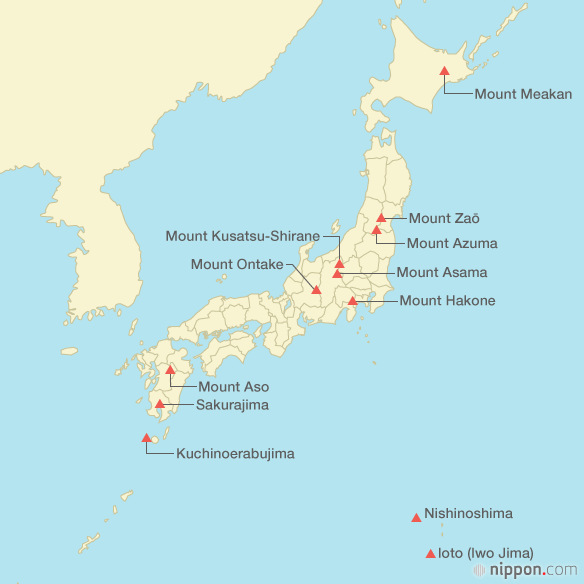
Volcanic Activity Since the Great East Japan Earthquake
| Date | Volcano, Prefecture | Description |
|---|---|---|
| 2013.11 | Nishinoshima (Ogasawara Islands), Tokyo | Continuous eruption, creating new island (ongoing) |
| 2014.6 | Mount Kusatsu-Shirane, Gunma | Near-crater warning issued |
| 2014.8 | Kuchinoerabujima, Kagoshima | Small-scale eruption of Mount Shindake |
| 2014.9 | Mount Ontake, Nagano | Steam-blast eruption; 63 on mountain found or presumed dead |
| 2014.11 | Mount Aso, Kumamoto | Small-scale eruptions from Nakadake crater |
| 2014.12 | Mount Azuma, Fukushima/ Yamagata | Near-crater warning issued |
| 2015.4 | Mount Zaō, Yamagata | Near-crater warning issued (lifted in June) |
| 2015.5 | Kuchinoerabujima, Kagoshima | Explosive eruption of Mount Shindake; entire island evacuated |
| 2015.6 | Mount Asama, Gunma/Nagano | Very small-scale eruption at summit |
| 2015.6 | Mount Hakone, Kanagawa | Very small-scale eruption at Ōwakudani; access restricted |
| 2015.7 | Mount Meakan, Hokkaidō | Near-crater warning issued |
| 2015.8 | Sakurajima, Kagoshima | Evacuation ordered in response to sudden deformation leading to fears of major eruption; small eruptions resume |
| 2015.8 | Ioto (Iwo Jima,Ogasawara Islands), Tokyo | Very small-scale, intermittent eruptions |
| 2015.9 | Mount Aso, Kumamoto | Small-scale eruptions at Nakadake crater; access restricted |

Moreover, one of the characteristics of volcanic events is that even relatively small eruptions can be quite devastating. In the late eighteenth century, Japan experienced a succession of volcanic eruptions that claimed more than 16,000 lives in a period of less than 20 years—and this when the countryside was far less populated than it is today. It helps one appreciate how quiet our volcanoes have been since then.



 Read in other languages