


A Festival of Nationalism in Imitation of War
Media coverage of the Pyeongchang Olympics prominently displayed the games’ role as a festival of nationalism. Witness the high viewership ratings, peaking at 42.3%, for Japan’s live coverage of women’s curling, an event in which the Japanese team earned a bronze medal. It is unlikely that even one in a hundred Japanese understands the rules and tactics of curling, which has been described as “chess on ice,” but even so they tuned in and were able to taste the thrill of seeing Japan’s women performing strongly against their rivals. The high ratings are subject to various interpretations, but we should not ignore the nature of the matches as imitations of wars between nation states.
The modern Olympics in fact originated as a civilized imitation of war. Pierre de Coubertin founded the International Olympic Committee in 1894, the year when hostilities broke out between Japan and Qing-dynasty China, and the first modern games were staged in Athens two years later. The ancient Olympics are said to have their roots in the funeral games that Achilles staged after the death of his dear friend Patroclus during the Trojan War. Under the sacred Olympic truce that was proclaimed during the games, it was forbidden to attack the participants. Coubertin idealized this truce, aiming to make the modern games a festival of peace.
A truce is of course just a temporary cessation of hostilities; it does not entail the negation or absence of war. As a patriotic Frenchman, Coubertin himself cannot have been free from a sense of humiliation at his country’s defeat in the Franco-Prussian war of 1870–71. And the modern Olympics, in which athletes compete not as individuals but as representatives of their countries, have from the start been seen as “war by other means.” The second Olympiad, held in Paris in 1900, coincided with the Boxer Rebellion in China. As the forces of an eight-nation alliance (Austria-Hungary, Britain, France, Germany, Italy, Japan, Russia, and the United States) were conducting an all-out attack on Beijing, athletes from these countries were taking part in an elegantly staged pseudo-war in Paris. The events included ballooning, firefighting, tug of war, car racing, falconry, and even shooting of live pigeons—birds of the same family as doves, the symbol of peace,
The Politicized Olympics: Looking on the Positive Side
According to sociologist Norbert Elias, sports are a civilizing device created as a controlled outlet for emotionality that modern society requires us to keep under restraint. Combat sports in particular have gained popularity as events for the sublimation of the violent impulses that people are forbidden to express in ordinary life. The clothing and movements of athletes taking part in sporting matches are subject to precise rules; in this respect these formalized events may be compared to religious rituals. The controlled violence of sports is a symbol not of barbarity but of civilization.
Some of the vocabulary used in describing sporting events, including verbs like “beat,” “pummel,” and “thrash,” reflects the nature of sporting events as civilized forms of violence. And by natural extension, some of the terms, such as “victory,” “defeat,” and “rout,” are redolent of war. Sports may be seen as a means of averting real war by channeling the combative instinct of humans into games.
It is easy to complain that the Olympics have been “politicized” by being staged as pseudo-wars. But I think we should take note of the positive side of this politicization. In the total wars of the twentieth century, the combatants dehumanized their opponents, treating them as vermin to be exterminated; this led to the tragedies in places like Auschwitz and Hiroshima. The Olympics were not held during either of the two world wars, and naturally no Olympic truce was adopted. We Japanese in particular should remember the cancellation of the 1940 Summer Olympics, originally scheduled for Tokyo, as a symbol of the effects of all-out war without truces.
Politicized sporting events may be labeled “war by other means,” but they are opposite in nature to total war aimed at the annihilation of enemies. They are pseudo-war games in which defeated rivals can repeatedly come back and challenge the victors. To the extent that these contests serve as a substitute for the destruction and carnage of the battlefield, they fully qualify as a civilizing force.
As we prepare to host the Olympics in Tokyo, we must recognize their nature as pseudo-warfare between nations, and with this in mind we should draw on the power of design to make them as civilized as possible. And it is all right for the design process to involve imitation. I believe we should first ask ourselves what positive effects we can achieve by using the 2020 games as a political tool.
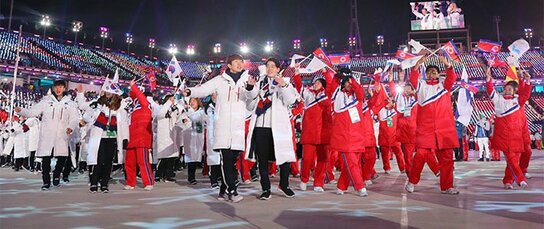
(Originally published in Japanese on May 14, 2018. Banner photo: The members of the North Korean and South Korean teams parade together at the closing ceremony for the Winter Olympics in Pyeongchang on February 25. ©Jiji.)







 Read in other languages