


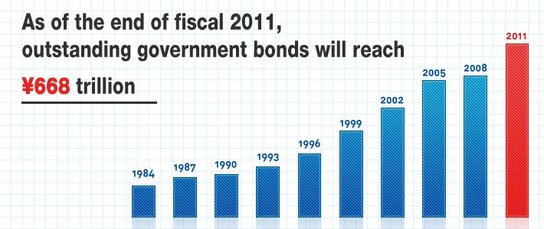
The Risk of Fiscal Insolvency
Debts have basically the same meaning whether an individual or a government incurs them. But whereas an individual who borrows from a bank will ordinarily make monthly payments of both interest and principal under a loan contract, when a government borrows by issuing bonds or other securities, it usually just pays interest (the coupon) on the debt at specified intervals and repays the full principal in a lump sum when the security matures.
Government bonds are tendered for bids at posted coupon rates, which are set in accordance with the market yields of the government bonds already issued. These bonds are traded on the open market. When there are numerous buyers, bond prices rise, meaning that the yield declines. Movements in bond prices thus produce changes in yields and influence the government’s interest burden. As can be seen in the Greek debt crisis, which flared up in 2010 and has become critical again in 2011, confidence in the ability of Greece to pay its debts has crumbled, and the view is spreading that the country poses a sovereign risk. Greek government bonds have suffered a downgrading to the status of junk bonds, and the burden of interest payments has grown heavier.
One of the yardsticks used to judge the likelihood of a country’s becoming financially insolvent is an escalating debt burden measured as a share of GDP. If the burden is to be prevented from growing heavier, the country needs to get its primary balance into equilibrium and must achieve nominal GDP growth in excess of the long-term interest rate. Another indicator is the share of government bonds held by investors in other countries. Japan’s share is unusually small, with overseas investors holding only about 6.6% of its bonds. Thanks to the demand for these bonds within Japan, they can be successfully floated even at low interest rates. The money for buying the bonds comes from the large stock of domestic savings. It is estimated that the net financial assets of the household sector are in excess of ¥1 quadrillion. A large portion of this goes through banks into the acquisition of government bonds. But it is also reported that general government financial liabilities now amount to about ¥980 trillion. In short, the domestic market is reaching the limit of its ability to absorb bond issues.
Also of concern is the rapid decline in the household sector’s saving rate, which will lower the share of government debt held by domestic investors. The graying of the population will aggravate the situation. By 2025 the baby-boom generation (those born from 1947 to 1949) will be 75 years of age or older, and social security benefits are expected to reach ¥141 trillion, almost 34% above the 2010 level (figure 6). (*8) As can be understood, further delays in fiscal reform will surely result in a downgrading of Japan’s sovereign debt rating and a rise in long-term interest rates, which in Japan’s case are based on the yield on government bonds. Debt-servicing costs will swell, and public indebtedness will further expand.
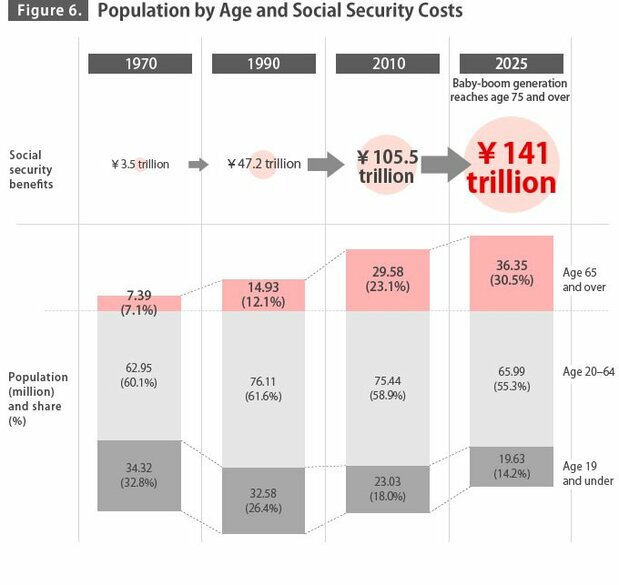

Source: Ministry of Finance data.
Note: Baby-boomers are defined as those born from 1947 to 1949.












 Read in other languages