


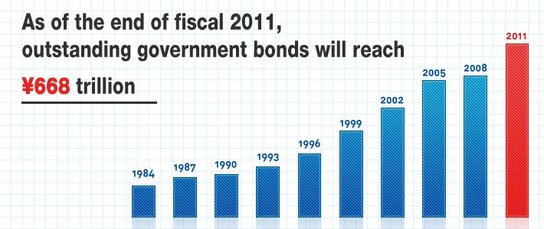
The 3/11 Disaster Darkens the Outlook
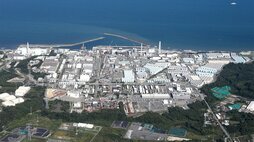
On March 11 Japan was hit by a huge earthquake and tsunami, and the disaster was compounded by a nuclear plant accident. The Cabinet Office calculates that the direct damage from the quake and tsunami is on the order of ¥25 trillion, but surely this is an underestimate. And even if we suppose that the losses in capital stock were only ¥25 trillion, future damage in the form of unrealized GDP growth over the next several years will mount to a tremendous sum. It has been estimated that government expenditures for recovery and reconstruction will be about ¥10 trillion per year over the coming 10 years. The poor outlook for public finances will become even bleaker if the state has to bear the financial costs of redressing the damage from the nuclear plant accident and guaranteeing the liabilities of the plant’s owner, Tokyo Electric Power Co.
There are three main options for securing financial resources: (1) reallocating existing expenditures, (2) raising taxes, and (3) issuing government bonds. All are problematic propositions. The first supplementary budget for fiscal 2011 is somewhat larger than ¥4 trillion, of which ¥2.5 trillion was diverted from resources earmarked for the basic pension as a stopgap measure. When the state spends money it has pooled for public pension benefits on other purposes, it is consuming its own assets. The result will be a heavier load on future generations.
Recently there has been talk about securing funds by drawing on the state’s foreign currency reserves, which are on the scale of $1 trillion. At first glance this seems like a fine idea. However, in order to acquire foreign currency reserves, the state raises funds by issuing treasury bills. The reserves are assets denominated in foreign currencies, such as US treasury bills and bonds. If these assets are sold, the first priority will be to redeem the Japanese treasury bills used to acquire them. These reserves are not, in short, a true component of the government’s “buried treasure.” Such techniques as diverting money from the basic pension fund and selling foreign currency reserves amount to a sleight of hand by which the government creates the illusion that it is raising funds without imposing a burden on the public, as it would if it issued government bonds.
In its April 2011 survey of Japan, the OECD offered the following advice: “Achieving the fiscal targets will require tax increases. . . . Revenue should be increased by a comprehensive tax reform that broadens direct tax bases and encourages labour force participation, in part by relying primarily on the consumption tax for additional revenue. To balance the primary budget, the consumption tax rate would have to be raised by five to nine percentage points from its current 5%.” (*9)
Staff members of the International Monetary Fund made a similar suggestion in a report issued on June 16. They said that “a gradual increase in the consumption tax from 5 percent to 15 percent over several years . . . could provide roughly half of the fiscal adjustment needed to put the public debt ratio on a downward path within the next several years.” (*10)
Without waiting for advice from the OECD and IMF, the Japanese government ought to have bravely placed the issue of the social security system’s sustainability before the public, stimulating a debate over costs and benefits and seeking the people’s support. When politicians fail to exercise leadership, the resolution of fundamental problems is delayed. If we Japanese have no hope regarding the political abilities of our own leaders, we ought to consider the possibility of allowing such international organizations to guide the nation forward. We must squarely face the question of how to put our society on a sustainable course. (Written in June 2011)
(Originally written in Japanese by Nariai Osamu, Professor at Reitaku University.)
(*1) ^ Ministry of Finance, “Nippon no zaisei o kangaeru” (A Look at Japan’s Government Finances) [Japanese]; Ministry of Finance, “Highlights of the Budget for FY2011” [English].
(*2) ^ “Zaisei un’ei senryaku” [Japanese], “Fiscal Management Strategy” [English], June 22, 2010.
(*3) ^ Cabinet Office, Heisei 22 nendo nenji keizai zaisei hōkokusho (Annual Report on the Japanese Economy and Public Finance 2010), July 2010 [Japanese]. English summary of the report available here.
(*4) ^ Organization for Economic Cooperation and Development, Economic Outlook, no. 88 (December 2010), annex table 32.
(*5) ^ Ministry of Finance, “OECD shokoku no kokumin futan ritsu (tai kokumin shotoku hi)” (National Burden Ratio of OECD Countries [Comparison of National Income]) [Japanese].
(*6) ^ Cabinet Office, “Keizai zaisei no chūchōki shisan” (Tentative Medium- to Long-Term Calculation of Economy and Finances), January 21, 2011 [Japanese].
(*7) ^ Headquarters of the Government and Ruling Parties for Social Security Reform, “Shakai hoshō, zei ittai kaikaku seian” (Concrete Proposal for Combined Reform of Tax and Social Security Systems), June 30, 2011 [Japanese]. Information in English available here.
(*8) ^ Ministry of Finance, “Nippon no zaisei o kangaeru,” op. cit. Information in English available on p. 11 of “Highlights of the Budget for FY2011,” op. cit.
(*9) ^ OECD, Japan: Overview (OECD Economic Survey), April 2011, p. 11.
(*10) ^ International Monetary Fund, “Raising the Consumption Tax in Japan: Why, When, How?” IMF Staff Discussion Note, June 16, 2011, p. 3.






 Read in other languages