


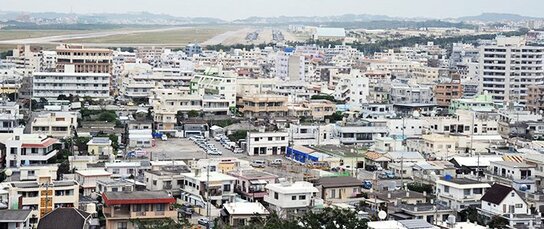
An Okinawa Consensus
MIYAGI I think it’s interesting to note that the opposition to the current Henoko plan is coming from all across the political spectrum. What does this suggest about what’s going on in the prefecture?
TAIRA I think you have to look at the changes in Okinawa’s political structure over the years. The kind of polarization into the conservative and progressive wings that marked mainland politics made its way into Okinawa as well from around 1960, but when you look at the phenomenon more closely, you realize that in Okinawa, there had long been common ground on which both sides of the political spectrum could stand regarding local issues.
They took opposing positions on many national issues, such as the Japan-US security alliance, US bases in Japan, and the constitutionality of the Self-Defense Forces, but they were united in seeking a smaller US military presence in the prefecture and in demanding economic stimulus measures from Tokyo, partly for hosting the bases. This is a point that is often misunderstood by many people on the mainland, who unthinkingly assume that the conservatives in Okinawa prioritize economic growth, while the progressives are pushing for a pacifist, antibase agenda.
To some extent, of course, the conservatives do focus on the economy while the progressives are more interested in shutting bases down. So ideally, if Okinawa gains a prosperous economy free of US bases, then the chief issues dividing the two sides would dissipate, and it wouldn’t be at all surprising to see them becoming even less polarized.
Indeed, the end of the Cold War opened the possibility of a withdrawal of US forces from Okinawa, and fiscal measures taken by Tokyo were reducing local businesses’ reliance on the US military. Breaking free of a base-reliant economy and seeking the reduction and consolidation of US military installations now became realistic goals for conservatives and progressives alike, thus drawing the two sides closer together. An awareness of such changes in the political mindset is crucial to an understanding of shifts in Okinawa’s public opinion.
Benefits in Exchange for Acquiescence
ENDŌ For most of the postwar period, Japan has had conservative governments, and these administrations worked hard for Okinawa’s return. Following reversion, they focused less on eliminating the bases and more on providing economic benefits to local residents in exchange for a continued US military presence. These benefits were offered in much the same way that public works projects were implemented around the country by postwar administrations to drive economic growth. The island’s conservative forces were receptive to such economic measures, and it was to them that the government directed the benefits.
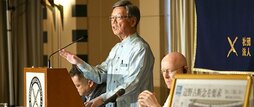
I think it would be fair to describe Onaga Takeshi, who was elected governor in November 2014, as a conservative politician. His supporters are also basically conservative. The fact that such a politician has now become a highly vocal and visible opponent of US bases is a telling sign that the formula of providing benefits in exchange for acquiescence on the American presence no longer works.
There’s a fairly logical economic dimension to this shift. Tourism has become a major industry in Okinawa, and many resorts have been successfully developed and marketed. The community centers and the like that were built with government funds, on the other hand, may have temporarily provided construction jobs for local workers, but they haven’t engendered sustained economic growth, and the outlays needed to maintain them have become a drag on local finances. As Okinawa’s popularity as a resort grew, the US bases become an eyesore, so rather than contributing to the local economy, they came to be seen as a detriment to the prefecture’s growth and self-reliance.
Statistics bear out the fact that the return of US bases in Okinawa has had positive economic repercussions, leading to new jobs and new marketing opportunities. Income from land leased to the US military is often just a fraction of the gains that have been realized from the effective utilization of former bases. These findings have convinced the Okinawa people—both conservative and progressive—that economic growth is not something to be gained in exchange for the continued presence of US bases; even bigger growth can be expected if the Americans return the land. This is the reality in Okinawa today.
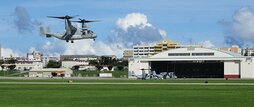
Especially since Governor Onaga has stepped into office, the prefecture has been seeking a new approach that doesn’t rely on the pork-barrel policies of the post-reversion years and that have so far proven to generate more economic growth. The prefectural government in Naha is not simply demanding the return of Futenma; backed by statistical evidence, it’s convinced that having the Marines leave would lead to both economic benefits and greater safety for area residents.
Despite these changes on the ground, political leaders in Tokyo continue to assume that bigger economic packages would be enough to appease the opposition. They’re not listening to the arguments from both ends of the political spectrum. The two sides are increasingly speaking with one voice, but people in Tokyo aren’t paying attention and are unaware that the bait no longer works. Or maybe they are aware of this but are just pretending not to notice, thinking that they can force their will on the local populace. This, I think, is the root cause of the current impasses in Naha-Tokyo relations.
Public Outrage
MIYAGI As both of you just explained, there definitely seem to be structural obstacles to resolving the Okinawa issue. In addition to the economic factors that you’ve pointed out, there appear to have been several turning points that galvanized public opinion against the US forces. One was the rape of a twelve-year-old schoolgirl by three US servicemen in 1995 that caused a public outrage. Another was the negotiations for the return of Futenma, which were concluded in a rush before a replacement site had been agreed upon. Prime Minister Hashimoto Ryūtarō knew this would be a big gamble, but he nevertheless pushed ahead for an agreement.
Relocating to a site within Okinawa Prefecture is next to impossible, as shown by the fact that the plan to move Naha Port Facility has been held up for decades. Hashimoto was a policy expert, so I’m sure he knew this. But he needed a dramatic, political breakthrough that could change Okinawa’s public opinion, since Governor Ōta Masahide was refusing to sign an extension of the leases on land provided to the US military, which meant that many of the bases, including Kadena Air Base, would be in a state of illegal occupancy when the leases ran out the following year.

When the Futenma relocation agreement was announced in April 1996 by Prime Minister Hashimoto and US Ambassador Fritz Mondale, they noted that the Marines stationed there would be split up, moving to a newly built heliport at an existing installation in Okinawa and to another facility on the mainland. For one reason or another, though, the “heliport” soon turned into a huge landing strip. After studying the options available, Hashimoto settled on a plan to create an offshore, floating runway.
Japan’s Okinawa policy had long been on the verge of collapse, although this had remained hidden from view. The Futenma controversy, though, exposed the barrenness of this policy.



 Read in other languages