


Mutual Efforts at Historical Reconciliation
SHIRAISHI The panel’s discussion centered on the theme of reconciliation, rather than apology, and I think there was general consensus that this would be the thrust of the statement.
HOSOYA In that sense, bilateral ties might be back to where they were when the 1998 Japan-China Joint Declaration was issued—a document reflecting the strong desire on both sides to improve their relationship. Recent trends indicate that such sentiments are being felt today as well.
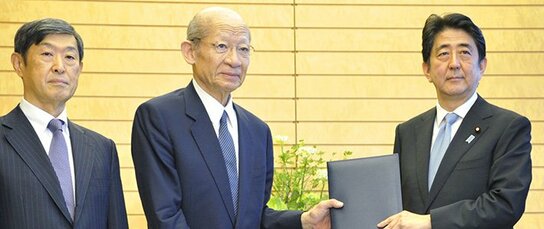
In his statement, the prime minister talked about the importance of mutually making efforts at historical reconciliation, on the strength of which countries can come to enjoy amicable ties. He strongly alluded to the fact that such efforts have been made with the United States, Australia, and Britain and that this could also happen with China and South Korea. This, I believe, is the reason for his emphasis on reconciliation, and I think things are already heading in that direction with our neighbors.
KAWASHIMA What the 1998 joint declaration in effect says is that Japan will continue to uphold the Murayama statement. And I’m sure you remember that the 1998 visit by President Jiang Zemin left the Japanese public cold.(*2) So while the declaration describes the bilateral relationship in glowing terms, there was no real outpouring of warm feelings. On April 12, 2007, though, in his speech to Japan’s Diet, Premier Wen Jiabao spoke positively about the efforts had made by Japan to resolve historical issues and about the Murayama and Koizumi statements. Unfortunately, Japan subsequently had a new prime minister almost every year, so it was unable to respond to this Chinese overture in an appropriate manner.

So I think it’s fair to say that both after 1998 and 2007, the two countries squandered opportunities to achieve reconciliation. As Mr. Hosoya pointed out, Xi Jinping’s September 3 speech, which came on the heels of the August 14 Abe statement, was restrained in its criticism of Japan and emphasized China’s pacifist record. Perhaps we’re finally seeing both governments trying to build on the message being sent by the other.
History as a Contemporary Issue
INTERVIEWER That said, there is a real danger that tensions in East Asia could escalate; competing claims in the South China Sea, for instance, remain completely unresolved. What significance will the issue of historical perception and the Abe statement have in this context, especially with regard to Japan’s diplomatic options in the region?
SHIRAISHI Whenever history is brought up as a political issue, you can generally assume that it’s really about contemporary concerns. During the Nakasone years, the prime minister’s visits to Yasukuni Shrine were viewed as being problematic from a constitutional perspective, but today Yasukuni is totally a foreign policy issue. What’s important is for government leaders, particularly the prime minister and members of his cabinet, to refrain from making careless remarks. We don’t want to repeat the mistake of having issued a carefully worded statement, only to later find our leaders acting and speaking in ways that contradict the sentiments expressed.
Chinese leaders regard diplomatic relations in a highly strategic manner, so they’ll seek to take the moral high ground whenever Japanese politicians make heedless remarks. But this is an option that the Chinese leadership is careful not to overuse, given the host of domestic issues with which Beijing must grapple.
On the other hand, Seoul has a much freer hand in using the moral card, and given the pervading domestic hostility toward Japan, it will probably continue to do so at every opportunity. South Korea is in the process of making some very important strategic choices. Its security needs can be met by maintaining good ties with the United States and China, while the key to its economic growth right now is exports to China. So it wants to avoid alienating China for both security and economic reasons in the face of US rebalancing toward the Asia-Pacific and the momentum toward network-building among the region’s US allies. Its strategy appears to be to label Japan as an unrepentant villain and to secure both its national security and economic growth by skillfully managing its relations with the “Group of Two.” The only thing Japan can do is to maintain its cool under the circumstances.







 Read in other languages