


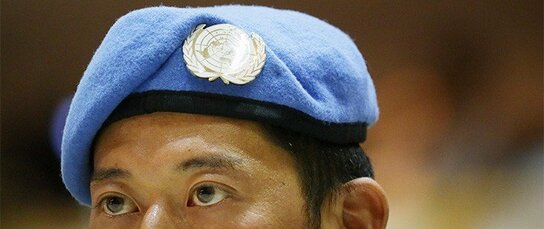
Japan’s Self-Defense Forces have not been deployed on a peacekeeping mission since 2017, when an SDF contingent was withdrawn from South Sudan. Going forward, what can Japan do to contribute to peacebuilding efforts?
Japan’s national defense guidelines, revised every five years, are expected to call in their next version for maintaining superiority in emerging key areas like cyberspace and outer space. Although I cannot accurately predict the details of the upcoming guidelines, I would like to offer insights into some pertinent issues from my perspective as a specialist in international peace cooperation.
UN Peacekeeping Missions Stall
Since the enactment of the Act on Cooperation with United Nations Peacekeeping Operations in 1992, one of the highlights of the Self-Defense Forces’ activities has been participation, albeit on a limited scale, in international peace cooperation, with the deployment of Ground Self-Defense Force civil engineering corps in Cambodia, East Timor, Haiti, and South Sudan. In addition to these activities, under the Act on Special Measures Concerning Humanitarian Relief and Reconstruction Work and Security Assistance in Iraq, the SDF was dispatched to Iraq in 2003 to assist the US-led reconstruction of the country. Revision of the Self Defense Forces Act in 2007 added international peacekeeping cooperation to the SDF’s basic duties. However, no personnel have been dispatched on PKO operations since the 2017 withdrawal of a GSDF unit partway through a difficult UN peacekeeping mission in South Sudan, a move that had the international community scratching its collective head.
The United Nations’ overall PKO budget has shrunk, and personnel levels are being cut. And it is the countries with experienced military forces that have historically been most willing to do the job that are receiving the most preferential treatment when it comes to these drawdowns. In an environment like this, it is extraordinarily difficult for a country like Japan to offer to take part in new operations while also stating “we won’t have any part of missions like that; we won’t do this sort of thing; we will only perform this smaller set of duties.”
Japan is also in a difficult position. Passage of military legislation in 2015 to allow the SDF to participate in foreign conflicts under the proviso of collective self-defense for allies seems to have had the unintended effect of strengthening public opposition to SDF overseas deployments. This sentiment was further reinforced during the 2017 tenure of Defense Minister Inada Tomomi, who was embroiled in a controversy over a cover-up of SDF internal records, with Diet deliberations thrown into an uproar over whether the GSDF’s daily logs actually contained wording to the effect that personnel were in fact stationed in a war zone.
Japan formerly contributed 20% of the United Nations’ budget. As the second-largest contributor, it could conceivably have had a say in where its peacekeeping contingents would be dispatched. But today, Japan’s contribution is less than 10% of the UN’s budget, and it trails behind China in third place. Meanwhile, China, a UN Security Council member, ranks eleventh in PKO activities, with 2,500 personnel taking part. It continues to play an important PKO role, engaging in some of the riskiest peacekeeping missions, such as in Mali, which have even cost Chinese peacekeepers’ lives.
The Report on Improving the Security of UN Peacekeepers (the “Cruz Report,” compiled by Brazil’s Lieutenant General Carlos Alberto dos Santos Cruz), attracted extensive comment following its late 2017 release by the Fifth Committee of the United Nations General Assembly. Advocating “more proactive and preemptive” actions, the report has been frequently quoted by UN Secretary General Antonio Guterres. The Cruz Report, which also explicitly states that no special requests by dispatching countries will be entertained, puts Japan’s SDF in a distinctly unfavorable position and makes future SDF participation in PKO an increasingly remote possibility.
Alternatives
Under the circumstances, there are only two possible scenarios. One is to lay the groundwork to enable the SDF to participate in UN peacekeeping activities under the same conditions as other countries. This, however, would necessitate amending the 1992 UN Peacekeeping Cooperation Act and possibly even the Constitution.
The other is to shift course and contribute in ways that do not require boots on the ground: international peacebuilding in the civil sector comes to mind. This alternative is less desirable, as it would deprive SDF members of the opportunity to systematically acquire peacekeeping experience and interact with other militaries, experience they could gain if deployed on site. Participating in international activities would be a valuable asset for SDF members, and personally I feel it is highly regrettable to decide that a personnel deployment is most likely off the table. Realistically, however, Japan may have no other choice. Short of sending a peacekeeping contingent, how can it remain involved in and benefit from international peacebuilding activities?
Nations participate in international peacebuilding for a number of reasons related to national interest: participation contributes to the international community and enhances their own prestige, creates a pool of people with a broad range of experience working with other countries toward a shared objective, and gives them influence in the countries they have assisted.
This is usually accomplished by deploying military personnel, but if that is not possible, the goals must be reached by other means. Contributions to international peacebuilding can be made in three ways: through technology, capacity building, and partnerships. Where Japan’s contributions to international peacebuilding are concerned, I believe that the National Defense Program Guidelines should highlight the importance of these three areas.


 Read in other languages