


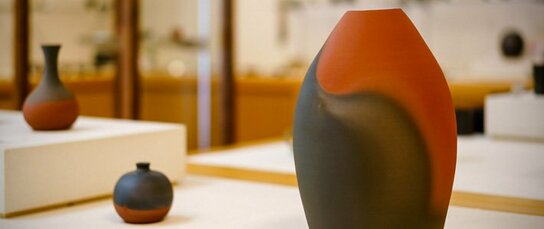
Breaking New Ground
Following the creation of his innovative two-color series, in 1972 Yōichi had his first work accepted for inclusion in the annual exhibition of the Japan Kōgei Association, which supports traditional crafts. His reputation grew, and in 1977 he became the fifth in his line to take the Sekisui name. However, he still sought to break new ground. His next challenge was to knead together different colors of clay, a technique known as neriage, so as to produce a pattern. In 1985, his mumyōi works in this style won the Grand Prize and Prince Chichibu Cup at the Japan Ceramic Art Exhibition.
His early neriage pieces were simple patterns based around lines. Today he has advanced to flowers, fish, and birds, created by layering clay so it looks something like rolled sushi, cutting through it, and lining up the cross-sections.
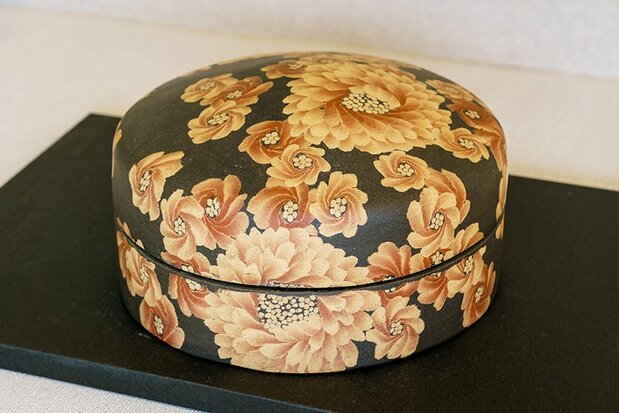
 A flower-patterned neriage container.
Designation as a living national treasure in 2003 did not slow him down either. In 2009, he applied rhyolite and granite from Sado, a volcanic island, to a new mumyōi-yaki series he called Sadogashima, after the island’s Japanese name. The use of natural minerals gave the works a rough, unsophisticated power.
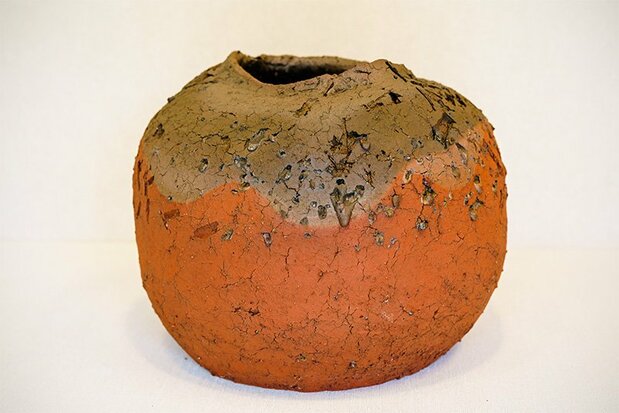 The Sadogashima series uses volcanic materials.
Although he speaks of the heavy importance he places on Sado and his family trade, Sekisui displays a freedom and lightness in his attitude to and thinking about his creations. He is not tied by tradition and does not cater to his admirers.
“It might sound like I’m showing off a little,” he says, “but we creators trust our own sense and work on the pieces that we want to. It’s better if people ultimately accept that. My basic thinking is to create by myself. I’m not just making something; I’m creating my own work. My family has worked with mumyōi clay for generations, but within that genre it’s important for me to exercise my originality.”
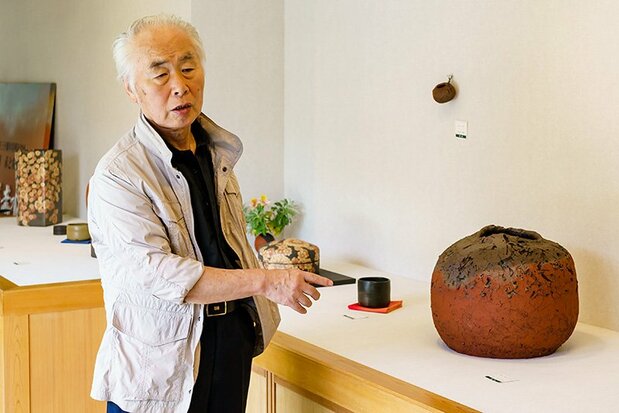 Although many Japanese people refer to the island as simply Sado today, Sekisui prefers the older name, Sadogashima.
An Island of Exile
Sekisui has exhibited overseas on numerous occasions and institutions like the Metropolitan Museum of Art in New York, the Smithsonian Institution in Washington DC, and the Victoria and Albert Museum in London include his works among their collections. He is still full of energy. In 2017 his solo exhibition Red Soil was held at the Onishi Gallery in New York after seven years of preparation.
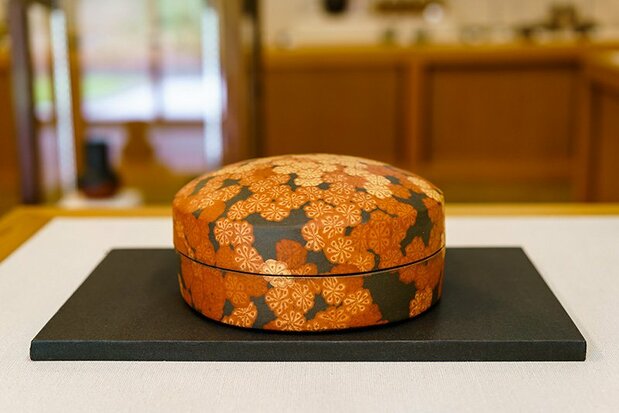 The connecting flower pattern between the lid and the container displays the care that went into the work.
Sekisui feels the pressure of his heritage, but seems to use it as a springboard for vigorous creativity. I ask him about Sado again and he responds, “When I think about what the island possesses to convey to the world, the answer has to be culture.
“Sadogashima has been an island of exile since ancient times. People who defied the central government were sent here, including Emperor Juntoku, the Buddhist priest Nichiren, and the playwright Zeami. But what was unusual was that they had to be self-sufficient. So long as they didn’t leave the island, they were free to marry or apply their talents to business. As a result, the manners and customs of the nation’s center were conveyed here, fostering a kind of highly cultured freedom, which took firm root. If my works have inspired any interest in Sadogashima, I would like to tell people that it is not the kind of place that you can get around and understand from a day trip alone.”
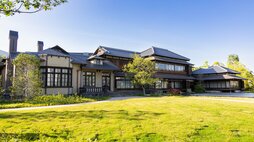
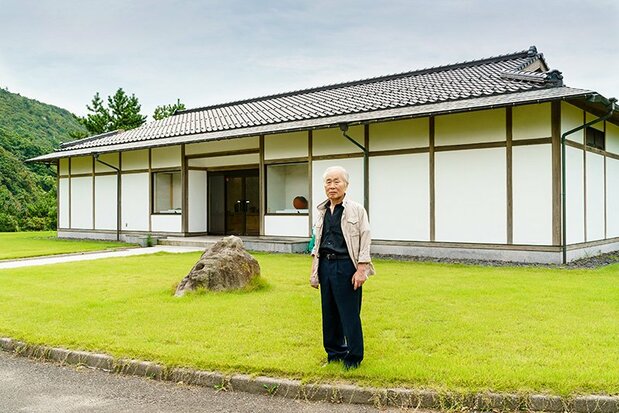 The Itō Sekisui Museum building looks down over the Japan Sea.
Itō Sekisui Museum
Address: 808-3 Shimoaikawa, Sado, Niigata Prefecture
Open: Every day from the second Saturday in April until November 23. Closed during winter.
Hours: 8:30 am to 5:00 pm (until 4:00 pm during some parts of the year)
Tel.: 0259-74-0011
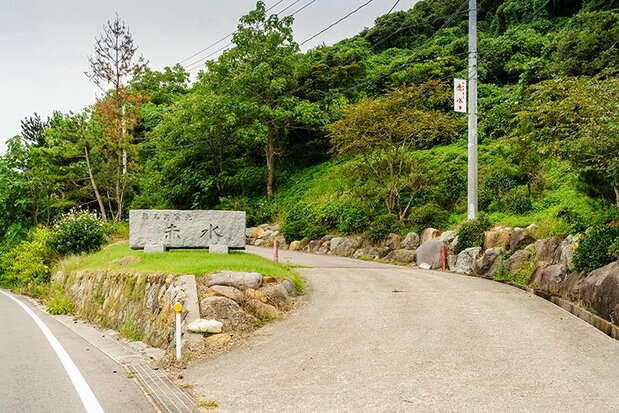 The sign reading 赤水 (Sekisui) displays the entrance to the museum along the seaside road Route 45.
(Originally published in Japanese on February 2, 2018. Reporting and text by Aoki Yasuhiro. Photographs by Miwa Noriaki.)


 Read in other languages