


Improving Conditioning and Management Skills Key to the World
On May 30, 2015, Su Bingtian of China became the first Asian-born male to officially run under 10 seconds when he marked a 9.99 at the third meet of the IAAF Diamond League held in Oregon. While Su beat Kiryū to that record, the question of who got there first or how high one ranks compared to others does not actually matter much. Far more important for the athlete is whether or not he can achieve results at the largest of stages—namely, the quadrennial Olympic Games and the biennial World Championships.
These are the goals toward which I hope Kiryū will work. As I trust he is well aware, breaking the 10-second barrier will be no more than a milestone in his career, and I hope that he will make a goal of racing in the Olympic finals.
Thus far Kiryū has achieved solid results only in the months of April and May. To perform more consistently he will need to master peaking, the skill of adjusting one’s condition to peak at crucial moments.
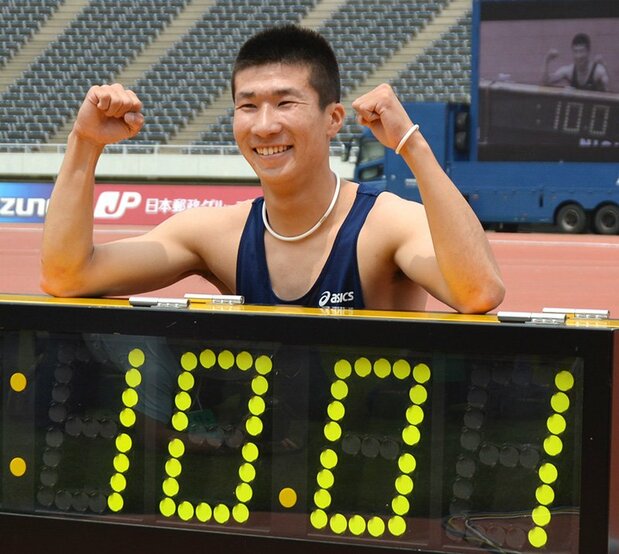
Another skill that Kiryū needs to work on is self-management over the 48 hours during which the preliminary, semifinal, and final rounds of a competition take place. The objective in the first two heats is to run without getting knocked out. A sprinter only needs to give the best performance in one out of three heats. The fastest of sprinters will not be able to win if his ability to run at that speed is fragile; self-management in a race means getting through the preliminaries while conserving energy.
There is also the matter of warming up mentally for a competition. Kiryū needs to be able to perform at his best under immense pressure as many fellow Japanese closely follow the race. Acquiring such nerves of steel will call for mental training and putting a good deal of gritty competition experience under his belt.
Kiryū has already proven his immense physical potential, but he has yet to demonstrate his potential in the other aspects given above—the keys to competing at the global level. These are the skills that he must work on from here on.
Facing the Tokyo Olympics at Age 24
Being only 19 years old, Kiryū will likely have close to 10 chances in total to compete on the big stage of the Olympic Games and World Championships. Conversely, though, it can be said that his opportunities to learn and gain experience competing at the highest level are limited. For now, the best reference point toward which he can aim to reach peak performance is the Tokyo Olympics, at which time he will be 24 years old. If, by then, he is able to clock under 10 seconds purely on his own ability and grasp something of the secret to running at that speed, he may be on his way to further greatness.
He would still have a good chance of improving his records even after the Tokyo Olympics. Asahara Nobuharu, bronze medalist in the men’s 4 x 100 m relay at the Beijing Olympics, was 29 years old when he achieved his career best of 10.02 seconds, the third best time in Japan.
If Kiryū were to break the 10-second barrier, it would influence the mind-set of other athletes as well. By 2020, I hope that two or three Japanese athletes will have achieved sub-10-second times and be competing with rivals from around the world at the Tokyo Olympics.
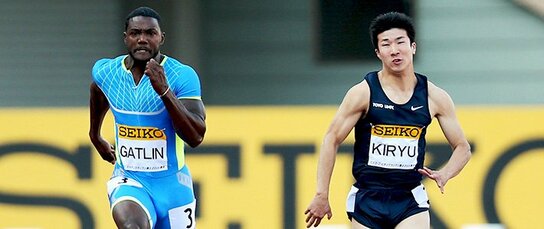
(Originally written in Japanese and published on June 26, 2015. Banner photo: Kiryū Yoshihide of Tōyō University, right, runs alongside Justin Gatlin of the United States in the men’s 100 meters at the Seiko Golden Grand Prix at the National Stadium in Tokyo on May 11, 2014. © Jiji.)




 Read in other languages