



The Future of Japanese Culture
Having made original teas and even established a presence in Shibuya, the next key question for Maruwaka is how to raise awareness.
“I don’t just want to sell tea leaves,” says Maruwaka. “I want to offer a new lifestyle, one that allows time for the enjoyment of Japanese tea. For instance, I created a cold-brew tea you can make simply by putting a tea bag and cold water in a container and shaking it. This means that even young Japanese or foreigners who don’t know how to prepare green tea can easily have a drink without needing a traditional Japanese tea service. The first thing to do is to get people interested. You can introduce the various implements after you’ve done that. This is where the handcrafts which I’ve been involved with thus far will come together with green tea.”
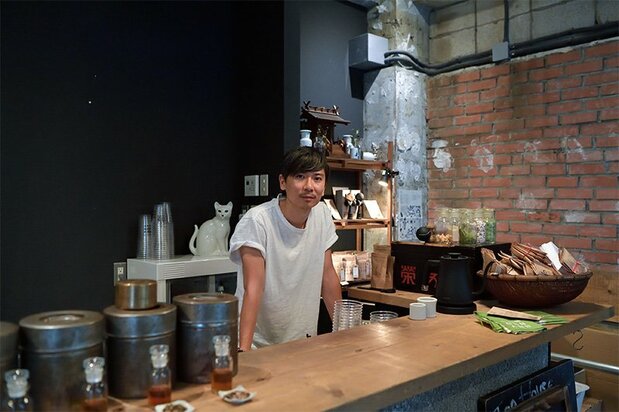
In accordance with Maruwaka’s stated intent to broaden the appeal of Japanese tea, Gen Gen An feels like it belongs on the streets of Shibuya, with the counter which serves as the centerpiece of its interior, and the noticeable fashionable youth presence among the shop’s clientele. The menu ranges from such standards as kama-iri-cha (tea roasted in the pot rather than steamed) and hōji-cha (toasted tea) to such novelties as chamomile hōji-cha and lemongrass green tea. The shop does mainly takeout business, and its containers are primarily disposable cups, calling to mind a chain café.
“I want to redefine the very meaning of green tea,” says Maruwaka. “Some may critique me as looking down on tradition or tea ceremony etiquette, but Japanese culture also has a rebel aspect, one of constantly overturning rigid ways of thinking. For example, the shunga illustrations of the Edo period [1603–1867] were casually used as wrapping paper by ceramics exporters in the late 1800s—despite their artistic quality, which was evident to the Western people who were amazed by those packaging materials as creations in and of themselves.”
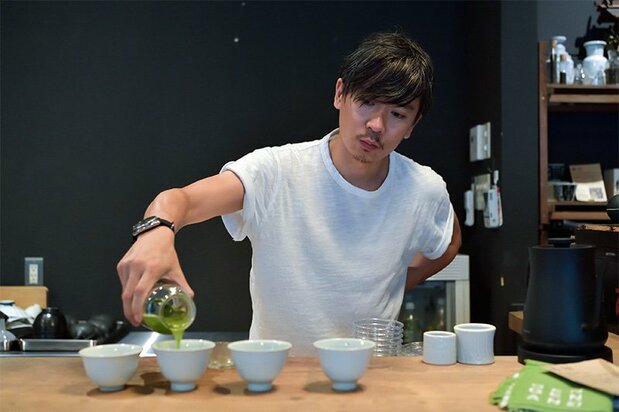
 Maruwaka pouring cold-brewed green tea at the Gen Gen An counter.
Maruwaka’s quest to compete in the wider world is already underway. In September 2017, at Maison & Objet Paris, a world-class interior design trade show, he worked with the Japanese creative organization TeamLab to present a digital art installation causing flowers and outer space alike to appear in cups of tea. The brand name for this project, En Tea, is rich with the sensibilities of Japanese culture, including the concepts of en, the joining together of various disparate objects and concepts, and ensōzu, drawings of circles in Zen Buddhist art.
“I don’t want to push culture on anyone,” Maruwaka says. “The sum total of my approach is simply to share green tea that needs no words to be loved—even by children on the other side of the world who know nothing about Japan.”
Maruwaka’s own inspiration and model is Baisaō, an Edo-period Zen monk.
“I got the name Gen Gen An from his last residence,” Maruwaka says. “He was known for passing himself off as a Chinese tea master and having philosophical conversations while making zencha, green leaf tea, at the side of the road—a reaction to the tea ceremony having become bound up with prestige and authority. I was fascinated by the idea that a rebel like this, someone we might call a punk today, was around 300 years ago.
“It doesn’t pay to be a hardliner about ‘the way things must be done.’ I think it gets much more to the essentials of tea to say, well, that looks interesting, and to find out that it’s delicious once you try it. Naturally, I want to be a part of Japan’s future, but it’s all because I want to hold my own in the wider world with things I like, not because I have any desire to change the situation of green tea or traditional Japanese crafts. If what I’m doing leads to some kind of change in the world as a consequence, then I’ll be happy.”
(Originally published in Japanese on November 8, 2017. Interview and text by Fukasawa Keita. Photographs by Ōkōchi Tadashi.)



 Read in other languages