


A Spirit of Pious Devotion
INTERVIEWER What has impressed you the most during the restoration work?
ISHIZAWA In February 2001 we discovered 274 Buddhist statues that had been buried in the ground at the Banteay Kdei Temple. The images ranged in size from around 20 centimeters up to 1.8 meters. Most were made from sandstone, but we also uncovered two small bronze Buddhas. It was a totally unexpected find, and a great way to mark the tenth year of our excavation training program. It was the largest discovery of its kind since French scholars first introduced the wonders of Angkor to Europe in 1860.
When we discovered the images, the eight Cambodian students who were taking part in the dig joined their hands in prayer before cleaning the mud and dirt off them with bamboo spatulas and brushes. I was moved by the piety and reverence that the Cambodians, all of them devout Buddhists, showed the images.

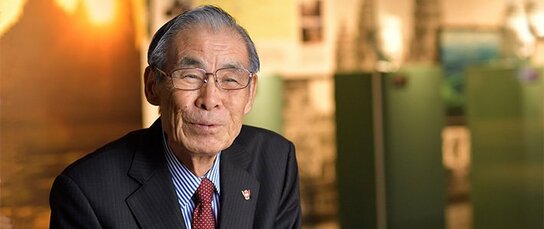
 Professor Ishizawa sits on a block of stone transported from Angkor to Sophia University while holding a stone image of Jayavarman VII, the king who laid the foundations of the Angkor dynasty.
The images had had their heads broken off before being buried and very few could be restored to their original form. I think it’s quite likely that there are other images buried in a similar way. Because they had been buried underground, though, they had suffered very little erosion or other damage from the elements and still maintained the serene facial expressions as 800 years ago.
INTERVIEWER What was the reason for this iconoclasm?
ISHIZAWA We’ve looked into various possibilities, but the facts remain shrouded in mystery. Perhaps there was some historical event that sparked a spate of iconoclastic violence, like religious antagonism between Hinduism and Buddhism that was sponsored by the kings. Or possibly a power struggle within the ruling royal family at court broke out.
Whatever the case, the way that each image was broken and buried shows that incidents of anti-Buddhist iconoclasm toward the end of the Angkor court period did not take place in a context of chaos and unrest. Until recently, the standard scholarly explanation was that the end of the dynasty was a decadent period of decline in which there was a power vacuum, and that the court eventually fell to the armies of the neighboring Ayutthaya kingdom. But this discovery has cast doubt on this thesis. This type of iconoclasm could not have happened unless ordinary political authority was still functioning and the royal command was still effective.
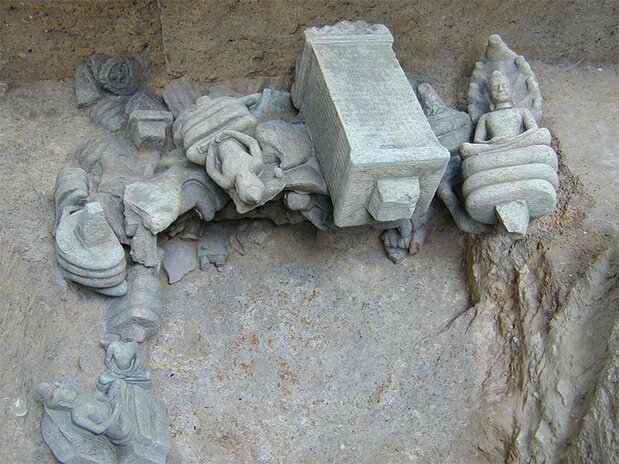 Some of the damaged Buddhist images discovered by Ishizawa’s team. (Photo courtesy of Sophia University)
Respecting Cambodian Values
INTERVIEWER What are the things you have to be mindful of in a restoration project like this?
ISHIZAWA Cambodians are quite accepting of having agricultural fields and livestock in among the monuments. They also aren’t much concerned that the monuments are enveloped in thick jungle. Preserving the monuments in a form that balances nature and people’s lifestyles is, I think, more in accord with the cosmological beliefs of Cambodians. I think it’s important to strike a balance among developing local village society, preserving indigenous folk culture, and creating a comprehensive, all-inclusive approach to preserving and restoring the monuments. After all, Angkor Wat is not only a reminder of past glories, it is also a sacred place where pilgrims and visitors still come to pay their respects today.
After having spent many years observing the multitude of sculptures carved into the walls of the monuments, I have come to feel that they aren’t the products of forced labor. In a Western European context, you would probably say that slaves worked to build a grand fortress for the king, but I think maybe things were a bit different. Tens of thousands of stonemasons and sculptors worked for decades to carve out a grand temple complex. But they found in the work the joy of performing meritorious deeds for which they would ultimately get their karmic reward.
In the end, it is the Cambodian people who must decide how the environment surrounding the monuments at Angkor is preserved protected into the future. All we can do is lend our assistance and help in any way we can.
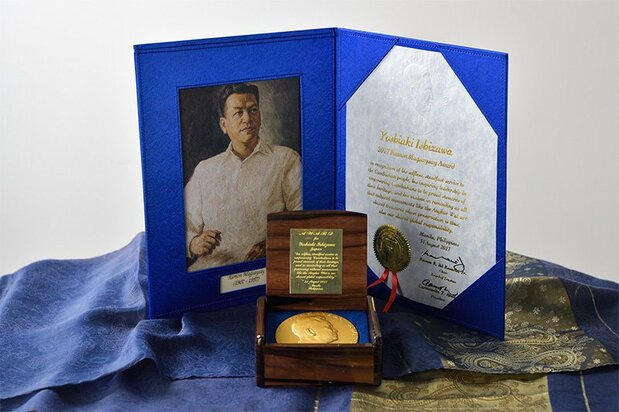 Professor Ishizawa’s Ramon Magsaysay Award citation and medal.
(*1) ^ A twelfth-century temple located seven kilometers northwest of Angkor Wat.






 Read in other languages