



A Golf Course Discovery
On returning to Japan in 1973, Ōmura became the head of antibiotic research at the Kitasato Institute. Members of his team were assigned the task of collecting a spoonful of soil on their way to work or on business trips. In 1974, soil collected near a golf course on the Izu Peninsula 100 kilometers southwest of Tokyo yielded a novel microbe, Streptomyces avermectinius, which Ōmura sent to Merck. Fluid from a culture of the bacterium injected in mice infected with parasitic nematodes was found to dramatically reduce their number. This substance was named avermectin.
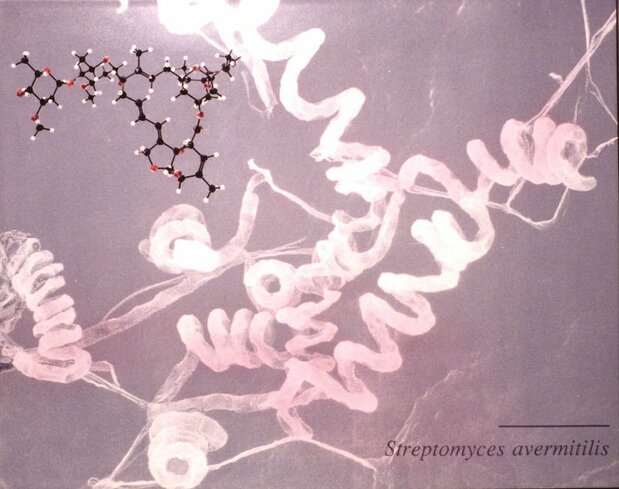
Avermectin was highly effective against parasites living in the intestinal tracts of cows and horses, almost completely eliminating them. Efforts by Merck’s synthetics group—including William C. Campbell, who shared the Nobel—to improve on avermectin led to the synthesis of ivermectin, which was launched in 1981 as Ivomec, an anti-parasitic drug for livestock and pets. Feed conversion efficiency increases greatly when nematodes living in the digestive tracts of livestock are eliminated so Ivomec found a ready market and became the top-selling animal drug in 1983. The drug contributed to a worldwide increase in food and leather production, and it was also given to pet dogs to prevent filariasis.
Effective Against Human Diseases
While the animal applications of avermectin were already a boon for humankind, the drug was also found to be effective against human diseases. Onchocerciasis is a tropical disease affecting many people in Africa that impairs the skin and eyes. The disease is spread from person to person through blackflies carrying the microfilariae (embryonic larvae) of nematodes. The microfilariae grow into adult worms in humans and release large numbers of new microfilariae, which lodge under the skin and cause intense inflammation when they die. One in five people with onchocerciasis lose their eyesight. The disease is the second leading cause of blindness after trachoma in Asia and Africa.
Ivermectin is effective only against microfilariae and not against the adult worm. This is actually a benefit since the sudden death of the adult worm can cause anaphylaxis, or an acute systemic allergic reaction, in the human host. Adult nematodes can live for 14 years in the human host, and people who are infected need to take the drug once a year during this period. The elimination of microfilariae, however, will prevent the disease from spreading to new people. This means the number of people infected with adult worms will decrease, and the disease will eventually be eradicated.
France became the first nation to approve ivermectin under the brand name Mectizan in 1987, and Merck began to provide the drug freely through the World Health Organization in 1988. Ivermectin was also found to be effective against lymphatic filariasis, a disease spread by mosquitoes where nematodes interfere with the functioning of the lymphatic system. In 2012, ivermectin was taken by more than 300 million people, in most cases distributed freely through projects to eradicate tropical diseases.
Onchocerciasis is expected to be eradicated in 2025 and lymphatic filariasis in 2020. This prospect was acclaimed by UNESCO as representing “one of the most triumphant public health campaigns ever waged in the developing world.”









 Read in other languages